
Outdoor Ethernet Installation: Three Methods
Quick answer / TL;DR: Short answer: choose the method by site conditions – aerial (support wire, UV jacket, height rules), conduit (standard outdoor jacket, water management at the ends), or direct burial (burial-rated gel-filled cable, depth per code). Each method changes the cable specification and the labor; the cable's outdoor rating is required in all three.
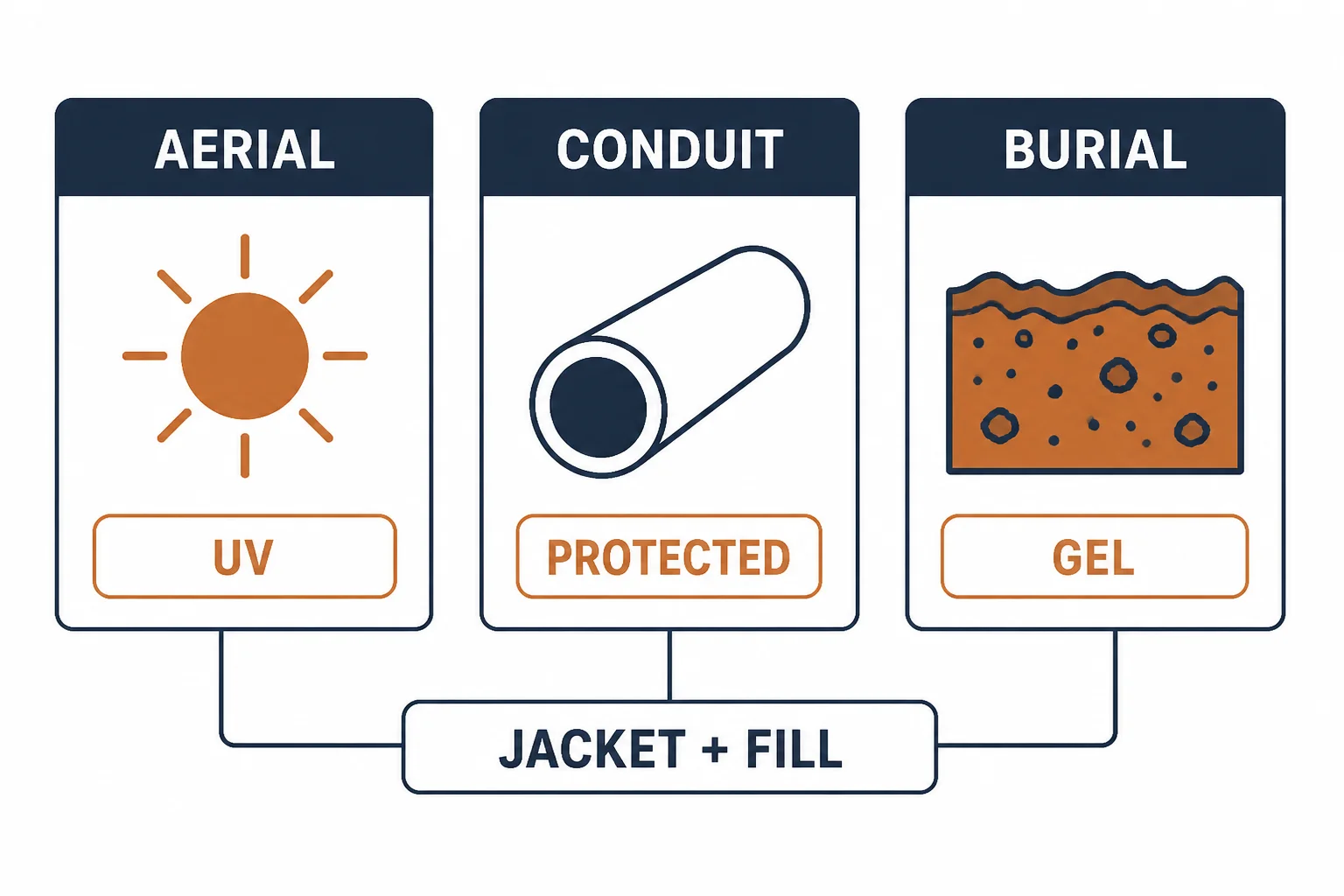
Outdoor ethernet is an installation project before it is a cable purchase: the route method decides the cable, the protection, and the labor. Aerial spans need support; conduits need water management; burial needs depth and protection. This guide compares the three methods as buying decisions.
This is the methods guide: the three routes, their cable requirements, and the checklist per method.
The Three Methods
| The method | The cable | The protection |
|---|---|---|
| Aerial | Outdoor jacket plus support wire | Height and tension rules |
| Conduit | Outdoor jacket, water blocking | Physical protection, drainage |
| Direct burial | Burial-rated, gel-filled | Soil protection, depth |
The method table is also a cost table: aerial is fastest, conduit is most protective per meter, burial is the most labor-intensive.
The Buying Checklist per Method
- Aerial: outdoor-rated cable, messenger wire or self-supporting type, clamps and tension hardware
- Conduit: outdoor cable, conduit and fittings, drainage at low points, pull line
- Burial: gel-filled burial cable, warning tape, depth per code, entry protection at both ends
The checklists are what separates a working run from a seasonal one: the hardware is part of the purchase, not an afterthought.
The Failure Points
| The method | The common failure |
|---|---|
| Aerial | Cable carrying its own weight – jacket stretch and conductor strain |
| Conduit | Water pooling at the low end – the foil corrodes |
| Burial | Shallow depth – a spade finds it in the first season |
Standards and Verification
| The reference | The relevance |
|---|---|
| Local electrical code | Depth, height, and separation rules |
| TIA-568.2-D | Exterior cabling practice |
| Outdoor cable markings | The rating that permits exterior use |
Per-market installation rules are not provided in the knowledge base. The methods and checklists are standard; confirm depth and height requirements locally.
Real-World Applications
The garden office span
A 20-meter gap between house and studio: aerial with a messenger wire – the fastest route, the load on steel.
The courtyard conduit
A paved courtyard crossed in conduit: outdoor cable with water blocking, drainage at the low point – the paving undisturbed.
The field run
A camera 60 meters from the building: direct burial gel-filled cable at code depth with warning tape – the run protected for years.
Related reading: The rating the route needs? Read can ethernet run outdoors — blogs/news/outdoor-ethernet-cable
Related reading: The outdoor cable construction? Read is Cat6 outdoor rated — blogs/news/cat6-outdoor-rated
Frequently Asked Questions
What is the best way to run ethernet outdoors?
Conduit where protection matters, aerial for speed where spans allow, direct burial for long underground runs. Each needs outdoor-rated cable.
Can I bury ethernet cable without conduit?
Only with burial-rated gel-filled cable at the depth local code requires. Standard cable will fail.
How do I protect aerial ethernet?
Use a support wire or self-supporting cable so the jacket does not carry the span's weight.
Do outdoor runs need surge protection?
Where the route exposes equipment to lightning or ground potential differences, surge protection on the data line is commonly specified. Confirm with the site's electrical design.
Sourcing FTP (F/UTP) Cat6 for a project, a store, or a shielded system? Contact our B2B sales team for shield construction data, category reports, and volume terms – FOB and CIF options available. Request a quote or sample.