
Shielded Keystone Jacks: The Shield's Landing Point
Quick answer / TL;DR: Short answer: a shielded keystone jack adds a metal shell and a shield contact to the standard jack – the foil or drain bonds to the shell, which bonds to the faceplate and panel. Buy jacks rated for the category and the cable's construction, terminate per the jack's color code, and verify shield continuity from the jack shell to the panel.
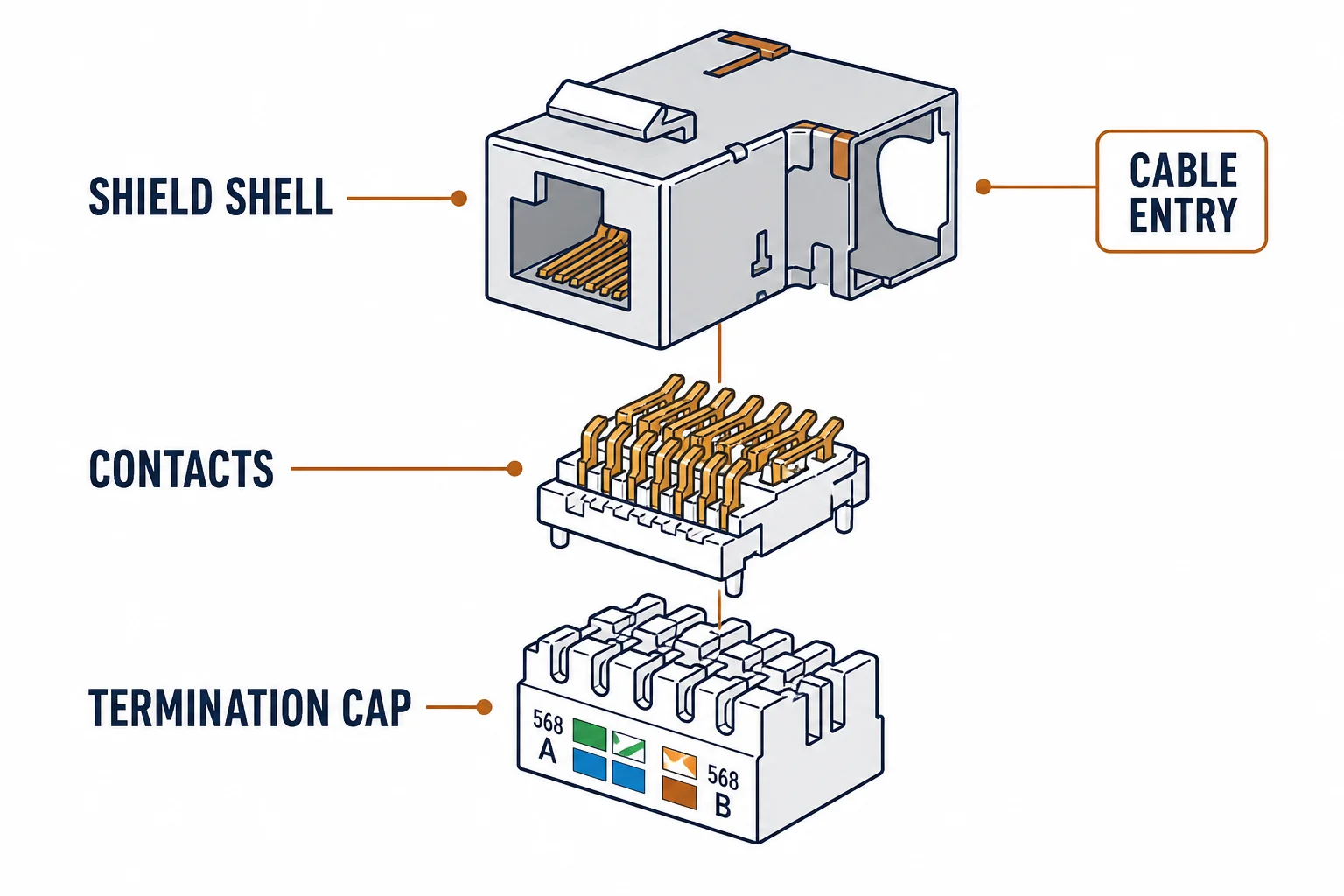
The shield's journey ends at the jack: if the keystone's shell does not bond the foil, the cable's shielding stops at the wall plate. Shielded keystone jacks are the part that completes the channel, and they are specified separately from the cable.
This is the jack guide: the assembly layers, the termination sequence, and the purchase checks.
The Assembly Layers
| The layer | The function |
|---|---|
| Shield shell | Bonds the cable's foil and carries it to the panel |
| Contacts | The eight signal contacts |
| Termination cap | Holds the pairs at the correct spacing |
| Rear opening | Accepts the cable's diameter – larger on shielded types |
The shell is the difference: a standard jack has no path for the shield, so the foil arrives and stops.
The Termination Sequence
- Prepare the cable: strip, fold the foil back, keep the drain long enough to bond
- Seat the pairs per the jack's color code (T568B common)
- Close the cap and trim
- Bond the drain or foil to the shell per the jack's design
- Verify continuity from shell to panel
The sequence mirrors field termination with one addition: the bond. That step is where shielded installs are won or lost.
The Purchase Checks
| The check | The question |
|---|---|
| Category | Does the jack state Cat6 or Cat6a? |
| Shield support | Metal shell and a bonding point? |
| Cable diameter | Will the rear opening take the shielded cable? |
| Faceplate | Is the plate metal or does it bond the jack? |
Standards and Verification
| The reference | The relevance |
|---|---|
| TIA-568.2-D | Connecting hardware and shielded practice |
| IEC 60603-7 | The jack interface standard |
| Field test | Channel test plus shield continuity |
Per-SKU jack designs are not provided in the knowledge base. The layers and checks are standard; follow the specific jack's termination instructions for the bond.
Real-World Applications
The wall-plate upgrade
A shielded run landing on plastic jacks: the shield's path broken at the plate – metal-shell jacks fitted, the continuity restored.
The patch panel build
A panel assembled with shielded jacks and a bonded bar: the drains landed per jack – the whole cabinet's shield path verified.
The diameter surprise
Shielded cable that would not enter standard jacks: the rear opening too small – the correct shielded jacks ordered, the batch saved.
Related reading: The grounding the jack bonds to? Read the grounding guide — blogs/news/shielded-cat6-grounding
Related reading: The termination sequence? Read shielded termination — blogs/news/terminate-shielded-cat6
Frequently Asked Questions
Do I need shielded keystone jacks?
Yes if the cable is shielded – otherwise the shield floats at the jack and the channel loses its benefit.
How do shielded keystone jacks work?
A metal shell bonds the cable's foil or drain and carries the shield to the faceplate and panel, completing the channel's shield path.
Can I use shielded cable with plastic jacks?
It terminates electrically but the shield has no landing point. The shielding is wasted.
How do I verify the jack's shield?
Continuity from the jack shell to the panel, plus the channel test after termination.
Sourcing FTP (F/UTP) Cat6 for a project, a store, or a shielded system? Contact our B2B sales team for shield construction data, category reports, and volume terms – FOB and CIF options available. Request a quote or sample.