
Does Cat5e Support PoE: The Class Answer
Quick answer / TL;DR: Short answer: yes – Cat5e supports standard PoE and PoE+ in typical installations, because PoE was designed around the installed base of twisted-pair cable. Higher-power classes (PoE++/Type 3-4) stress gauge and heat: check conductor gauge, bundle size, and ambient temperature, and replace with Cat6 where the margins are thin.
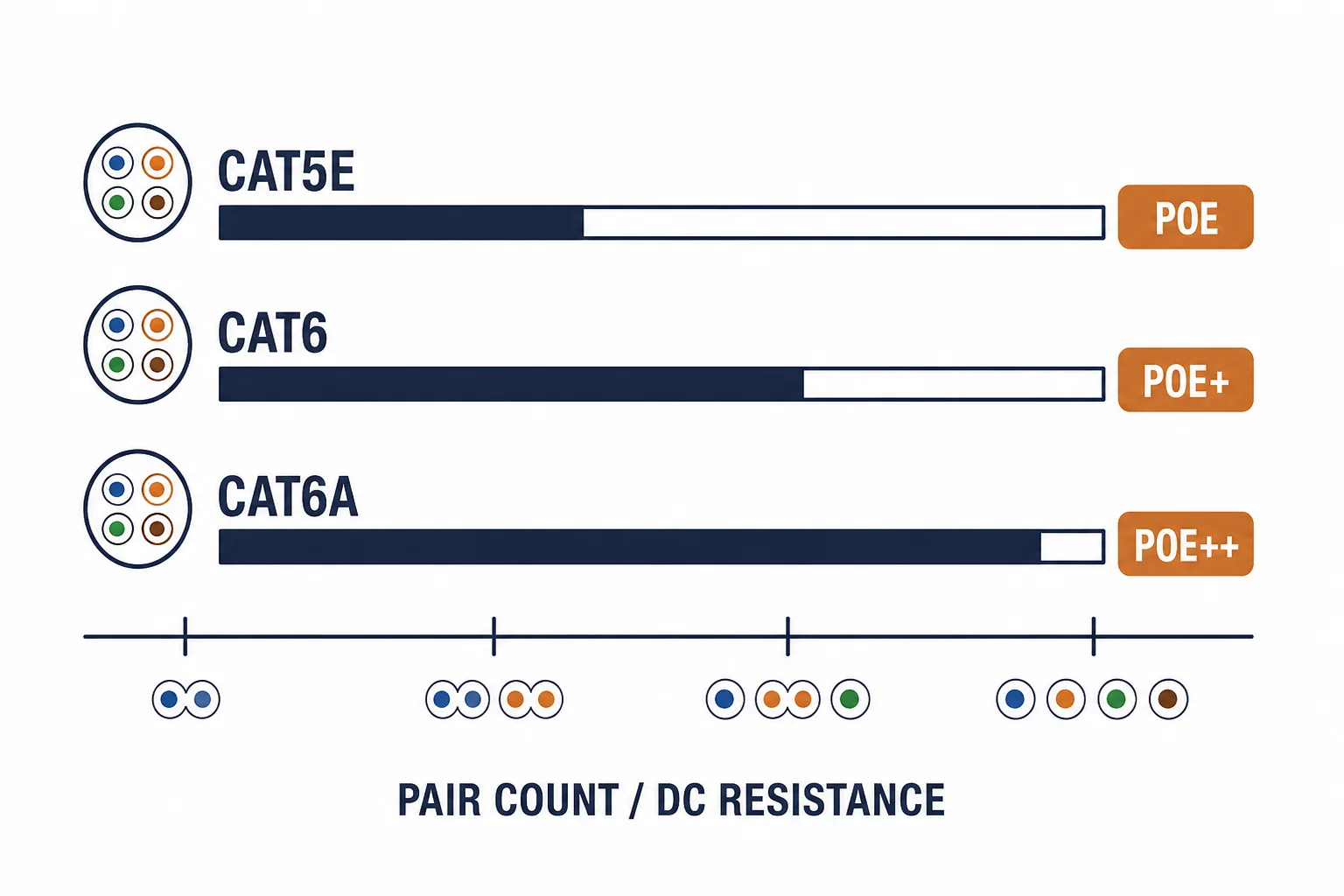
Cat5e predates widespread PoE but handles it: the standard was written for the installed base, and the pair count and gauge of a decent Cat5e cable satisfy the common power classes. The limits are thermal and resistive – bundling and length matter more than the category label.
This is the legacy-PoE guide: which classes work, where the limits bite, and when the run should be replaced.
The Classes on Cat5e
| The class | Typical use | Cat5e suitability |
|---|---|---|
| PoE (Type 1) | Phones, basic cameras | Good |
| PoE+ (Type 2) | Access points, PTZ cameras | Good within limits |
| PoE++ (Type 3-4) | High-power devices | Check gauge, heat, bundling |
The classes rise in current, and current is where legacy cable's gauge and heat become the constraint.
Where the Limits Bite
- Gauge: 24 AWG Cat5e has more resistance than 23 AWG Cat6 – voltage drop grows with length
- Bundling: cables in tight bundles cannot shed heat – the standard derates them
- Temperature: warm ceilings and plant rooms reduce the margin
- Length: the 100 m channel limit combines with resistance
The limits are thermal and resistive; the category name does not describe either. The installation's conditions decide.
When to Replace
| The situation | The call |
|---|---|
| Standard PoE on sound Cat5e | Keep it |
| PoE+ on long or bundled runs | Test and derate, or replace |
| PoE++ devices | Move to Cat6/6a for margin |
| Aging jacket or failing test | Replace regardless of class |
Standards and Verification
| The reference | The relevance |
|---|---|
| IEEE 802.3af/at/bt | The PoE classes and their power levels |
| TIA-568.2-D | Channel and bundling guidance |
| Field test | The evidence the existing channel passes |
Per-SKU gauge and temperature ratings are not provided in the knowledge base. The class structure is standard; verify the installation's bundle and temperature conditions.
Real-World Applications
The phone system upgrade
An office moving to PoE handsets on existing Cat5e: the channels tested first – the standard class delivered without a re-cable.
The dense bundle
A comms cabinet packed with PoE+ runs: the bundle derated and the count reduced – the heat managed rather than assumed.
The PoE++ door
A high-power access control device on legacy Cat5e: the gauge and length checked – Cat6 pulled to that door for margin.
Related reading: The power-and-shield question? Read the PoE shielding guide — blogs/news/poe-shielded-cable
Related reading: The legacy construction? Read is Cat5e shielded — blogs/news/is-cat5e-shielded
Frequently Asked Questions
Can Cat5e run PoE?
Yes – standard PoE and PoE+ work on Cat5e in normal installations. Higher-power classes need the gauge and heat checked.
What limits PoE on Cat5e?
Conductor gauge, bundle heat, ambient temperature, and length – the thermal and resistive limits, not the category label.
Should I replace Cat5e for PoE?
Only where the class, length, or bundling exceeds the margins, or the channel fails its test. Otherwise the legacy cable serves.
Does shielded Cat5e help PoE?
No – shielding addresses interference. PoE depends on conductor and heat.
Sourcing FTP (F/UTP) Cat6 for a project, a store, or a shielded system? Contact our B2B sales team for shield construction data, category reports, and volume terms – FOB and CIF options available. Request a quote or sample.