
Does PoE Require Shielded Cable: The Answer
Quick answer / TL;DR: Short answer: no – PoE does not require shielded cable. Power travels on the same copper pairs as data, and unshielded Cat5e/Cat6 handles standard PoE. Shielded PoE cable is chosen for interference rejection or code requirements, not for the power itself; where used, the drain still needs grounding.
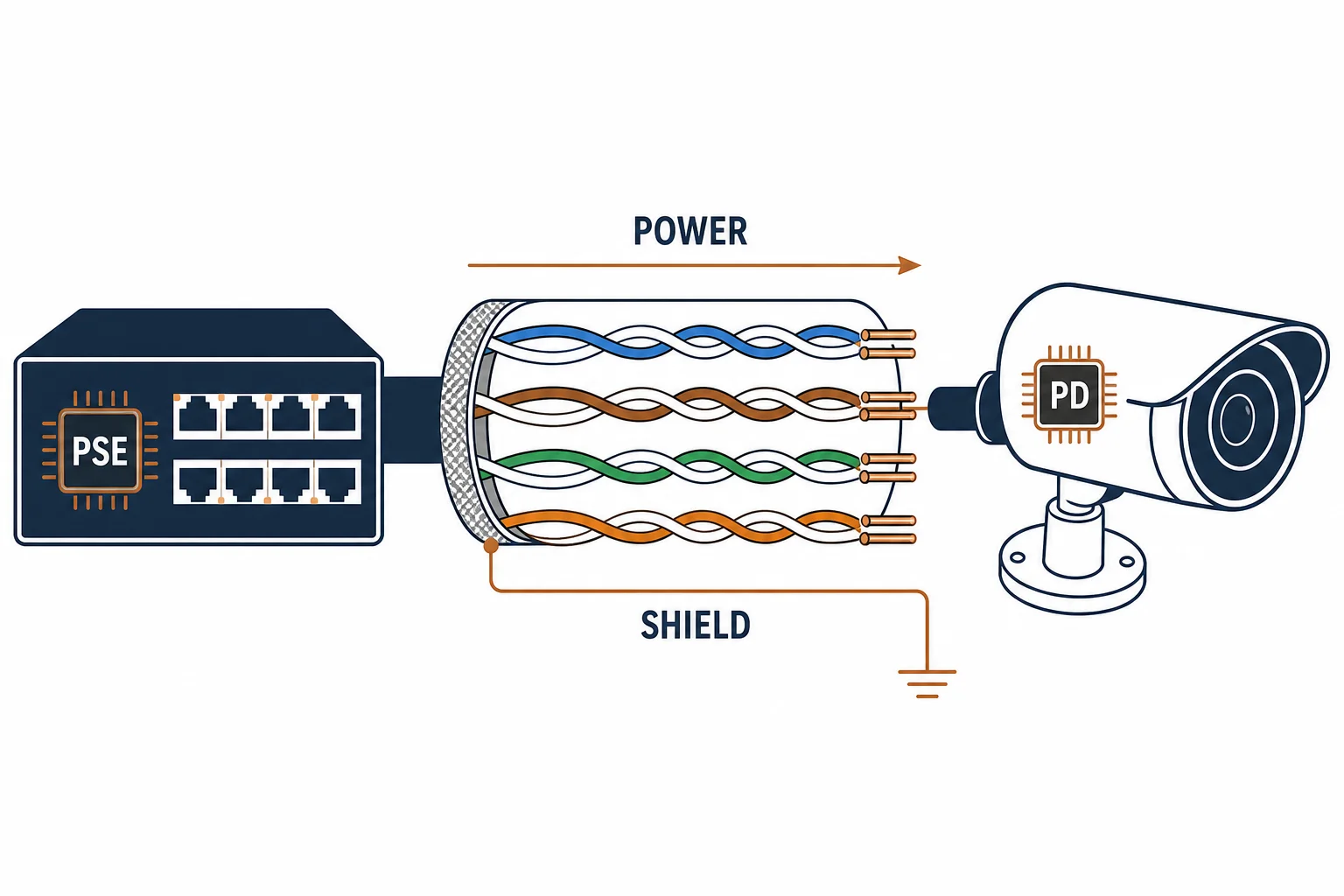
Power over Ethernet and shielding get confused because both involve 'protection': the shield protects the signal, PoE delivers power. They are independent. PoE works on unshielded cable – it was designed to – and shielding is added for interference, not for current.
This is the PoE-and-shield guide: what the pairs carry, what the shield does, and when the combination matters.
What Each Part Does
| The element | The job | The dependency |
|---|---|---|
| Pairs | Data plus DC power | Pair count and conductor gauge |
| Shield | Interference rejection | Grounding at the panel |
| Jacket | Route rating | The installation environment |
The table separates the functions: power rides the pairs, the shield handles noise. Confusing them leads to buying shielding for a power problem or ignoring grounding on a shielded PoE run.
PoE on Unshielded Cable
- Standard PoE and PoE+ run on Cat5e UTP in ordinary installations
- Higher-power PoE types care about conductor gauge and heat, not shielding
- Shielded PoE cable appears where EMI is present or the specification demands it
- The electrical rules: pair count, DC resistance, and bundling heat
The rules are electrical, not shielding-related: PoE budgets are about copper and heat. The shield neither helps nor hurts the power delivery.
When Shielded PoE Earns Its Place
| The situation | The call |
|---|---|
| Industrial cameras near drives | Shielded PoE with grounding |
| Cable sharing a tray with power | Shielded plus separation |
| Standard office access points | Unshielded – shielding adds nothing |
Standards and Verification
| The reference | The relevance |
|---|---|
| IEEE 802.3af/at/bt | The PoE standards and their power classes |
| TIA-568.2-D | Cabling requirements including shielded practice |
| Local code | Bonding and separation rules |
Per-SKU DC resistance and temperature ratings are not provided in the knowledge base. The independence of power and shielding is standard; confirm the PoE class and conductor gauge with the supplier.
Real-World Applications
The office AP rollout
Access points on PoE+ over unshielded Cat6: the budget met by gauge, not by shielding – the simpler cable correctly chosen.
The industrial camera
Cameras beside conveyor drives: shielded PoE cable with the drain grounded – interference handled, power delivered on the same pairs.
The ungrounded mistake
Shielded PoE cable installed without bonding: the shield floating and the interference unchanged – the grounding completed.
Related reading: The legacy PoE question? Read does Cat5e support PoE — blogs/news/cat5e-poe-support
Related reading: What the shield actually does? Read the FTP primer — blogs/news/what-is-ftp-cat6
Frequently Asked Questions
Does PoE need shielded cable?
No – PoE was designed for unshielded twisted pair. Shielding is for interference or code requirements, not for the power.
Can PoE run on Cat5e?
Yes – standard PoE and PoE+ work on Cat5e within its distance and bundling limits.
Does shielding help PoE voltage drop?
No – voltage drop depends on conductor gauge and length. The shield does not carry the power.
Do I need to ground shielded PoE cable?
Yes – any shield must be bonded at the panel to work, regardless of whether PoE is present.
Sourcing FTP (F/UTP) Cat6 for a project, a store, or a shielded system? Contact our B2B sales team for shield construction data, category reports, and volume terms – FOB and CIF options available. Request a quote or sample.