
Can Ethernet Cables Be Run Outdoors: The Rating Answer
Quick answer / TL;DR: Short answer: yes, ethernet can run outdoors – with outdoor-rated cable. Standard PVC indoor cable is not UV-stable and not moisture-resistant; outdoor constructions add a UV-stable jacket and often gel fill or a water-blocking layer, and direct-burial types add mechanical protection. Choose the route first (aerial, conduit, burial), then the construction the route demands.
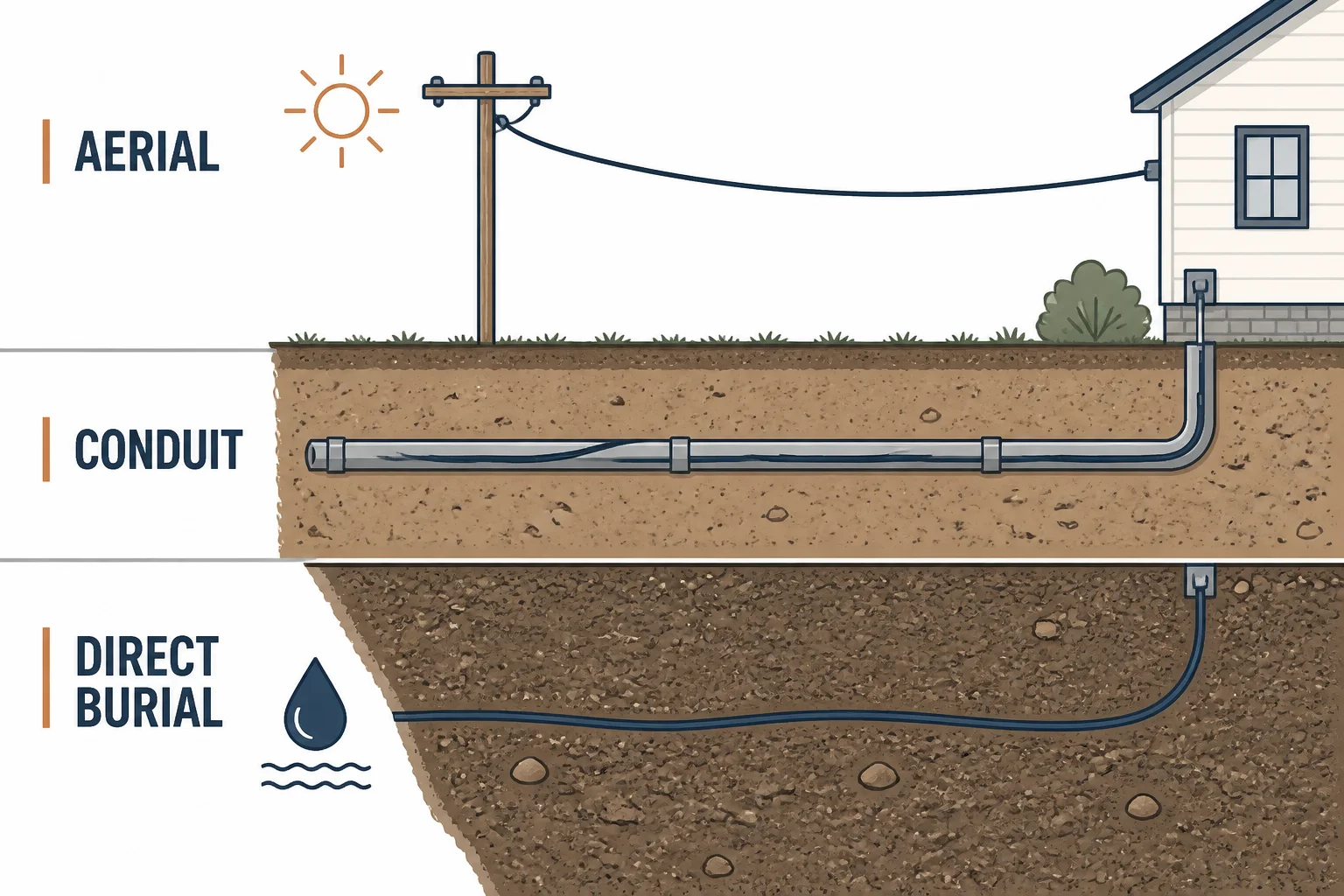
Standard indoor ethernet cable fails outdoors for reasons that have nothing to do with bandwidth: sunlight degrades the jacket, moisture reaches the foil, and temperature swings work the terminations. Running cable outside is possible – with the right construction and route. This guide answers the question the way a buyer needs it.
This is the outdoor guide: the three failure mechanisms, the ratings that counter them, and the route decision.
The Three Failure Mechanisms
| The mechanism | The damage | The counter |
|---|---|---|
| UV | Jacket cracks and chalks | UV-stable jacket compound |
| Moisture | Water reaches the foil, corrodes the shield | Gel fill or water-blocking tape |
| Temperature | Expansion stresses terminations | Rated jacket and slack at the ends |
The mechanisms explain why indoor cable fails in months rather than years: the jacket is the first casualty, and the shield follows.
The Rated Constructions
- Outdoor-rated jacket: UV-stable, often black, marked for exterior use
- Gel-filled or water-blocked: for wet locations and burial
- Direct-burial: added mechanical protection for soil contact
- Aerial: a messenger or support wire carries the load – the cable should not
The constructions map onto routes: an aerial span needs UV stability and support, a buried run needs water blocking and protection.
The Route Decision
| The route | The requirement |
|---|---|
| Aerial | UV jacket plus support wire; height per local rules |
| Conduit | Standard outdoor jacket; the conduit takes the weather |
| Direct burial | Burial-rated, gel-filled, protected from digging |
Standards and Verification
| The reference | The relevance |
|---|---|
| TIA-568.2-D | Cabling practice including exterior runs |
| Local electrical code | Burial depth, separation, and support rules |
| Jacket markings | The evidence of the outdoor rating |
Per-market burial depths and rules are not provided in the knowledge base. The mechanisms and constructions are standard; confirm local code requirements before trenching.
Real-World Applications
The garden office
A run to a garden room: direct-burial gel-filled cable in conduit – the route protected twice, the jacket rated for the exposure.
The camera pole
An exterior camera on a pole: UV-rated cable with a support wire – the span's load carried by steel, not by the jacket.
The indoor cable mistake
Standard PVC cable stapled along a fence: the jacket chalking within a season – the replacement specified outdoor-rated.
Related reading: The installation methods compared? Read the outdoor methods guide — blogs/news/outdoor-install-methods
Related reading: The outdoor Cat6 construction? Read is Cat6 outdoor rated — blogs/news/cat6-outdoor-rated
Frequently Asked Questions
Can I run regular ethernet cable outside?
Not reliably – indoor jackets are not UV-stable or moisture-resistant. Use outdoor-rated cable for any exterior run.
What cable is best for outdoor ethernet?
Direct-burial gel-filled for underground, UV-rated for aerial with a support wire. The route picks the construction.
How deep should outdoor ethernet be buried?
Local code sets the depth and protection requirements – confirm before trenching. The knowledge base does not hold per-market figures.
Does outdoor cable need grounding?
Shielded outdoor cable needs its drain bonded like any shielded run, and aerial installations follow the site's bonding rules.
Sourcing FTP (F/UTP) Cat6 for a project, a store, or a shielded system? Contact our B2B sales team for shield construction data, category reports, and volume terms – FOB and CIF options available. Request a quote or sample.