
What Is Shielded Cable: The Three Families
Quick answer / TL;DR: Short answer: shielded cable comes in three common builds – U/UTP (no shield), F/UTP (overall foil, the FTP construction), and S/FTP (braid overall plus foil per pair). The shield position decides the interference rejection and the installation care: more shielding means more grounding discipline and stiffer cable.
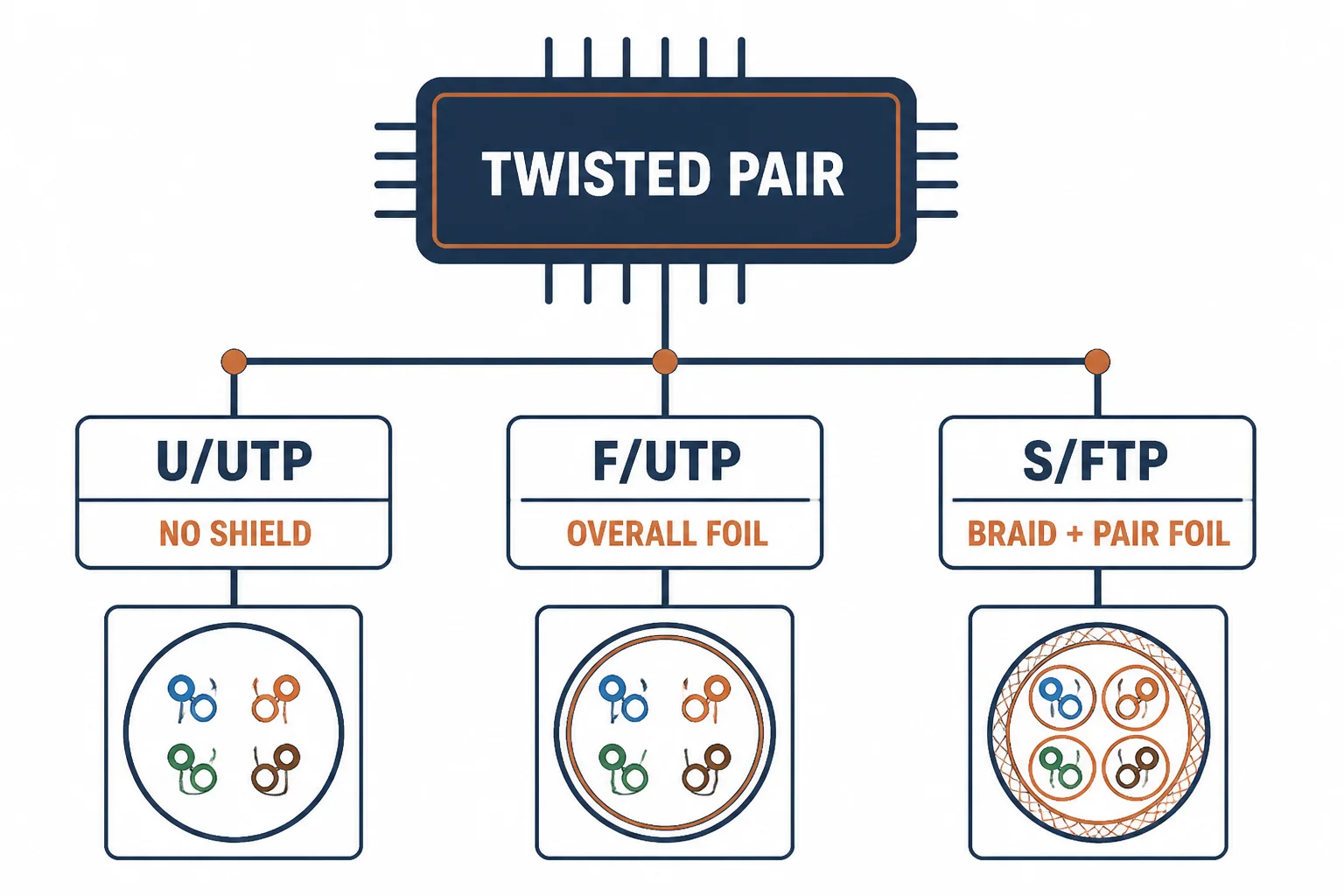
Shielded cable is a family, not a single product: the screening code describes where the shield sits – around the whole cable, around each pair, or both. The code on the jacket is the buying instruction, and each family carries its own handling and grounding demands.
This is the family guide: the three common codes, what each shield rejects, and how to specify them.
The Three Families
| The code | The shield | The typical use |
|---|---|---|
| U/UTP | None | Quiet offices and homes |
| F/UTP | Overall foil | General shielded installs |
| S/FTP | Braid plus pair foils | Industrial and high-interference paths |
The code reads outward-in: the first letter is the overall shield, the second the pair-level shield. The pattern is consistent across manufacturers.
What Each Shield Rejects
- Foil: high-frequency interference – the thin layer is effective against radiated noise
- Braid: lower-frequency and mechanical robustness – the woven layer is tougher
- Pair foils: crosstalk between pairs inside the same cable
- The combination matters more than the thickness
The shield types answer different noise profiles; S/FTP's combination is the industrial answer, F/UTP the general one.
The Specification Each Implies
| The code | The purchase must include |
|---|---|
| U/UTP | Nothing beyond category and jacket |
| F/UTP | Shielded jacks and panels, drain grounding |
| S/FTP | The same, plus care with the pair foils at termination |
Standards and Verification
| The reference | The relevance |
|---|---|
| ISO/IEC 11801-1 | Screening class definitions |
| TIA-568.2-D | Shielded installation and grounding practice |
| IEC 61156 | Construction definitions for the codes |
Per-SKU shield materials and coverage are not provided in the knowledge base. The codes are standard; confirm the exact construction and grounding instructions on the datasheet.
Real-World Applications
The office default
A tenant fit-out with no unusual noise: U/UTP Cat6 – the family's simplest branch chosen deliberately, not by habit.
The plant room
A run along a plant room wall: F/UTP for the segment – the foil's frequency range matching the noise present.
The machine cell
A robotic cell's control network: S/FTP – the braid and pair foils together, the industrial branch of the family.
Related reading: The FTP build in detail? Read the FTP primer — blogs/news/what-is-ftp-cat6
Related reading: The identification checks? Read is Cat6 shielded — blogs/news/is-cat6-shielded
Frequently Asked Questions
What are the types of shielded ethernet cable?
The common screening codes are U/UTP (unshielded), F/UTP (overall foil – FTP), and S/FTP (braid plus pair foils). The code describes where the shield sits.
Which shielded cable is best?
The one matching the noise environment: F/UTP for general interference, S/FTP for industrial paths. More shielding brings more grounding discipline.
Do all shielded cables need grounding?
Yes – any shield must be bonded, typically through the drain wire at the panel, to deliver its benefit.
Is shielded cable worth the cost?
In noisy environments yes; in quiet ones it buys obligations. The environment decides.
Sourcing FTP (F/UTP) Cat6 for a project, a store, or a shielded system? Contact our B2B sales team for shield construction data, category reports, and volume terms – FOB and CIF options available. Request a quote or sample.