
Can Cat6 Support 10GBASE-T: The Distance Answer
Quick answer / TL;DR: Short answer: yes – Cat6 supports 10GBASE-T to about 55 meters of channel (roughly 50 m of permanent link plus cords), assuming proper installation and alien-crosstalk conditions. Beyond 55 m, 10GBASE-T needs Cat6a, which reaches 100 m. Always check the longest run before specifying Cat6 for 10G.
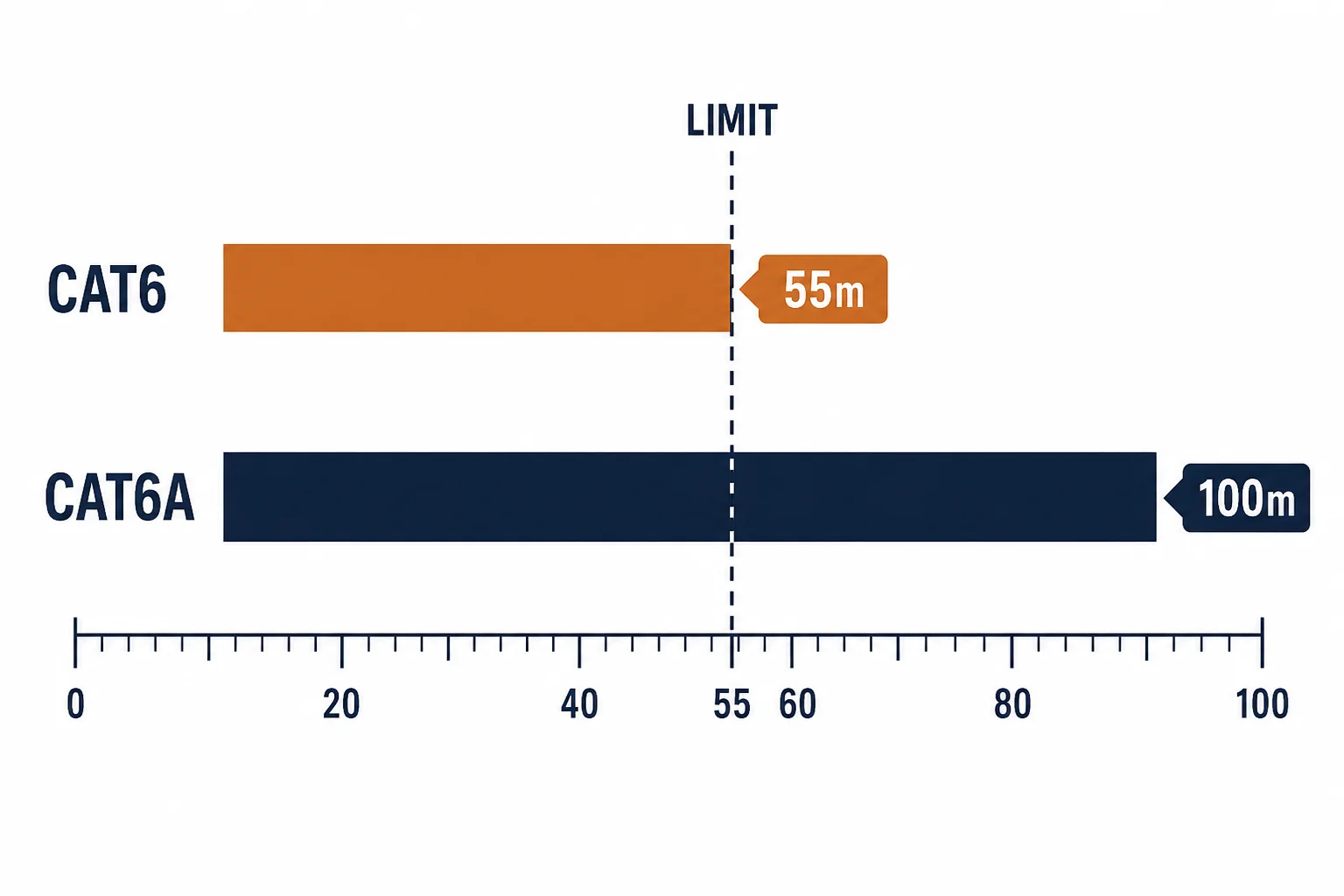
Cat6 does support 10GBASE-T – within a distance ceiling of roughly 55 meters of channel, in good installation conditions. Beyond that, the standard's assumptions stop holding and Cat6a becomes the requirement. The distinction matters at quote time: a 10G contract written without the distance check can deliver a link that negotiates down.
This is the distance answer: the number, the physics behind it, and the checks that protect a 10G purchase.
The Numbers
| The category | 10GBASE-T distance | The limiting factor |
|---|---|---|
| Cat6 | About 55 m | Alien crosstalk between adjacent cables |
| Cat6a | 100 m | None within the channel standard |
| Cat5e | Not supported | Insufficient bandwidth |
The 55-meter figure is a channel limit, not a marketing choice: it comes from the standard's assumptions about noise between cables in a bundle.
Why the Limit Exists
- Bandwidth: 10GBASE-T needs 500 MHz-class headroom; Cat6 provides 250 MHz with tight geometry
- Alien crosstalk: signal leaking between adjacent cables – worse in long bundles
- Length: the noise accumulates with distance, so the margin shrinks
- Installation: poor separation and untidy bundles reduce the usable distance
The physics explains the practical rule: Cat6 10G works when runs are short and the bundle is well behaved. Long runs in dense bundles are where the ceiling bites.
The Buyer's Check
| The check | The action |
|---|---|
| Longest run | Measure the channel, including cords |
| Bundle density | Separate or derate where cables run tight |
| Test report | Permanent-link test at the installed category |
| Headroom | Specify Cat6a where runs approach the ceiling |
Standards and Verification
| The reference | The relevance |
|---|---|
| IEEE 802.3an | 10GBASE-T and its channel assumptions |
| TIA-568.2-D | Cat6/Cat6a channel and alien-crosstalk requirements |
| Field test | The evidence the installed channel meets the category |
Per-SKU performance is not provided in the knowledge base. The distance figures are standard; the actual channel must be tested to prove the installation meets them.
Real-World Applications
The short 10G link
A 30-meter server-to-switch run on Cat6: 10G negotiated and stable – the ceiling respected with margin to spare.
The bundle problem
A 45-meter run inside a dense bundle: errors appearing after commissioning – the alien-crosstalk margin lost to density. The run re-routed or upgraded.
The tender correction
A specification naming Cat6 for 10G on 80-meter runs: the distance check applied – Cat6a substituted before the tender closed.
Related reading: The category step that removes the limit? Read Cat6a vs Cat6 — blogs/news/cat6a-vs-cat6-buyer
Related reading: The Cat8 short-run case? Read Cat8 vs Cat6 — blogs/news/cat8-vs-cat6-buyer
Frequently Asked Questions
Can Cat6 run 10GBASE-T?
Yes, to about 55 m of channel in good installation conditions. Beyond that, Cat6a is required.
Why is Cat6 limited to 55 meters for 10G?
Bandwidth headroom and alien crosstalk: the standard's noise assumptions stop holding beyond that distance in typical bundles.
Does Cat6a guarantee 10G at 100 m?
The category supports it; the installation must still pass its field test. Cable category is necessary, not sufficient.
What about 2.5G and 5G on Cat6?
Both run comfortably on Cat6 within standard distances – the reason Cat6 remains the sensible office default.
Sourcing Cat6 or Cat6a for a project, a store, or a private-label line? Contact our B2B sales team for datasheets, category test reports, and volume terms – FOB and CIF options available. Request a quote or sample.