
What Is an Ethernet Patch Cable: Anatomy and Spec
Quick answer / TL;DR: Short answer: an ethernet patch cable is a factory-terminated flexible cord – stranded copper conductors, RJ45 plugs at both ends, T568B wiring by default, lengths from about 0.5 to 10 m. Buy by category (matching the fixed cabling), length (shortest that reaches), and boot type (molded for durability, snagless for dense panels).
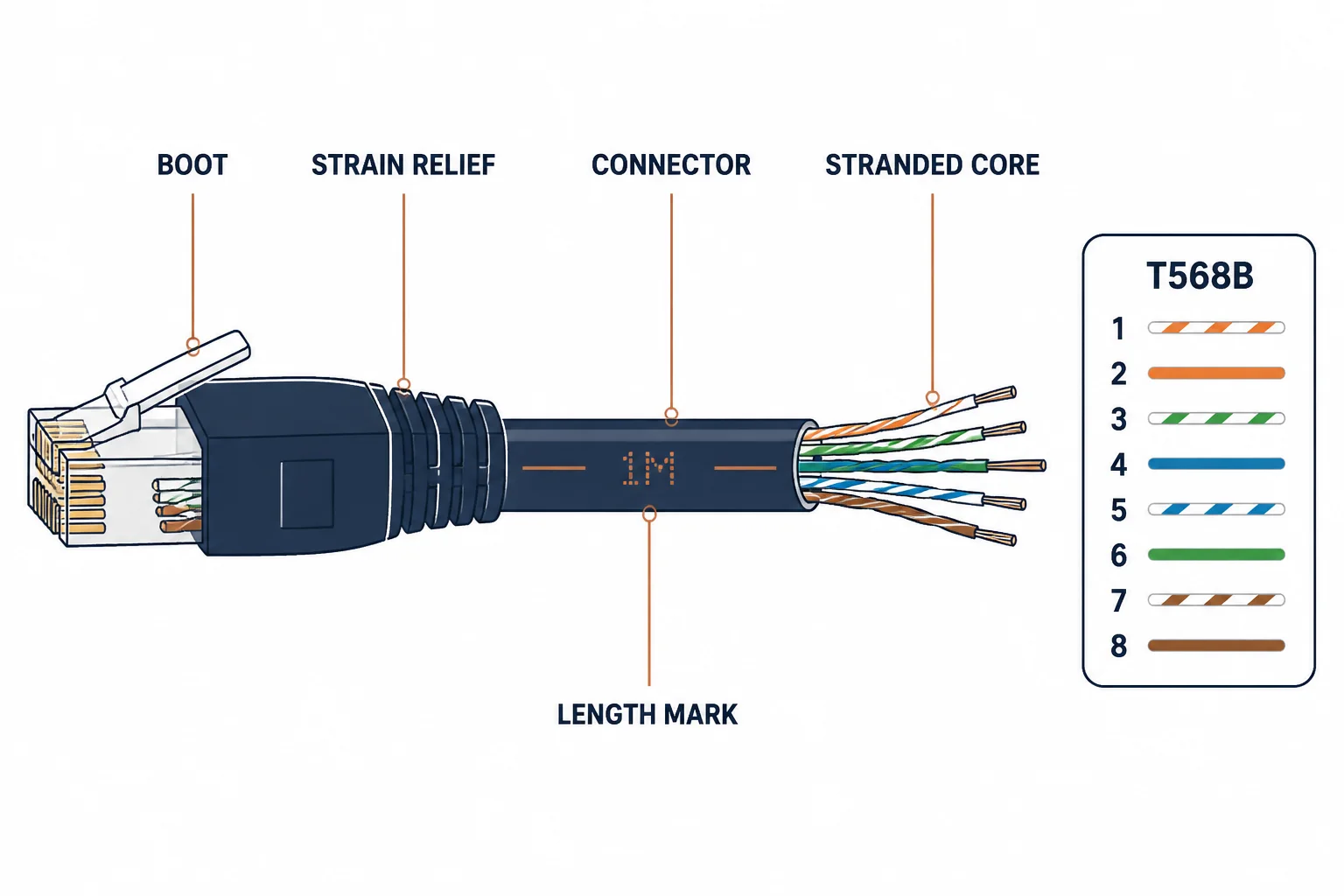
A patch cable is the flexible short cable that connects equipment to the fixed cabling: stranded conductors, factory-terminated plugs, a molded boot, and a length measured in meters rather than hundreds of them. It is a different product from bulk cable, bought for different reasons, and specified with its own rules.
This is the patch-cable guide: the anatomy, the specification lines, and the buying checks that separate a reliable cord from a drawer of failures.
The Anatomy
| The part | The function |
|---|---|
| Stranded conductors | Flexibility – the reason patch cords survive repeated handling |
| RJ45 plugs | Factory-terminated, T568B wiring |
| Molded boot | Strain relief where the cable meets the plug |
| Length marking | Printed on the jacket or the boot |
The anatomy explains the product's job: movement. Solid cable fails where it flexes; stranded cord is built for the flex.
The Specification Lines
- Category: match the fixed cabling – a Cat6 run deserves a Cat6 cord
- Length: the shortest that reaches, with slack for service loops
- Boot: molded for durability, snagless for high-density panels, slim for tight spacing
- Wiring: T568B standard; verify consistency across the batch
The four lines are the purchase order: category, length, boot, wiring. The batch consistency matters more than any single cord's specification.
The Buying Checks
| The check | The failure it catches |
|---|---|
| Continuity and pair mapping | Miswired or crossed pairs |
| Plug latch | Loose connections in the panel |
| Boot adhesion | The bend point breaking early |
| Length accuracy | Short cords sold as longer |
Standards and Verification
| The reference | The relevance |
|---|---|
| TIA-568.2-D | Patch cord requirements within the channel |
| T568A/T568B | The two wiring patterns – B is the common default |
| Category test | Patch cords tested as part of the channel |
Per-SKU patch-cord constructions are not provided in the knowledge base. The anatomy and the checks are standard; request the wiring and category from the supplier.
Real-World Applications
The data-center batch
A rack refresh ordering 200 cords: one category, three lengths, snagless boots – the batch consistency that makes the panel legible.
The desk-side swap
A single cord replaced after a latch broke: the shortest length that reaches chosen – the drawer kept emptier than before.
The miswired batch
A delivery failing pair mapping: the whole batch returned against the test – the check that costs minutes and saves a network.
Related reading: The patch vs bulk distinction? Read the order-line guide — blogs/news/patch-cable-vs-ethernet-cable
Related reading: The Cat5e-to-Cat6 decision? Read the upgrade arithmetic — blogs/news/cat6-vs-cat5e-upgrade
Frequently Asked Questions
What is the difference between a patch cable and an ethernet cable?
A patch cable is the flexible, factory-terminated short cord; 'ethernet cable' usually means the bulk or installed cable. Same signal, different construction and purpose.
What lengths do patch cables come in?
Commonly 0.5 m to 10 m, with 1, 2, and 3 m covering most desk and rack needs.
Should patch cables match the installed cable category?
Yes – the channel performs to its lowest component. A Cat6a run with a Cat5e cord is a Cat5e link.
Are flat patch cables acceptable?
For short, low-speed runs they work; they are not category-rated for performance and should not carry critical links.
Sourcing Cat6 or Cat6a for a project, a store, or a private-label line? Contact our B2B sales team for datasheets, category test reports, and volume terms – FOB and CIF options available. Request a quote or sample.