
Is Cat8 Better Than Cat6: The Short-Run Answer
Quick answer / TL;DR: Short answer: Cat8 is faster than Cat6 – 2000 MHz versus 250 MHz, with 25G/40G capability over short runs of about 30 meters. It is a data-center and switch-to-server cable. For office and home runs, Cat6 or Cat6a delivers the needed speeds over longer distances at lower cost; Cat8's distance limit makes it the wrong tool outside dense racks.
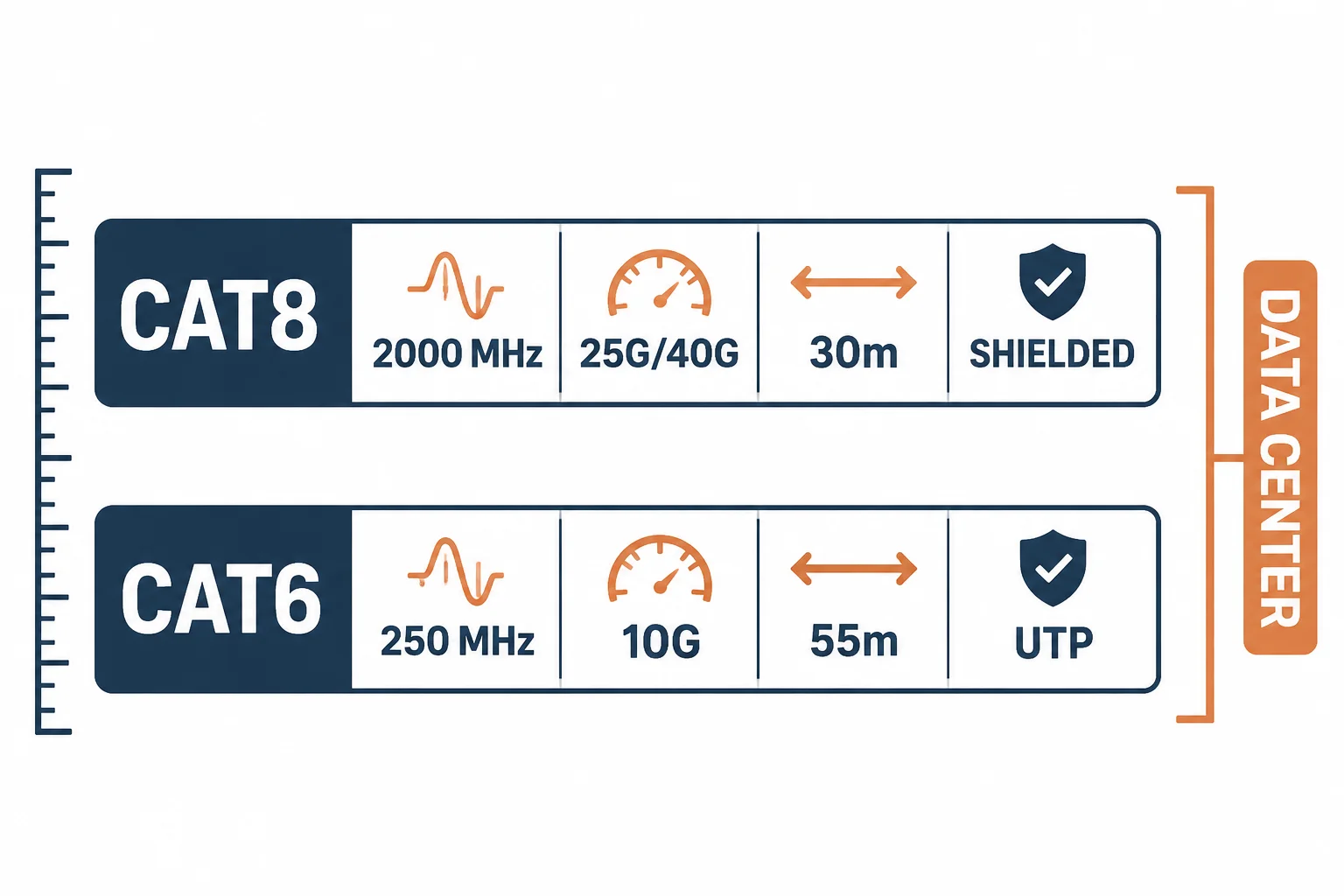
Cat8 is the highest defined category and the most misunderstood: its 2000 MHz bandwidth and 25G/40G capability apply over runs measured in tens of meters, which makes it a data-center cable rather than an office upgrade. Comparing it with Cat6 is fair only inside that context.
This is the Cat8 comparison: the numbers, the distance ceiling, and the buyer who actually needs it.
The Numbers
| The attribute | Cat6 | Cat8 |
|---|---|---|
| Bandwidth | 250 MHz | 2000 MHz |
| Speed | 10G to ~55 m | 25G/40G to ~30 m |
| Typical length | Up to 100 m | Short – rack and adjacent rows |
| Shielding | Optional | Required by construction |
| Use case | Office, home, campus | Data-center top-of-rack |
The comparison has one hinge: distance. Cat8's speed exists inside a 30-meter envelope – the rack's own world.
Why Offices Rarely Need It
- Office runs are long – 30 meters is a corridor, not a floor
- Office switching is 1G/2.5G/10G – Cat6a covers 10G fully
- Cat8's stiffness and shielding add installation cost for no gain
- The money is better spent on Cat6a and good termination
The office case fails on distance and on need: the cable's capability sits outside both the building's geometry and the network's plan.
The Buyer Who Does Need It
| The environment | The requirement |
|---|---|
| Top-of-rack switching | 25G/40G links within 30 m |
| Dense server rows | Short, high-density, shielded runs |
| AI/GPU clusters | High-speed short links between nodes |
Standards and Verification
| The reference | The relevance |
|---|---|
| TIA-568.2-D | Cat8 construction and channel requirements |
| ISO/IEC 11801-1 | Class I/II definitions aligned with Cat8 |
| IEEE 802.3by / 802.3cd | 25G and 50G Ethernet specifications |
Per-SKU performance is not provided in the knowledge base. The category figures are standard; confirm the channel length and test report for the specific installation.
Real-World Applications
The rack refresh
A data-center row moving to 25G: Cat8 patch runs within the row – the distance ceiling respected, the speed delivered.
The office near-miss
A buyer pricing Cat8 for desk drops: the 30-meter ceiling and the 10G requirement checked – Cat6a specified, the budget recovered.
The GPU cluster
Short inter-node links in a compute cluster: Cat8's bandwidth inside the rack – the category matched to the geometry.
Related reading: The compatibility question? Read is Cat8 backwards compatible — blogs/news/cat8-backwards-compatible
Related reading: The office-grade comparison? Read Cat6a vs Cat6 — blogs/news/cat6a-vs-cat6-buyer
Frequently Asked Questions
Is Cat8 better than Cat6?
In bandwidth and short-run speed, yes. In applicability, no – Cat8 stops around 30 m, which excludes most office runs where Cat6 works to 100 m.
Can Cat8 be used for home networking?
It works electrically but is unnecessary and harder to install. Cat6 or Cat6a covers home speeds and distances at lower cost.
How long can Cat8 runs be?
About 30 meters for its rated speeds – the reason it is a data-center cable.
Does Cat8 need special connectors?
Yes – shielded, category-rated connectors and panels, with grounding. Standard RJ45 keystones will not deliver the category.
Sourcing Cat6 or Cat6a for a project, a store, or a private-label line? Contact our B2B sales team for datasheets, category test reports, and volume terms – FOB and CIF options available. Request a quote or sample.