
Cat6a vs Cat6: The Upgrade Case
Quick answer / TL;DR: Short answer: Cat6a doubles Cat6's bandwidth (500 vs 250 MHz) and extends 10GBASE-T to the full 100 m (Cat6 stops around 55 m). It costs more, is thicker and stiffer, and requires grounding. Choose Cat6a when runs exceed ~55 m at 10G, when interference is present, or when the installation must last through a 10G refresh.
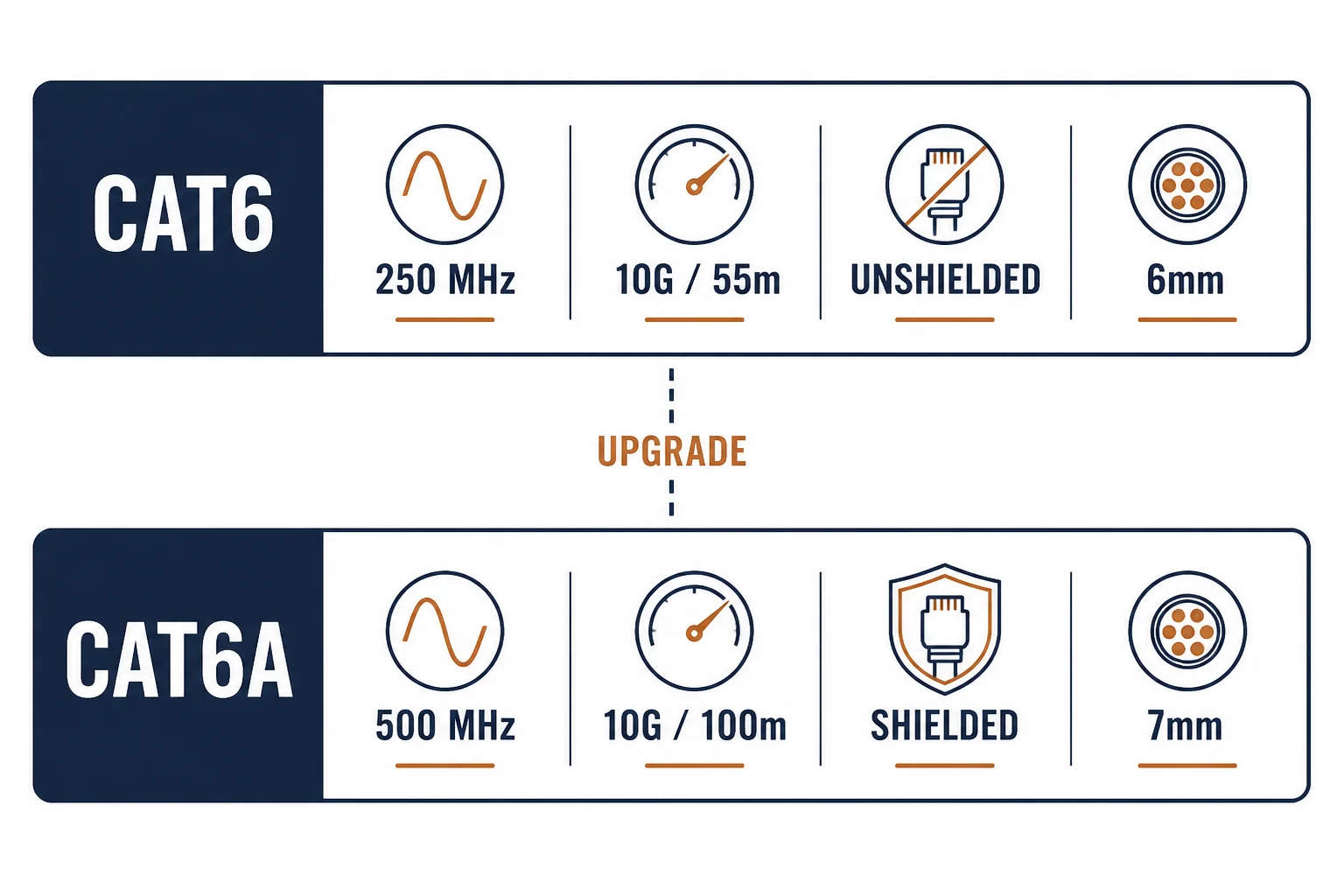
Cat6a is 'better' in the engineering sense – double the bandwidth, full-distance 10G, shielding by construction – but better is not the same as necessary. The upgrade decision turns on three facts: the run lengths, the speed the network will actually use, and whether the environment demands shielding.
This is the buyer's comparison: the measurable differences, the cost they carry, and the decision questions.
The Measurable Differences
| The attribute | Cat6 | Cat6a | |||
|---|---|---|---|---|---|
| Bandwidth | 250 MHz | 500 MHz | |||
| 10GBASE-T distance | About 55 m | 100 m | |||
| Shielding | Optional (U/UTP common) | Standard in practice (F/UTP/S/FTP) | Diameter | Around 6 mm class | Around 7 mm class |
| Termination care | Moderate | Higher – shield grounding |
The table is the whole case: the two categories differ first in frequency headroom, then in the distances that headroom buys.
The Three Decision Questions
- How long is the longest run? Above about 55 m at 10G, Cat6 cannot carry the link
- What speed will the network actually run in the next decade? A 10G refresh argues for headroom
- Is the environment noisy or code-restricted? Shielding needs and jacket ratings push toward Cat6a
Answering the three settles the purchase: two 'no' answers mean Cat6 is the value choice; any 'yes' on distance or interference moves the answer to Cat6a.
The Cost Side
| The cost line | The Cat6a effect |
|---|---|
| Cable | Higher per meter |
| Connectors and panels | Shielded components cost more |
| Installation time | Grounding and bend radius add care |
| Testing | Higher-frequency test equipment and time |
Standards and Verification
| The reference | The relevance |
|---|---|
| TIA-568.2-D | Both categories' construction and test requirements |
| IEEE 802.3an | 10GBASE-T and its channel assumptions |
| ISO/IEC 11801-1 | The international category table |
Per-SKU performance and pricing are not provided in the knowledge base. The category figures are standard; confirm the specific product's test report and construction.
Real-World Applications
The long backbone
A 70-meter run between floors: Cat6a specified for the 10G link – the distance question alone deciding the category.
The short desk run
A 25-meter desk drop at 1G today: Cat6 installed, with the trunk left upgradable – the value choice recorded in the documentation.
The EMI correction
A workshop link failing intermittently beside drives: Cat6a F/UTP replacing the unshielded run – the interference question answering the upgrade.
Related reading: The construction question first? Read is Cat6a shielded — blogs/news/is-cat6a-shielded
Related reading: The next category up? Read Cat8 vs Cat6 — blogs/news/cat8-vs-cat6-buyer
Frequently Asked Questions
Is Cat6a worth the extra cost?
When runs exceed about 55 m at 10G, when interference is present, or when the install must support a 10G refresh – yes. For short 1G runs, Cat6 is the better value.
Can Cat6 run 10G?
Yes, to roughly 55 m. Beyond that, 10GBASE-T needs Cat6a's headroom.
Does Cat6a work with Cat6 connectors?
The RJ45 interface is the same, but shielded Cat6a wants shielded connectors and proper grounding to deliver its performance.
Will Cat6a slow my network down?
No – the cable does not limit speed; it only fails to support higher speeds beyond its limits. Cat6a removes distance-related limits.
Sourcing Cat6 or Cat6a for a project, a store, or a private-label line? Contact our B2B sales team for datasheets, category test reports, and volume terms – FOB and CIF options available. Request a quote or sample.