
Do I Need Shielded Ethernet Cable: The Test
Quick answer / TL;DR: Short answer: you need shielded cable when the run is long and passes near strong interference (motors, drives, welding, radio equipment), when the environment's specification demands it, or when the cable shares a path with power. For quiet residential and office runs, unshielded Cat6 is simpler and sufficient – and does not require grounding.
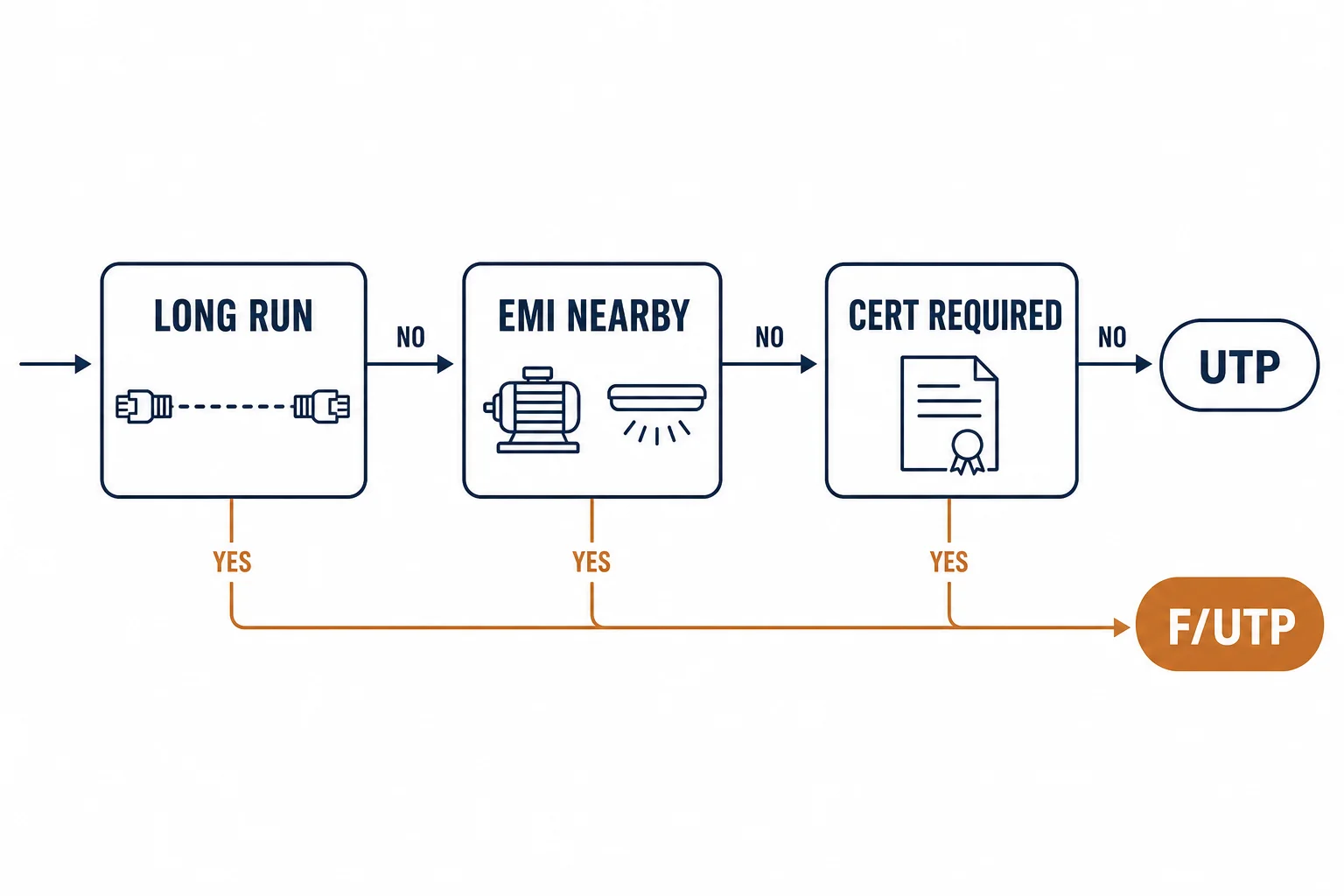
Shielding is sold as an upgrade and needed as an answer to specific conditions: long runs beside interference sources, or code requirements in certain environments. Outside those conditions it adds cost, stiffness, and a grounding obligation that is easy to get wrong. This article is the test that decides.
This is the three-question test: length, interference, and requirement – then the grounding follow-through.
The Three Questions
| The question | The 'yes' signal | The outcome |
|---|---|---|
| Is the run long and near interference? | Motors, VFDs, welding, radio gear within a few meters | Shielded (F/UTP or S/FTP) |
| Does the specification demand it? | Industrial or healthcare tender language | Shielded to the specified code |
| Does the cable share a path with power? | Parallel runs in the same trunking | Shielded, with separation where possible |
Any 'yes' moves the answer to shielded; three 'no' answers leave unshielded as the correct, simpler choice.
What Shielding Costs
- Money: shielded cable and shielded connectors cost more
- Care: the drain wire must be grounded at the panel per the standard
- Space: larger diameter, tighter bend radius
- Time: termination takes longer and testing wants the shield in place
The cost list is the argument against over-specifying: shielding spent where the environment does not need it buys obligations, not performance.
The Grounding Follow-Through
| The step | The practice |
|---|---|
| Drain wire | Bonded at the patch panel end |
| Shielded jacks | Bonded to the panel's ground |
| Continuity | Verified as part of the channel test |
| Documentation | The grounding recorded for the next technician |
Standards and Verification
| The reference | The relevance |
|---|---|
| TIA-568.2-D | Shielded cabling and grounding practice |
| ISO/IEC 11801-1 | Screening classes and their installation requirements |
| Local codes | The environment's own requirements, which may exceed the cabling standard |
Per-SKU shielding options are not provided in the knowledge base. The decision structure is standard; confirm the environment's requirements with the project's specification and the local authority.
Real-World Applications
The quiet home
A house with no heavy equipment: unshielded Cat6 to every room – the three questions all answered 'no', the simpler cable correctly chosen.
The drive-adjacent run
An office run passing the building's motor room: F/UTP specified for that segment only – the shield where the interference lives, not everywhere.
The healthcare tender
A clinic's specification naming shielded Cat6a: the tender's code followed, the grounding documented – the requirement question answered by the document.
Related reading: What shielded Cat6a looks like inside? Read the Cat6a shielding guide — blogs/news/is-cat6a-shielded
Related reading: The Cat5e-to-Cat6 decision? Read the upgrade arithmetic — blogs/news/cat6-vs-cat5e-upgrade
Frequently Asked Questions
Do I need shielded ethernet cable at home?
Usually not – residential runs rarely face strong interference. Unshielded Cat6 is simpler and does not require grounding.
Does shielded cable improve speed?
No – it improves immunity to interference. Speed comes from the category; shielding protects the signal in difficult environments.
What happens if the shield is not grounded?
The shield floats and can act as an antenna; the benefit is lost and intermittent faults can appear. Grounding is part of the installation.
Can I mix shielded and unshielded runs?
Yes – the channel is documented per run. Mixing is common where only some paths face interference.
Sourcing Cat6 or Cat6a for a project, a store, or a private-label line? Contact our B2B sales team for datasheets, category test reports, and volume terms – FOB and CIF options available. Request a quote or sample.