
How Much Does Ethernet Cable Cost: The Structure
Quick answer / TL;DR: Short answer: the price is mostly copper plus jacket compound, with shielding, labor, testing, and freight on top. Higher categories cost more because of tighter construction tolerances and shielding, not because of a different metal. Volume reduces the fixed share (setup, testing, packaging) and improves copper purchasing – which is why per-meter cost falls with order size until freight takes over.
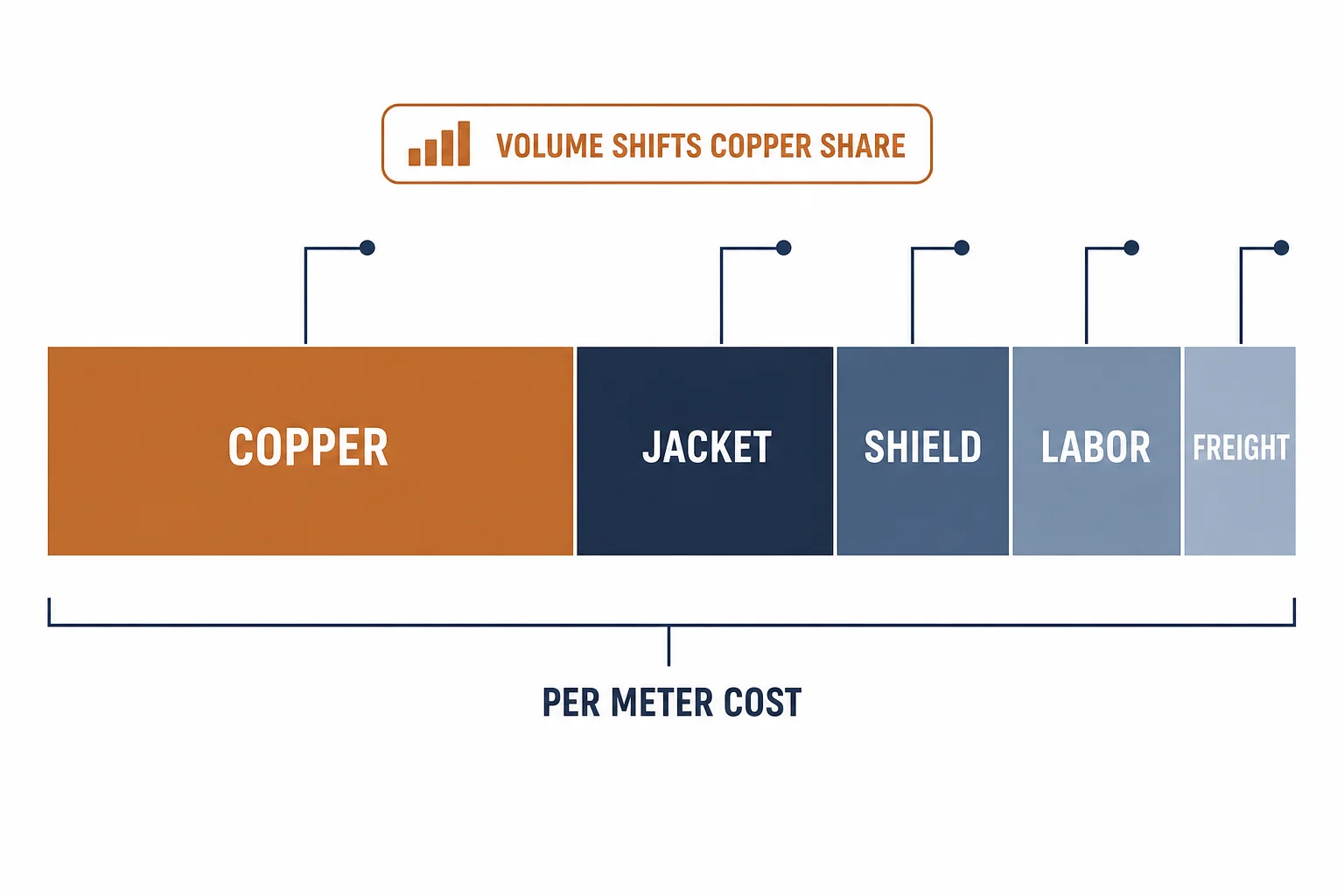
Ethernet cable pricing looks opaque because it is a stack of components, not a single number: copper, jacket compound, shielding, labor, testing, packaging, and freight each take a share. Once the stack is visible, the quotes stop being mysterious – and the buyer can see which line moves with volume and which is fixed.
This guide breaks the price into its segments, explains why categories price differently, and shows how order size shifts the shares.
The Cost Segments
| Segment | What drives it | Volume behavior |
|---|---|---|
| Copper | Metal price and conductor gauge | Falls with purchasing scale, tracks the market |
| Jacket compound | Material grade (PVC, LSZH) and diameter | Modest scale effect |
| Shielding | Foil, braid, drain wire | Category-dependent, scale-stable |
| Labor and testing | Pairing, jacketing, Fluke testing | Fixed per batch – the volume lever |
| Freight | Weight and volume of the shipment | Rises with distance, not with volume |
The segments explain the quotes: two suppliers with the same copper price can differ on testing and freight, and two categories differ mostly on shielding and tolerance.
Why Categories Price Apart
- Cat5e: two pairs of the four used for signaling, looser tolerances – the low-cost baseline
- Cat6: tighter pair geometry and a spline in some constructions – more material and care
- Cat6a: shielding by construction, larger diameter, heavier – the material step
- Cat8: short-run data-center construction, the highest tolerance and shield cost
The category premium is construction, not marketing: the buyer pays for geometry control and shielding material, both of which appear in the cross-section.
How Volume Changes the Stack
| The order | What improves |
|---|---|
| Sample and small carton | Nothing – setup and freight dominate |
| Pallet | Setup amortized, copper purchasing better |
| Container | Freight per meter falls, terms improve |
Standards and Verification
| The reference | The relevance |
|---|---|
| TIA-568.2-D | Category construction that drives the material cost |
| UL 444 | Cable construction and rating requirements |
| Market practice | Copper price is the volatile input – quotes carry validity windows |
Specific prices, copper indices, and freight rates are not provided in the knowledge base. The segment structure is standard; obtain current quotes with validity periods and state the Incoterm.
Real-World Applications
The quote that looked cheapest
Two quotes for Cat6a, 20 percent apart: the cheaper one excluded testing and named FOB terms – the stack comparison showing the gap was service, not cable.
The category downgrade
A buyer moving 40 short runs from Cat6a to Cat6: the distance math supporting the change – the saving real because the specification allowed it.
The container decision
A distributor comparing pallet and container pricing: freight per meter falling at the container level – the volume lever visible in the stack.
Related reading: The category map behind the price steps? Read the best type of ethernet cable — blogs/news/best-type-of-ethernet-cable
Related reading: The label that is not a category? Read what is CAT6E — blogs/news/cat6e-naming-trap
Frequently Asked Questions
How much does ethernet cable cost per foot?
It depends on category, construction, jacket, and order size – current prices are not held in the knowledge base. Compare quotes on the same specification and Incoterm.
Why is Cat6a more expensive than Cat6?
Shielding by construction, larger diameter, and tighter tolerances – the material and process cost of meeting the higher category.
Does buying more cable always lower the price?
The per-meter cost falls with volume until freight and storage dominate. The optimum is the largest order your demand can absorb without dead stock.
Why do cable quotes expire?
Copper is a traded commodity – quotes carry validity windows so the metal price risk is shared explicitly rather than absorbed silently.
Sourcing Cat6 or Cat6a for a project, a store, or a private-label line? Contact our B2B sales team for datasheets, category test reports, and volume terms – FOB and CIF options available. Request a quote or sample.