
What Is the Best Ethernet Cable: Ranked Criteria
Quick answer / TL;DR: Short answer: choose the category by speed and distance (Cat5e for 1G, Cat6 for 10G up to about 55 m, Cat6a for 10G to 100 m), then check construction – conductor gauge, shielding where the environment demands it, jacket rating for the route. Brand and price rank last; the certificate and the test report rank above both.
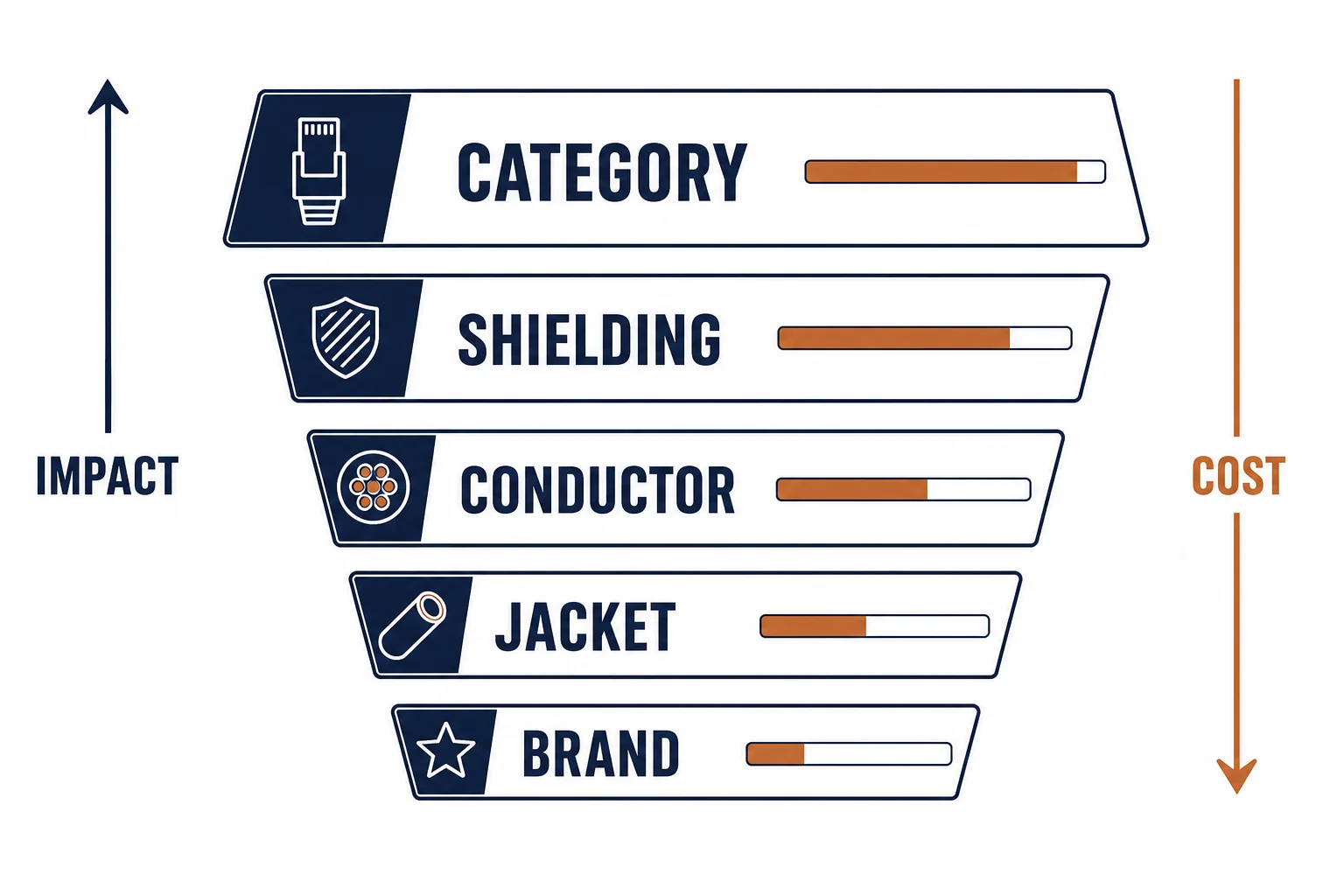
'Best ethernet cable' is a purchasing question with an engineering answer: the best cable is the lowest category that covers the run's speed and distance, built to the category's construction rules, with a jacket that fits the route. Everything above that line is durability, convenience, and marketing.
This guide ranks the criteria by what changes the result, then turns them into a specification any supplier can quote against.
The Ranking
| Criterion | What it changes | Weight |
|---|---|---|
| Category and distance | The speed the run can carry | First |
| Construction (gauge, pairs) | Whether it meets the category at all | Second |
| Shielding | Noise immunity in difficult environments | Third |
| Jacket and rating | Where the cable may legally run | Fourth |
| Brand and price | Durability, service, and cost | Last |
The ranking is the whole guide: the top two decide whether the link works, the middle two decide whether it survives the building, and the last row decides what it costs to feel good about.
The Category Ladder
- Cat5e: 1G to 100 m – still adequate for access and voice
- Cat6: 10G to roughly 55 m, 1G to 100 m – the general-purpose default
- Cat6a: 10G to the full 100 m, shielded by construction
- Cat8: 25G/40G over short runs – data-center territory, not office furniture
The ladder is published in the standards (TIA-568 and ISO/IEC 11801 families); the distances are the limits the categories were designed around, not marketing tiers.
The Specification Brief
| Line | Example |
|---|---|
| Category and length | Cat6a, 60 m runs, 24 drops |
| Construction | 23 AWG solid, F/UTP |
| Jacket | LSZH, plenum-rated where required |
| Testing | Fluke channel test per drop |
| Marking | Category and length printed on the jacket |
Standards and Verification
| The reference | The check |
|---|---|
| TIA-568.2-D | Category construction and field-test requirements |
| ISO/IEC 11801-1 | The international channel specification |
| IEEE 802.3 | The Ethernet standards behind the speed claims |
Per-SKU construction details and current pricing are not provided in the knowledge base. The category limits are standard; confirm the specific product's construction and test reports with the supplier.
Real-World Applications
The office refresh
A 60-desk office replacing 1G links: Cat6 to the desk, Cat6a on the long backbone runs – the ladder applied rather than buying one category for everything.
The noisy workshop
A production floor with drives and welding nearby: F/UTP Cat6a specified for the noise path – shielding chosen for the environment, not for the spec sheet's prestige.
The reseller's line card
A distributor narrowing its range: two categories covering 90 percent of demand, the brief written once – the catalogue simplified by the same ranking.
Related reading: The application matrix for the same decision? Read which ethernet cable is best — blogs/news/which-ethernet-cable-is-best
Related reading: The construction and jacket map? Read the best type of ethernet cable — blogs/news/best-type-of-ethernet-cable
Frequently Asked Questions
What is the best ethernet cable for home use?
Cat5e or Cat6 covers home speeds and distances. Choose Cat6 if the runs exceed 45 m or the network may move to 2.5G/5G later.
Is Cat7 or Cat8 worth it?
Only where the equipment and the distance justify it – Cat8 targets short data-center runs. For offices and homes, Cat6a is the practical ceiling.
Does a higher category always mean faster internet?
No – the category sets the cable's capability. The internet speed is set by the service and the equipment; the cable only avoids being the bottleneck.
What should I ask a supplier before buying?
The category's test report, the construction (gauge, pairs, shielding), the jacket rating, and the marking. Quote two suppliers against the same brief.
Sourcing Cat6 or Cat6a for a project, a store, or a private-label line? Contact our B2B sales team for datasheets, category test reports, and volume terms – FOB and CIF options available. Request a quote or sample.