
AOC vs Copper HDMI: The Crossover
Quick answer / TL;DR: Short answer: copper HDMI (passive to about 5 m, active to roughly 15 m) is cheaper and simpler for short runs; AOC takes over beyond that, with lighter cable, immunity to EMI, and no signal loss at length. The trade-offs: AOC is directional, not field-repairable, and costs more at short lengths where copper is fine.
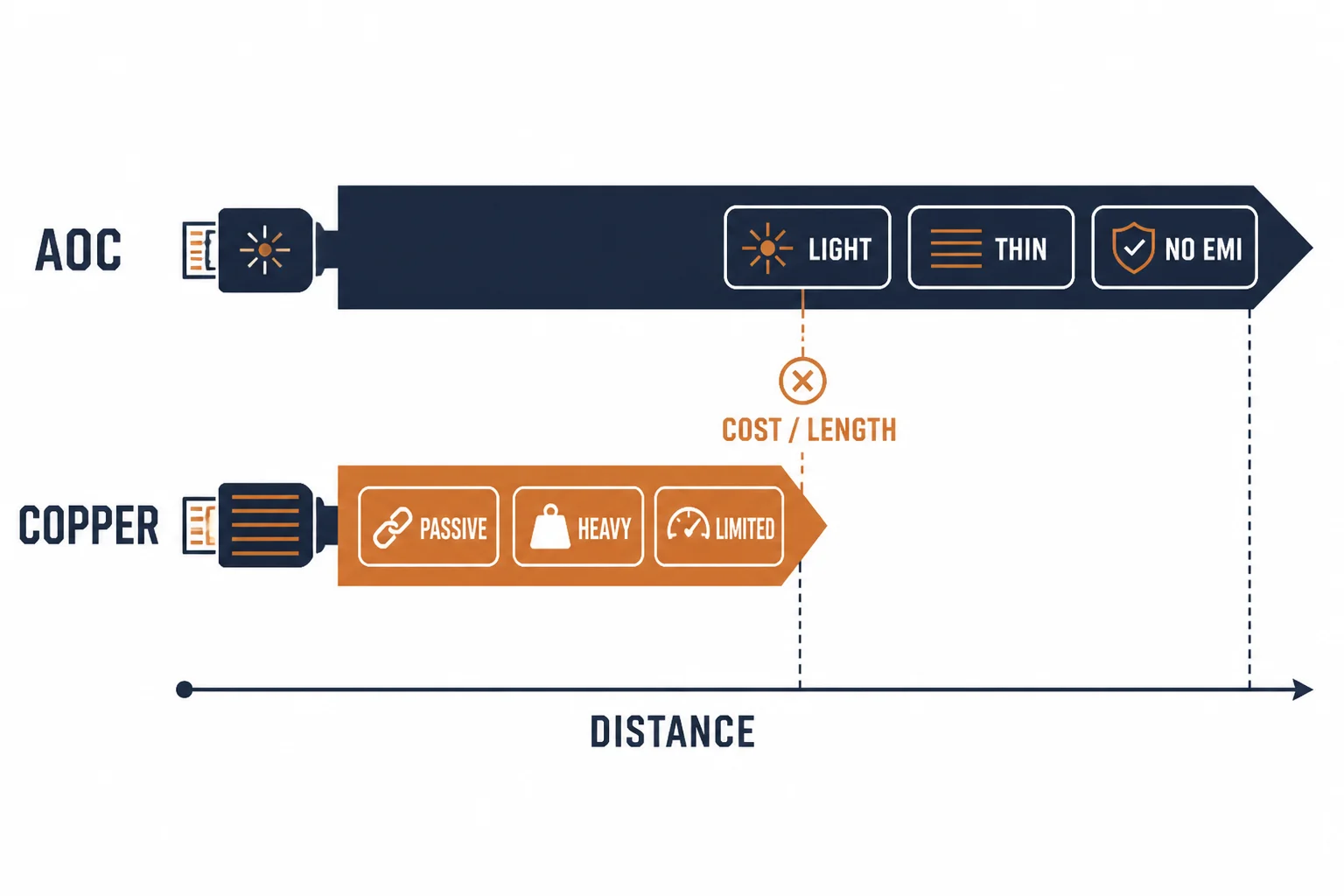
AOC and copper HDMI do the same job up to copper's limit, and then only one of them continues. The crossover is a length-cost calculation with two practical variables – cable weight and interference immunity – that decide installations as much as price.
This is the comparison: the crossover point, the two variables, and the installation rules that differ between the technologies.
The Crossover
| The length | Copper | AOC |
|---|---|---|
| Up to 5 m | Passive – cheapest, simplest | Overkill |
| 5-15 m | Active copper | Comparable |
| 15 m and beyond | At its limit | The only practical option |
The crossover is not a single number – it moves with bandwidth. At 4K/120 the copper limit arrives sooner than at 1080p.
The Two Variables
- Weight: AOC is dramatically lighter and thinner – the reason for long ceiling and conduit runs
- EMI: fiber is immune – the reason for industrial and dense-cabling paths
- Direction: AOC must be installed source-to-display
- Repair: copper can be re-terminated; AOC cannot
The variables decide installations where price alone would not: a 20-meter ceiling run favors the light cable, and a plant room favors immunity.
The Decision Table
| The situation | The choice |
|---|---|
| 2 m console link | Passive copper |
| 12 m projector drop | Active copper |
| 25 m hall run | AOC |
| Dense rack with EMI | AOC or fiber |
Standards and Verification
| The reference | The relevance |
|---|---|
| HDMI 2.1 specification | Bandwidth tiers and certification |
| Eye-diagram testing | The evidence at length |
| AOC engine practice | Direction and power requirements |
Per-SKU ratings and prices are not provided in the knowledge base. The crossover structure is standard; compare total installed cost including labor and weight handling.
Real-World Applications
The ceiling run
A 22-meter run above a suspended ceiling: AOC – the light cable pulled without additional supports, the direction marked before the pull.
The rack behind the wall
A media rack in a service closet 3 meters away: passive copper – the cheap, re-terminable option doing the job.
The plant-room display
A status display in a plant room with drives nearby: AOC – immunity ending the interference question.
Related reading: The AOC supplier checks? Read the AOC sourcing guide — blogs/news/aoc-cable-suppliers
Related reading: The copper length tiers? Read the HDMI length guide — blogs/news/hdmi-cable-length-buying
Frequently Asked Questions
Is AOC better than copper HDMI?
Beyond copper's length limit, yes. Below it, copper is cheaper and simpler – the crossover decides.
At what length should I switch to AOC?
Roughly beyond 15 m, sooner at high bandwidth. The crossover moves with the format.
Can AOC be used for short runs?
It works but costs more and adds direction rules. Copper is the sensible short-run choice.
Does AOC carry audio and CEC?
It carries the HDMI signal including audio and control channels, within the product's supported feature set.
Sourcing cables for a project, a store, or a private-label line? Contact our B2B sales team for specifications, certification evidence, and volume terms – FOB and CIF options available. Request a quote or sample.