
Custom Cable Assembly: The Brief to Production
Quick answer / TL;DR: Short answer: prepare a specification package (connectors, pinout, cable, length, labeling, test criteria), request a sample, test and seal the approved sample, then release production with an inspection clause. The approved sample is the contract's physical annex – production without it is a guess repeated at volume.
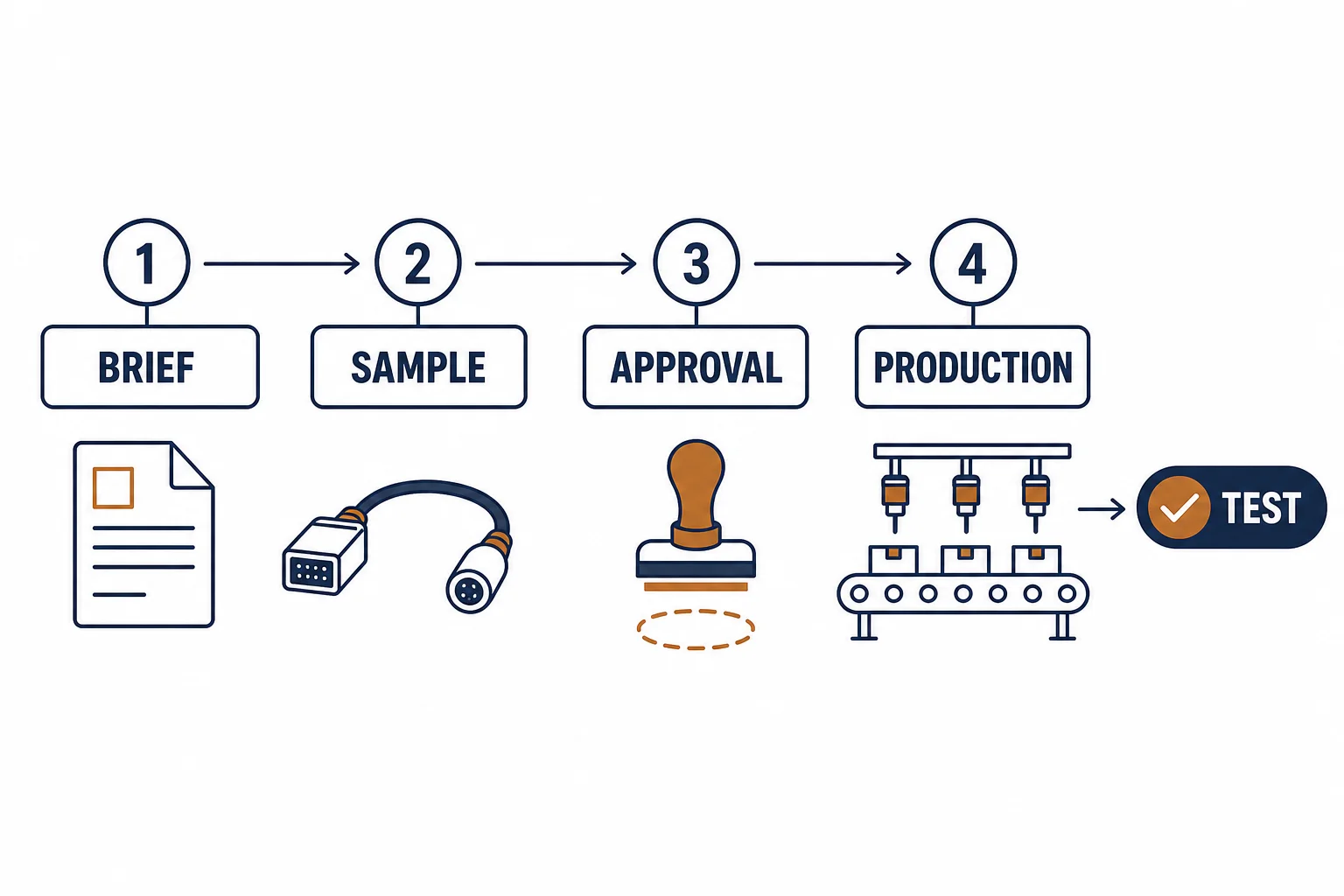
Custom cable assemblies are bought on a specification package, not a description: connector, pinout, cable, length, labeling, and test. The supplier's job is to reproduce that package exactly, batch after batch. The process that makes it repeatable is short and unforgiving.
This is the assembly guide: the package, the sample gate, and the production controls.
The Specification Package
| The element | The detail | The failure if missing |
|---|---|---|
| Connector | Type, gender, plating, shell | Wrong mating or corrosion |
| Pinout | The wiring map, tested | Crossed pairs or dead lines |
| Cable | Construction, gauge, jacket | Flex or signal failure |
| Length | Tolerance and measurement method | Fit problems on the line |
| Labeling | Print, heat-shrink, orientation | Misidentification in the field |
The package is the drawing and the test: everything the supplier must reproduce, and the criteria that prove it.
The Sample Gate
- Request the sample against the package – not a similar assembly
- Test it against the pinout and the mechanical requirements
- Seal and sign the approved sample with a date
- Reference the sample number in the purchase order
The sample gate is where custom assemblies succeed or fail: the sealed sample ends the ambiguity that otherwise appears at batch three.
The Production Controls
| The control | The method |
|---|---|
| First article | Compare the first unit to the sealed sample |
| In-process test | Continuity and pinout on every unit |
| Inspection | Sample pull and bend by lot |
| Traceability | Lot number and date code on the label |
Standards and Verification
| The reference | The relevance |
|---|---|
| IPC/WHMA-A-620 | Cable and wire harness acceptance criteria |
| UL 486 / connector standards | Termination requirements |
| The drawing | The governing document for the assembly |
Per-SKU test standards are not provided in the knowledge base. The package and gate structure is standard; specify the acceptance criteria explicitly in the purchase order.
Real-World Applications
The rack harness
A data-center rack harness with 40 custom leads: the package drawn once, samples sealed, production tested per unit – the rack assembled without surprises.
The OEM accessory
A device maker's custom power cable: first-article approval against the drawing – the launch batch matching the prototype.
The batch drift
A third production run with a substituted connector: the sealed sample revealing the change – the batch reworked before shipment.
Related reading: The USB-C rating discipline for assemblies? Read the OEM guide — blogs/news/usb-c-cable-oem
Related reading: The factory audit behind the supplier? Read HDMI factory sourcing — blogs/news/hdmi-cable-factory-sourcing
Frequently Asked Questions
How do I specify a custom cable assembly?
With a package: connectors, pinout, cable construction, length and tolerance, labeling, and test criteria – plus an approved sealed sample.
What should a sample approval include?
Testing against the pinout and mechanical requirements, a signature and date, and the sample number referenced in the purchase order.
How do I keep production consistent?
First-article comparison, per-unit continuity tests, lot sampling, and traceability labels.
What standard applies to cable assemblies?
IPC/WHMA-A-620 is the common acceptance standard for cable and wire harness assemblies.
Sourcing cables for a project, a store, or a private-label line? Contact our B2B sales team for specifications, certification evidence, and volume terms – FOB and CIF options available. Request a quote or sample.