
Fiber vs Copper: The Crossover Point
Quick answer / TL;DR: Short answer: copper twisted pair for runs up to 100 m where power delivery (PoE) matters; fiber beyond that distance, in EMI-heavy paths, or where bandwidth demand outgrows copper categories. The crossover is usually the inter-building link – copper cannot legally or reliably get there, so fiber wins before price enters.
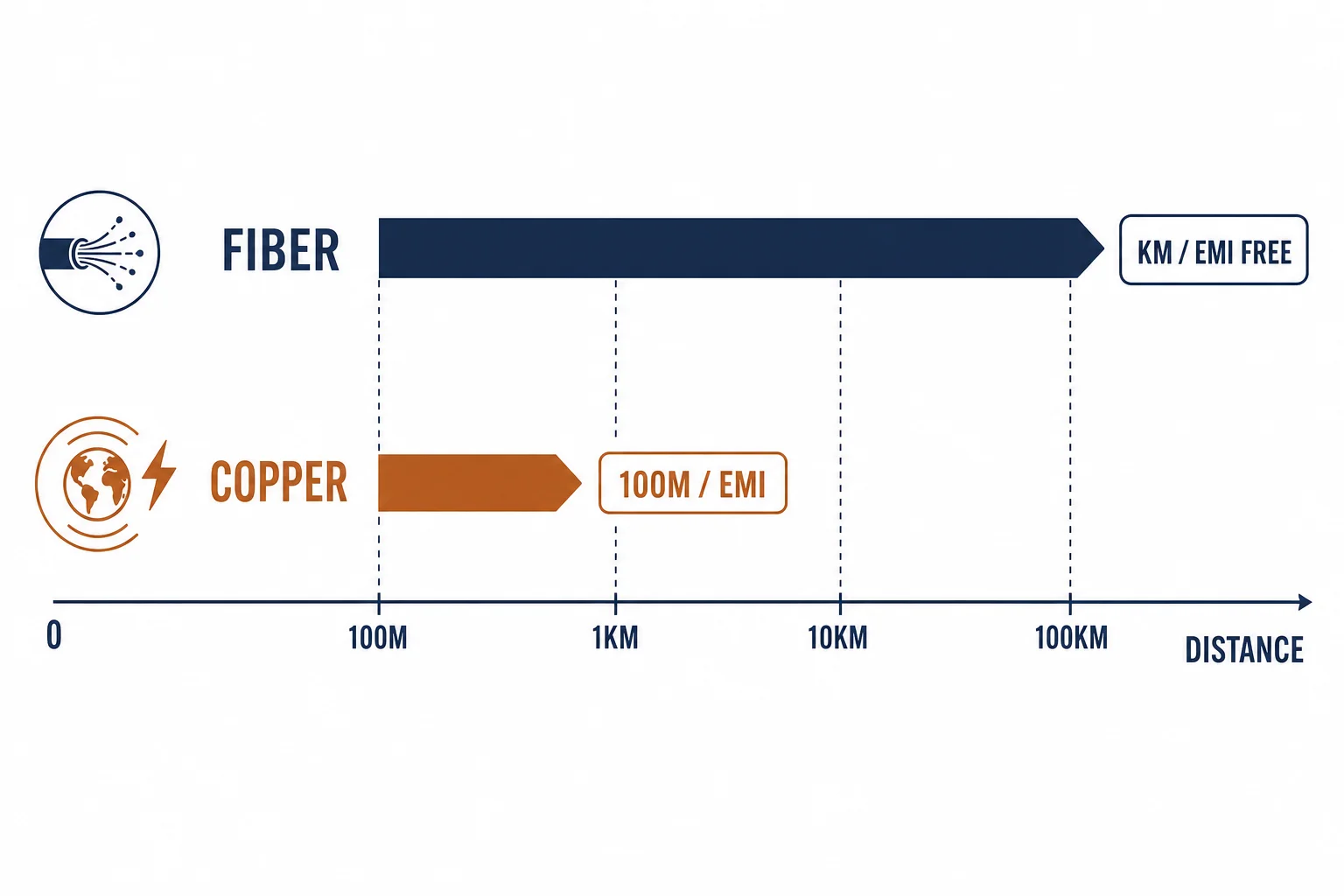
Fiber versus copper is decided by three numbers before any price comparison: distance, bandwidth, and interference. Copper's twisted pair stops at 100 meters and carries power; fiber runs kilometers and carries none. The crossover is where the distance need outweighs copper's cost and power advantages.
This is the crossover guide: the three numbers, the cost behavior, and the purchase that follows.
The Three Numbers
| The number | Copper | Fiber |
|---|---|---|
| Distance | 100 m channel | Kilometers |
| Bandwidth | Category-limited | Terabit-class potential |
| Power | PoE capable | None carried |
The three numbers rank the decision: distance first, bandwidth second, power as the constraint that keeps copper in place where it fits.
The Cost Behavior
- Copper: cheap cable, cheap termination, power included
- Fiber: higher electronics cost at each end, but cable cost per meter falls far below copper's at distance
- The crossover: where the electronics amortize against the copper that cannot reach
- Labor: fiber termination needs skill and test gear
The cost comparison is total-system: media converters or switches with fiber ports at both ends, plus the cable, plus the labor. At inter-building distances copper is not an option at all.
The Decision Table
| The need | The answer |
|---|---|
| Desk to switch, 30 m | Copper Cat6 |
| Access point with PoE | Copper – power over the same cable |
| Building to building, 300 m | Fiber |
| Industrial cell with drives | Fiber or shielded copper by EMI level |
Standards and Verification
| The reference | The relevance |
|---|---|
| TIA-568 / ISO 11801 | Copper channel definitions |
| ITU-T G.652 / G.651 | Fiber types |
| IEEE 802.3 | The ethernet variants over each medium |
Per-SKU costs and loss budgets are not provided in the knowledge base. The decision structure is standard; calculate the total system cost including electronics and labor.
Real-World Applications
The inter-building link
Two buildings 300 meters apart: single-mode fiber – copper eliminates itself before the price comparison starts.
The PoE camera
An outdoor camera 60 meters from the switch: copper with PoE – one cable for power and data, the fiber alternative needing local power.
The EMI-heavy plant
A production hall with welding nearby: fiber for the backbone – interference immunity ending the argument.
Related reading: The fiber cords themselves? Read the patch cord suppliers guide — blogs/news/fiber-patch-cord-suppliers
Related reading: The data families compared? Read the types guide — blogs/news/data-cable-types
Frequently Asked Questions
Is fiber always better than copper?
No – copper wins on cost, termination simplicity, and power delivery within its 100 m limit. Fiber wins on distance, bandwidth, and EMI immunity.
When should I choose fiber?
Beyond 100 m, between buildings, in high-interference paths, or where bandwidth demand exceeds copper categories.
Can fiber carry power?
Not in standard data installations – PoE is a copper capability. Fiber links need local power at the far end.
What is the cost crossover?
Roughly where the distance makes copper impossible or the electronics amortize – typically inter-building runs. Calculate total system cost.
Sourcing cables for a project, a store, or a private-label line? Contact our B2B sales team for specifications, certification evidence, and volume terms – FOB and CIF options available. Request a quote or sample.