
Digital Coaxial RCA: The 75-Ohm Rule
Quick answer / TL;DR: Short answer: buy a 75-ohm digital coaxial RCA cable for S/PDIF – not an analog audio lead. The plugs are identical; the cable's impedance and shielding are not. Keep the run short (a few meters), avoid sharp bends, and remember digital coax carries one channel of the S/PDIF stream, not stereo pairs.
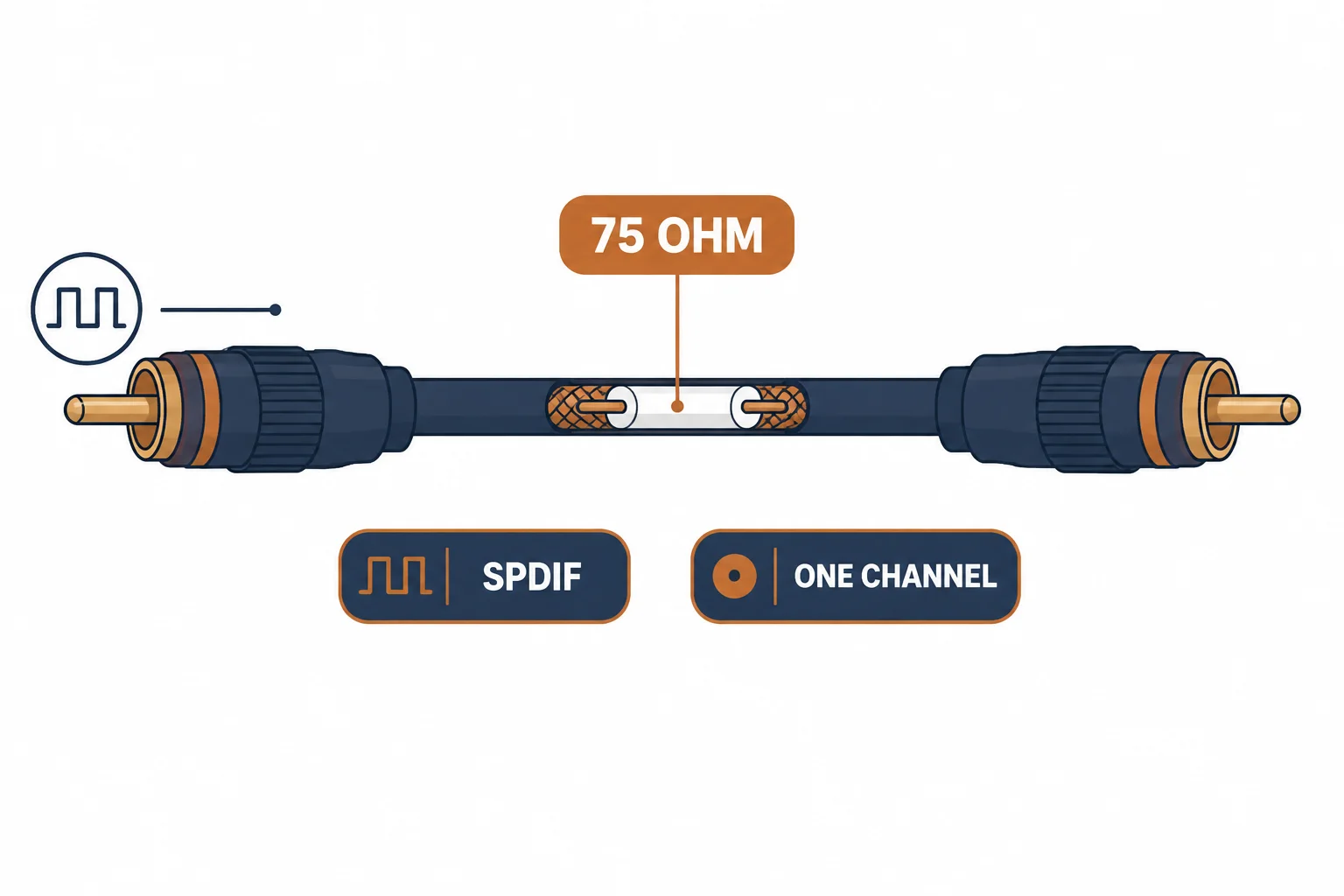
Digital coaxial audio uses the same RCA plugs as analog leads and a different specification: 75-ohm impedance carrying an S/PDIF datastream. An analog RCA cable will often work and will sometimes fail – the impedance mismatch shows as dropouts rather than noise. This guide is the buying rule.
This is the digital coax guide: the 75-ohm requirement, the difference from analog leads, and the checks for a reliable link.
The 75-Ohm Rule
| The cable | The impedance | The result |
|---|---|---|
| Digital coax | 75 ohm | The S/PDIF stream carried cleanly |
| Analog RCA lead | Unspecified | Often works – dropouts when it does not |
| Video RCA | 75 ohm | Electrically suitable, color-coded differently |
The table's middle row is the practical trap: an analog lead is not wrong until it is – the failure is intermittent, which is worse than absent.
What S/PDIF Carries
- One digital stream on one cable – stereo PCM or a compressed surround bitstream
- The format is set by the source; the cable carries what it is given
- Coaxial and optical carry the same formats on different media
- The destination's decoder decides what is audible
The one-channel rule surprises buyers expecting stereo pairs: S/PDIF multiplexes both channels into one datastream, so one cable is complete.
The Buying Checks
| The check | The question |
|---|---|
| Impedance | Is 75 ohm stated? |
| Length | Within a few meters for reliable consumer links |
| Shield | High coverage for a digital signal |
| Connectors | Tight RCA grip, gold or nickel plating stated |
Standards and Verification
| The reference | The relevance |
|---|---|
| IEC 60958 | The S/PDIF interface standard |
| 75-ohm coax practice | Impedance and termination for digital audio |
| Consumer format practice | The bitstream formats carried |
Per-SKU impedance and shielding figures are not provided in the knowledge base. The 75-ohm requirement is standard; confirm the specification on the datasheet rather than the color of the plug.
Real-World Applications
The soundbar link
A TV's coaxial digital out to a soundbar: a 75-ohm cable at 1.5 m – the surround bitstream arriving intact.
The DAC feed
A streamer to an outboard DAC on coax: the 75-ohm cable kept short – the digital link's jitter margin preserved.
The analog-lead dropout
An analog RCA lead used for digital audio: occasional dropouts under load – the 75-ohm cable substituted, the link stable.
Related reading: The coaxial family behind the cable? Read the coax wholesalers guide — blogs/news/coaxial-cable-wholesalers
Related reading: The A/V category map? Read the guide — blogs/news/a-v-cables-buying
Frequently Asked Questions
Can I use an analog RCA cable for digital audio?
Often it works, but the impedance is unspecified – dropouts can appear. A 75-ohm digital coax cable is the correct part.
What is the difference between coaxial and optical digital audio?
The medium: coax uses 75-ohm copper, optical uses fiber. Both carry the same S/PDIF formats.
Does digital coax carry stereo?
It carries one S/PDIF stream that can contain stereo PCM – one cable is complete, not two.
How long can a digital coax run be?
Consumer links are typically a few meters; longer runs need attention to impedance and shielding.
Sourcing cables for a project, a store, or a private-label line? Contact our B2B sales team for specifications, certification evidence, and volume terms – FOB and CIF options available. Request a quote or sample.