
AOC Cable Supply: The Optical Engine Question
Quick answer / TL;DR: Short answer: source AOC from factories that can name their optical engine supplier and test the link at the claimed bandwidth and length. Confirm the direction (source and display ends are fixed), the HDMI or DisplayPort tier, and the bend radius. AOC suits runs beyond passive copper limits; it is not repairable in the field.
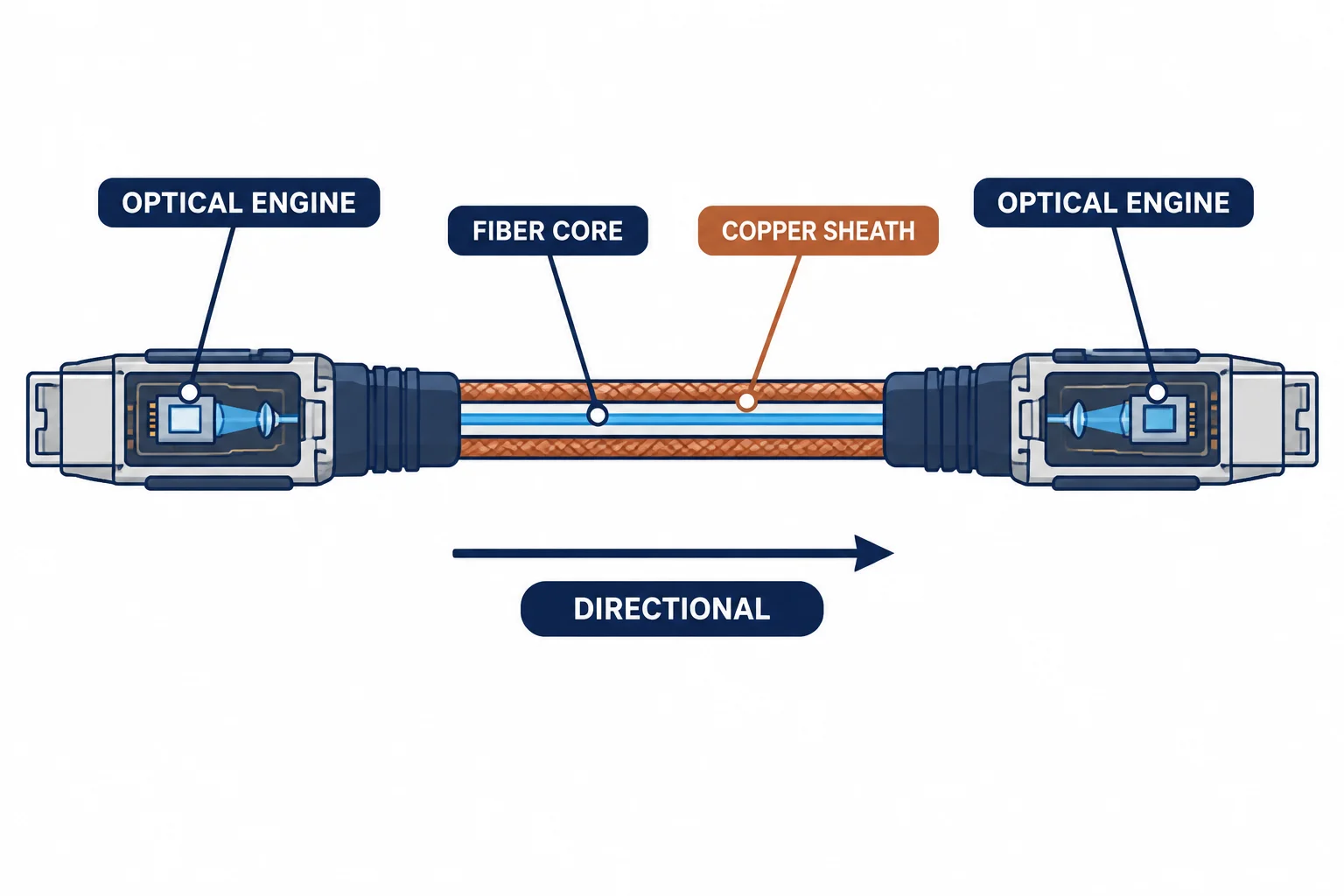
Active optical cables carry HDMI or DisplayPort signals over fiber with an optical engine in each connector – the answer to long runs where copper loses signal. Sourcing them means sourcing the engines, not just the cable, and the direction rule is absolute: AOC is directional, and a reversed cable simply does not work.
This is the AOC sourcing guide: the engine question, the direction rule, and the factory checks for long-run supply.
The Construction
| The part | The function | The sourcing question |
|---|---|---|
| Optical engine | Converts electrical to optical and back | Which engine, which generation? |
| Fiber core | Carries the light | How many strands, what type? |
| Copper sheath | Power for the engines | How is the engine powered? |
| Connector shell | Mechanical and thermal | Bend radius and pull rating |
The engine is the product: two AOC cables at the same length can differ entirely in engine quality and supported bandwidth.
The Direction Rule
- AOC is directional: one end is the source, the other the display
- The connectors are labeled or keyed – reversing gives no signal
- Installation must respect the direction before pulling through conduit
- Some AOC is hybrid (copper plus fiber) – confirm the construction
The direction rule is the field failure to prevent: an AOC pulled the wrong way is a re-pull, not a swap.
The Factory Checks
| The check | The method |
|---|---|
| Link test | At the claimed bandwidth and full length |
| Engine identity | Supplier and generation stated |
| Bend test | At the rated radius, then link again |
| Direction marking | Clear labels at both ends |
Standards and Verification
| The reference | The relevance |
|---|---|
| HDMI 2.1 specification | Bandwidth tiers AOC must carry |
| VESA DisplayPort standard | The DP tiers |
| Optical module practice | Engine qualification and burn-in |
Per-SKU engine models and test data are not provided in the knowledge base. The construction and direction rules are standard; request link-test reports for the supplied length.
Real-World Applications
The conference room run
A 25-meter HDMI run from a lectern to a ceiling projector: AOC at the required tier – beyond copper's passive limit, installed in the right direction.
The display wall
Multiple 4K runs across a hall: AOC with engines specified – the length no longer a constraint on layout.
The reversed pull
An AOC pulled source-end first into conduit: no signal at commissioning – the direction rule had been the missing check. The cable re-pulled.
Related reading: The copper-versus-optical crossover? Read the AOC vs copper HDMI guide — blogs/news/aoc-vs-copper-hdmi
Related reading: The length thresholds on copper? Read the HDMI cable length guide — blogs/news/hdmi-cable-length-buying
Frequently Asked Questions
What is an AOC cable?
An active optical cable: an optical engine in each connector converts the signal to light and back, carrying HDMI or DisplayPort over fiber for long runs.
Are AOC cables directional?
Yes – source and display ends are fixed. Reversing the cable gives no signal.
How far can AOC run?
Well beyond passive copper – tens of meters routinely, with the exact rating per product. Confirm the length and bandwidth together.
Can AOC cables be repaired?
Not in the field – the engines are sealed in the connectors. Treat the cable as a fixed asset and protect it during installation.
Sourcing cables for a project, a store, or a private-label line? Contact our B2B sales team for specifications, certification evidence, and volume terms – FOB and CIF options available. Request a quote or sample.