
Fiber Patch Cord Supply: The Specification Lines
Quick answer / TL;DR: Short answer: specify fiber patch cords by connector (LC/SC), fiber type (single-mode OS2 or multimode OM3/OM4), polish (UPC or APC – never mixed), and length. Suppliers stock common combinations; custom lengths carry lead time. Verify insertion loss and end-face quality on samples, and confirm the polish matches the existing plant.
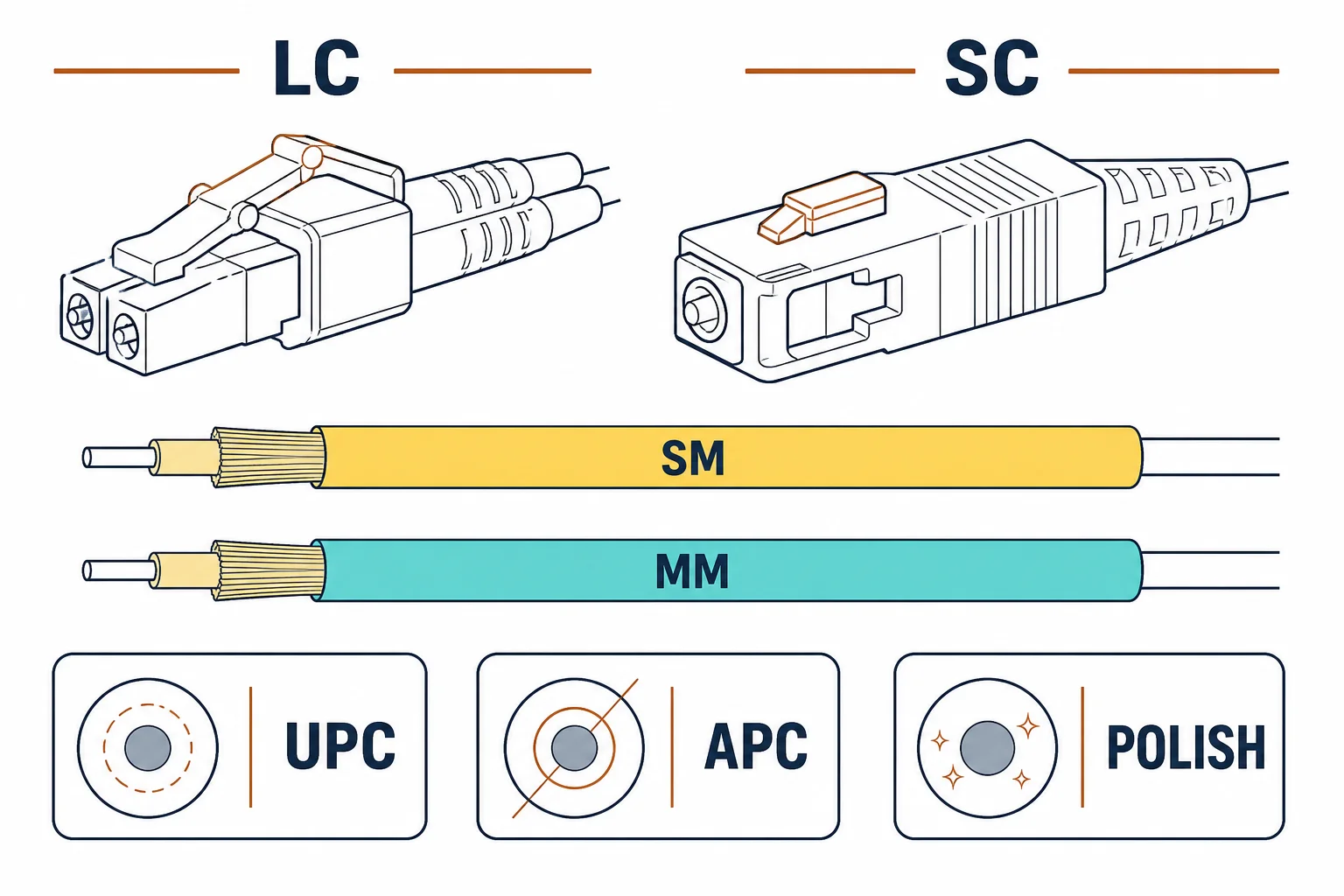
Fiber patch cords are specified in four lines that cannot be guessed: connector (LC or SC), fiber type (single-mode or multimode), polish (UPC or APC), and length. Suppliers stock the common combinations and build the rest – and the polish mismatch is the classic failure that looks like a broken link.
This is the fiber cord guide: the four lines, the supplier checks, and the combinations that must not be mixed.
The Four Lines
| The line | The options | The failure if wrong |
|---|---|---|
| Connector | LC, SC | Does not seat |
| Fiber type | OS2, OM3, OM4 | Link budget or mode mismatch |
| Polish | UPC, APC | APC mated to UPC loses signal |
| Length | Stock or custom | Wrong reach or excess coil |
The lines are independent: the connector does not imply the fiber type, and the polish is a separate decision – which is why the order must state all four.
The Polish Rule
- UPC: flat end-face, blue connectors typically
- APC: angled end-face, green connectors typically – lower reflection
- Never mate APC to UPC: the air gap costs signal
- The plant's existing polish sets the rule – check before ordering
The polish rule is the one that breaks links: the connectors physically mate, the light does not. The color code is the warning.
The Supplier Checks
| The check | The evidence |
|---|---|
| End-face quality | Inspection scope images on the sample |
| Insertion loss | Test report per cord |
| Polish and color | Green for APC, blue for UPC |
| Cable print | Fiber type and jacket rating |
Standards and Verification
| The reference | The relevance |
|---|---|
| ITU-T G.652 / G.651 | Single-mode and multimode fiber types |
| IEC 61753 / 61300 | Connector performance and test methods |
| TIA-568.3 | Fiber cabling practice |
Per-SKU insertion-loss figures are not provided in the knowledge base. The four-line structure is standard; request test reports and end-face images with the sample.
Real-World Applications
The data-center cross-connect
LC-to-LC OM4 cords for a rack cross-connect: the polish matched to the plant, the length stocked – the links passing first time.
The FTTH drop
SC/APC cords for a PON drop: green connectors throughout – the reflection budget respected.
The polish mismatch
An APC cord into a UPC panel: the link's loss spiked – the color code had been the warning. The cord replaced.
Related reading: The fiber-versus-copper decision? Read the crossover guide — blogs/news/fiber-vs-copper-buying
Related reading: The coaxial family alongside fiber? Read the coax wholesalers guide — blogs/news/coaxial-cable-wholesalers
Frequently Asked Questions
How do I buy fiber optic patch cords?
Specify connector (LC/SC), fiber type (OS2/OM3/OM4), polish (UPC/APC), and length. Ask for insertion-loss reports and end-face images.
What is the difference between UPC and APC?
UPC has a flat end-face; APC is angled for lower reflection. They must not be mated to each other.
Can I mix single-mode and multimode cords?
No – the fiber types serve different links and wavelengths. Mixing fails the link budget.
Are custom fiber lengths worth it?
For tidy installations yes, but they carry lead time. Stock lengths with service loops are the faster route.
Sourcing cables for a project, a store, or a private-label line? Contact our B2B sales team for specifications, certification evidence, and volume terms – FOB and CIF options available. Request a quote or sample.