
Yellow, Red and White Cords: The RCA Answer
Quick answer / TL;DR: Short answer: they are RCA cables – a composite video plus stereo audio set. Yellow carries composite video, white the left audio channel, red the right. Buy a single RCA cable of the right length for a missing cord; match the color at both ends. For digital audio, the same RCA plugs can carry S/PDIF on a 75-ohm cable – a different specification.
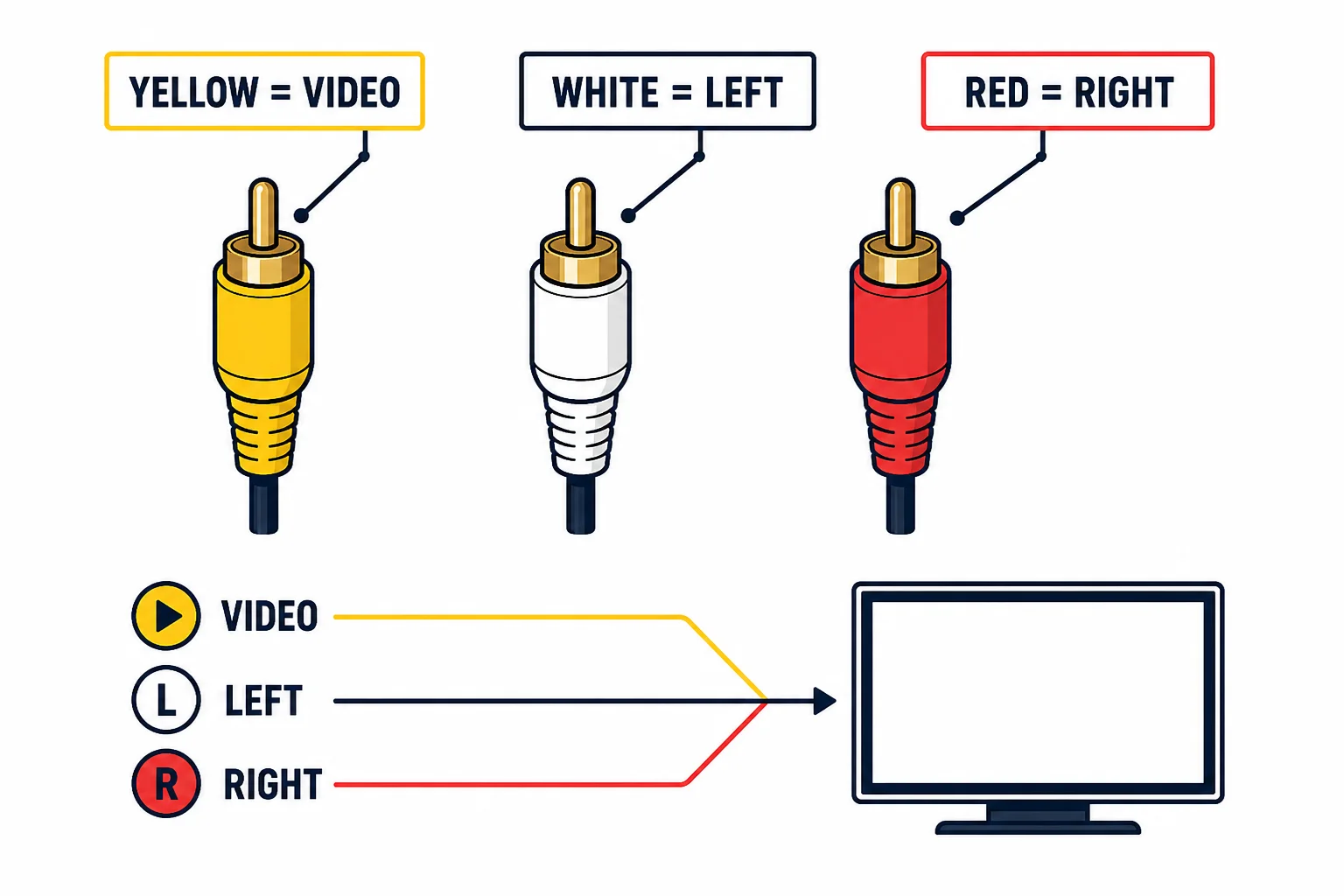
The yellow, red and white cords are RCA cables carrying composite video and stereo audio: yellow for the video signal, white for the left audio channel, red for the right. The trio is the analog AV standard of the VCR era, and the naming question usually hides a practical one – which cable to buy when one of the three is missing.
This is the naming guide: the color code, the signal each carries, and the purchase that replaces a missing cord.
The Color Code
| The color | The signal | The note |
|---|---|---|
| Yellow | Composite video | One video channel – the picture's full signal |
| White | Left audio | The stereo pair's left channel |
| Red | Right audio | The stereo pair's right channel |
The code is a convention, not a standard requirement: manufacturers follow it so installs stay legible. Matching the colors at both ends is the whole discipline.
What the Cables Actually Are
- RCA plugs on coaxial cable – the same family used for digital audio
- Composite video: one channel carrying luminance and chroma together
- Stereo audio: two channels, one cable each
- The cable is interchangeable across the three – the color is a label, not a specification
The interchangeability is the useful fact: in a pinch any of the three RCA cables carries any of the three signals. The colors are for sanity, not physics.
The Purchase When One Is Missing
| The need | The line |
|---|---|
| Replace one cord | RCA cable, the same length, color-matched |
| Upgrade the trio | Shielded RCA set, 1-2 m |
| Digital audio instead | 75-ohm digital coax RCA – a different spec |
| Longer run | Shielded cable, or a converter for long distances |
Standards and Verification
| The reference | The relevance |
|---|---|
| Composite video (NTSC/PAL practice) | The analog video format the yellow cord carries |
| IEC 60958 / S/PDIF | Digital audio over 75-ohm coax |
| RCA connector practice | The plug standard shared by both uses |
Per-SKU shielding and conductor specs are not provided in the knowledge base. The color code and signal assignments are standard; confirm shielding on the datasheet for audio quality.
Real-World Applications
The missing white cord
A set with the white channel lost: one RCA cable of the same length – the color matched, the stereo restored.
The DVD player revival
A composite trio from a DVD player to an older TV: the code read, the three cords seated – the picture and sound back.
The digital audio upgrade
A soundbar fed by coaxial digital: a 75-ohm RCA cable, not the analog trio – the same plugs, the right specification.
Related reading: The A/V family these cords belong to? Read the category map — blogs/news/a-v-cables-buying
Related reading: The digital audio use of RCA? Read the 75-ohm coax guide — blogs/news/digital-coaxial-rca-buying
Frequently Asked Questions
What are the yellow, red and white cords called?
RCA cables – a composite video plus stereo audio set. Yellow is video, white is left audio, red is right audio.
Are the three RCA cords the same?
Physically yes – the color is a label, not a specification. Any of them can carry any of the three signals in a pinch.
Can I use a yellow video cable for audio?
Yes – the cable is the same coax construction. Match the length and keep the colors consistent at both ends for legibility.
What about the orange RCA jack?
Orange often marks coaxial digital audio (S/PDIF) – the same plug on a 75-ohm cable. Check the device's label.
Sourcing cables for a project, a store, or a private-label line? Contact our B2B sales team for specifications, certification evidence, and volume terms – FOB and CIF options available. Request a quote or sample.