
Data Cable Types: USB, Ethernet, Fiber
Quick answer / TL;DR: Short answer: USB for device connections with power (specify generation and wattage); Ethernet twisted pair for building runs up to 100 m (specify category and jacket); fiber for long distances or EMI-heavy paths (specify single-mode vs multimode and connector polish). The family follows distance and power; the specification follows the equipment.
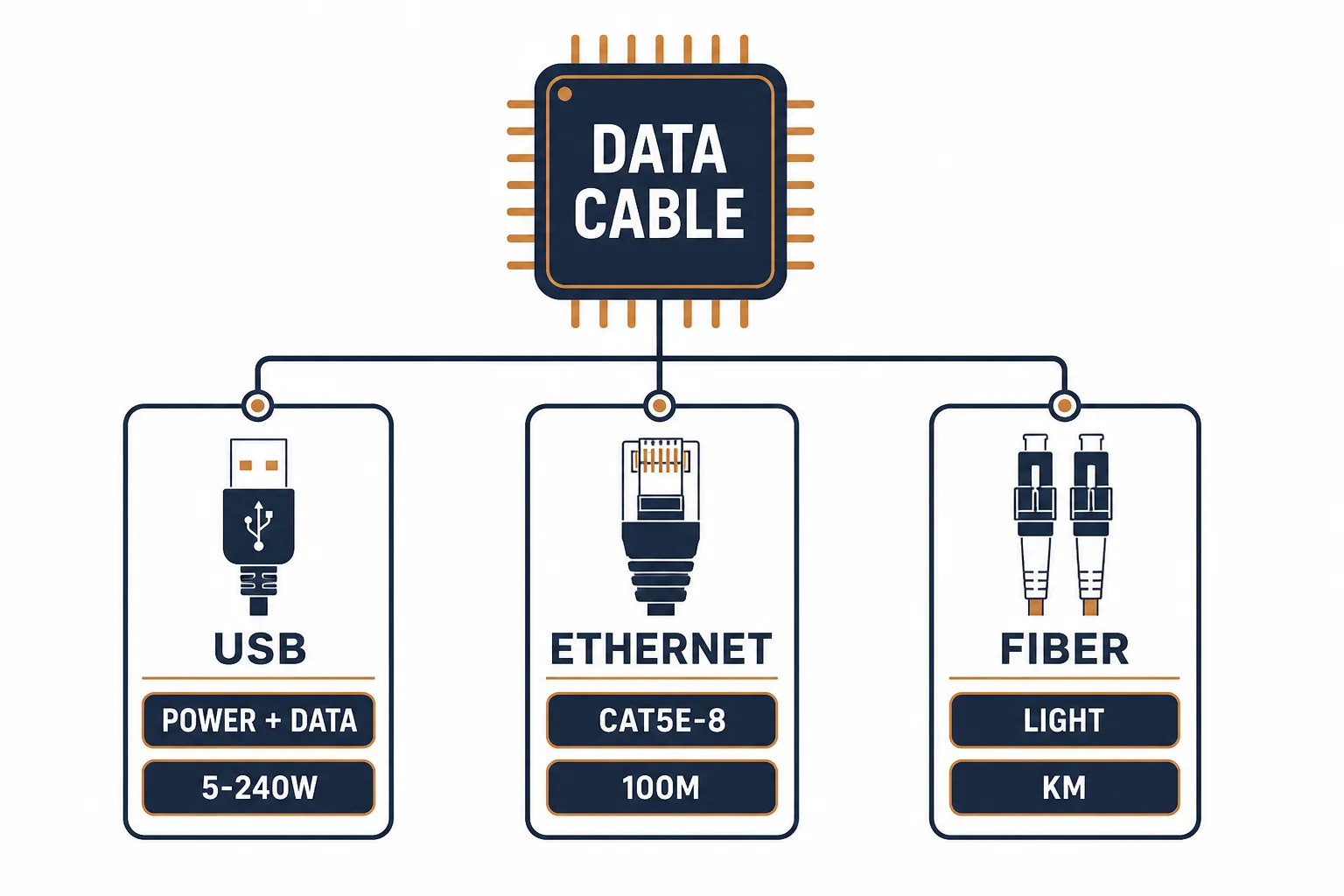
'Data cable' covers three families with different physics: USB (power plus data over short runs), Ethernet (twisted pair over building distances), and fiber (light over kilometers). Procurement mistakes usually come from treating them as interchangeable – they are not, and each has a specification line that decides the purchase.
This is the procurement comparison: what each family carries, its distance and power profile, and the line to order.
The Three Families
| The family | The distance | The power | The key spec |
|---|---|---|---|
| USB | Up to a few meters | Carries power | Generation and wattage |
| Ethernet | 100 m per channel | PoE possible | Category and jacket |
| Fiber | Kilometers | None | SM vs MM, connector polish |
The table's third column is the one buyers forget: USB carries power, Ethernet can, fiber never does – the power need alone can eliminate a family.
The Specification Lines
- USB: generation (2.0, 3.2, 4), wattage class, and connector types
- Ethernet: category (Cat5e to Cat8) plus jacket rating for the route
- Fiber: single-mode for distance, multimode for short high-density links, plus UPC/APC polish
- All three: length, because each family's length limit is physical
The specification lines are short because each family's variability concentrates in a few parameters. The purchase order should name them.
The Order Line
| The need | The line |
|---|---|
| Phone charging and sync | USB-C to USB-C, 240W class, 1 m |
| Desk to wall port | Cat6 patch cord, 2 m |
| Building backbone | Cat6a F/UTP, CMR, 305 m |
| Inter-building link | Single-mode fiber, LC/UPC, 30 m |
Standards and Verification
| The reference | The relevance |
|---|---|
| USB-IF specifications | The generation and power classes |
| TIA-568 / ISO 11801 | Ethernet categories and channels |
| ITU-T G.652 / G.651 | Single-mode and multimode fiber types |
Per-SKU performance is not provided in the knowledge base. The family structure is standard; verify ratings against the specification body's listing.
Real-World Applications
The desk kit
A laptop docked with one USB-C cable for power and display: the wattage class confirmed – the family carrying everything the desk needs.
The warehouse network
Access points across a warehouse: Cat6a with PoE – the family chosen for distance and power together.
The campus link
Two buildings joined over 400 meters: single-mode fiber – the distance eliminating copper before any price comparison.
Related reading: Fiber versus copper in detail? Read the comparison — blogs/news/fiber-vs-copper-buying
Related reading: The A/V families behind the same shelf? Read the category map — blogs/news/a-v-cables-buying
Frequently Asked Questions
What are the types of data cables?
USB, Ethernet twisted pair, and fiber optic – each with different distance, power, and specification profiles.
Which data cable is fastest?
Fiber carries the highest capacities over the longest distances; USB and Ethernet are limited by their standards and lengths.
Can USB replace Ethernet?
Only for short device links. Ethernet's 100 m channel and PoE capability serve building networks that USB cannot reach.
What should a data cable order state?
The family, the generation or category, the length, and the connector – plus the jacket or polish where the route or environment requires it.
Sourcing cables for a project, a store, or a private-label line? Contact our B2B sales team for specifications, certification evidence, and volume terms – FOB and CIF options available. Request a quote or sample.