
Industrial plants do not buy shielded cable the way offices do. A plant network runs beside variable frequency drives, welding cells and power trunks, and STP Cat6 exists for that electrical environment. The sourcing question is narrower than who sells Cat6: it is who can hold shield consistency across reels, support correct drain-wire termination and document each lot. This guide covers the channels that stock shielded construction, the FOB bands to expect, MOQ and lead-time ranges, and the tests that prove the shield actually works before you commit a plant fit-out budget.
Quick answer: Start with manufacturers in the Shenzhen and Dongguan cable clusters that publish a 250 MHz frequency sweep and a shield construction drawing, then cross-check them against Alibaba.com verified suppliers and one regional distributor holding EU or US stock. Expect FOB prices of 0.28 to 0.65 USD per meter depending on shield type and jacket, MOQ of 100 to 500 m for stocked reels, and 3 to 7 days for repeat stock orders. Confirm drain-wire termination and grounded patch panels before you commit, because a shielded cable on unshielded jacks adds cost without delivering shielding benefit.
Where to Find STP Cat6 Cable Suppliers for Industrial Plants
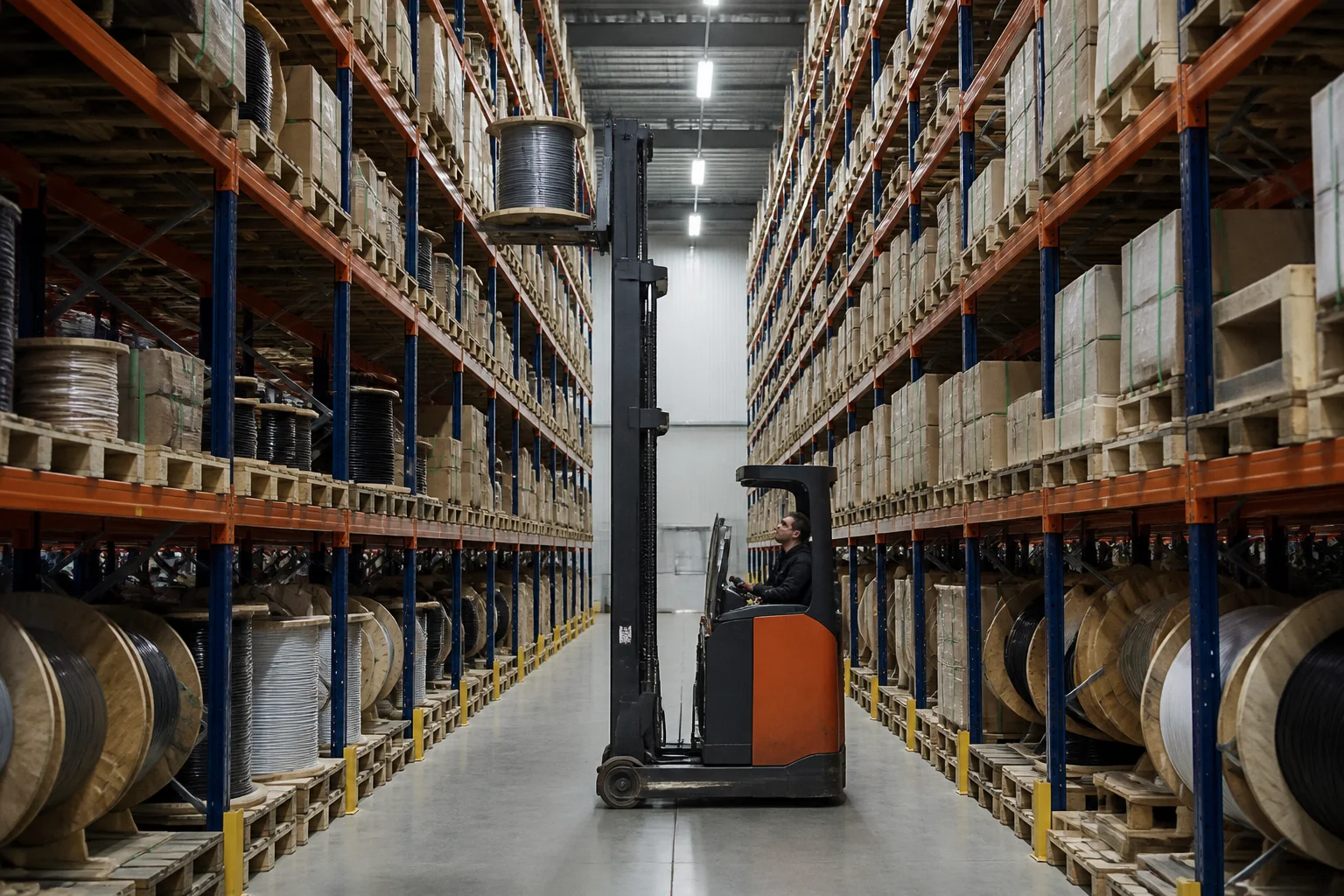
Start with manufacturers in the Shenzhen and Dongguan cable clusters that publish a 250 MHz frequency sweep and a shield construction drawing, then cross-check them against Alibaba.com verified suppliers and one regional distributor holding EU or US stock. Expect FOB prices of 0.28 to 0.65 USD per meter depending on shield type and jacket, MOQ of 100 to 500 m for stocked reels, and 3 to 7 days for repeat stock orders. Confirm drain-wire termination and grounded patch panels before you commit, because a shielded cable on unshielded jacks adds cost without delivering shielding benefit.
What Industrial Plants Actually Need From an STP Cat6 Supplier
Industrial buyers rarely purchase cable the way office buyers do. A plant network runs beside variable frequency drives, servo cabinets, welding cells, induction heaters and power trunks, and those sources push common-mode noise onto copper pairs. STP Cat6 – shielded twisted pair rated to 250 MHz under TIA-568.2-D Cat6 and ISO Class E – exists for that environment. The supplier question is therefore narrower than who sells Cat6: it is who can hold shield consistency across reels, support correct drain-wire termination, and document the lot.
Shield continuity is where low-cost supply chains fail. A reel that beeps on a continuity tester at the factory can still produce a channel that gains nothing from shielding, because the benefit only exists when foil and braid are bonded to ground at both ends through shielded jacks, shielded patch panels and grounded racks. Buyers who understand this ask for a construction drawing and termination guidance rather than a headline price per meter.
It also helps to be clear about what STP does not do. Shielded Cat6 is not faster than unshielded Cat6: both run 250 MHz, and 10GBASE-T at 100 m is a Cat6A matter rather than a Cat6 one. STP buys noise immunity and predictable error rates in electrically hostile rooms. If your cable route is clean office ceiling void, shielded construction mostly buys cost.
STP Cat6 Constructions Compared
The four constructions below cover most industrial inquiries. Indicative FOB ranges are per meter on 305 m reels, FOB China, and move with copper, jacket compound and order volume.
| Construction | Shield | Typical conductor | Environment fit | Indicative FOB (USD/m) |
|---|---|---|---|---|
| F/UTP Cat6, PVC jacket | Overall aluminium foil plus drain wire | 23 AWG solid bare copper | Machine halls with moderate EMI, indoor | 0.28 – 0.42 |
| F/UTP Cat6, LSZH jacket | Overall foil plus drain wire | 23 AWG solid | Indoor trays where fire performance matters | 0.33 – 0.48 |
| S/FTP Cat6, LSZH jacket | Braid plus pair-level foil | 23 AWG solid | Drive cabinets, broadcast, high-EMI zones | 0.38 – 0.58 |
| SF/UTP Cat6, PE jacket | Braid plus overall foil | 22-23 AWG solid | Outdoor trays, plant yards, wet areas | 0.42 – 0.65 |
Two notes on reading that table. Shielded constructions carry a premium over UTP of similar copper weight, and braided types sit above foil-only types because of the extra layer and the larger outer diameter that follows. Also, no serious supplier quotes a fixed number at inquiry stage: copper movement alone shifts quotes within weeks, and reel length, third-party test and private label each move the figure again.
Supply Channels That Stock Industrial STP Cat6
Shielded Cat6 is thinner in the channel than generic UTP, so industrial buyers usually work two or three routes in parallel: a factory for volume and customisation, a verified marketplace listing for a fast sample, and a regional distributor for emergency reels.
Shenzhen and Dongguan cable clusters
Guangdong hosts the densest concentration of LAN cable factories, and many of them run separate shielded lines for F/UTP and S/FTP. The advantage is breadth: braiding equipment, foil taping, LSZH extrusion and Fluke test benches sit within one industrial belt, so a factory can quote several constructions from one inquiry. The disadvantage is variance – two neighbouring plants with similar websites can differ sharply in shield workmanship. Screen on process, not on floor space.
Alibaba.com verified suppliers and sourcing desks
Marketplace listings are useful for price discovery and for obtaining a sample reel quickly, and verified status plus on-site verification reports reduce the risk of dealing with a pure trading account. Treat the platform as a first filter only. Ask for the production address, the conductor supplier, and a photo of the braiding or taping line; a trader will usually route those questions back to a third party.
EU bonded warehouses and regional distributors
If the plant is in Europe, a distributor holding LSZH stock in a bonded warehouse can cut 30 to 45 days of sea freight to days. The trade-off is a narrower construction menu and a price premium that reflects landed cost and handling. For shutdown-critical spools this is usually worth it; for a full building fit-out it rarely is.
MOQ, Lead Time and Order Structure
Shielded cable is quoted by reel, drum or kilometer, and the MOQ you are offered usually reveals which part of the supply chain you are talking to.
- Stocked reels: 100 – 500 m per SKU, the normal entry point for a plant trial or a single production line.
- Custom jacket colour or print: 3,000 – 10,000 m, because the extruder has to be set up and purged.
- OEM packaging and private label: 5 – 10 km across one or two constructions.
- Lead time: 3 – 7 days from stock, 15 – 30 days for production, then 30 – 45 days sea freight Asia to Europe or 25 – 40 days Asia to the US.
A practical order structure splits the award. Place a trial order of a few hundred meters for site testing, then release the balance against the same lot number once the channel passes. Suppliers accept this more readily than buyers expect, and it protects you from discovering a shield problem after 10 km has been extruded.
Verifying Shield Integrity Before You Place a Volume Order
Shielded cable fails quietly. Nothing looks wrong on the outside of a reel, so the checks below should be contractual rather than optional.
- Request a datasheet with a frequency sweep to 250 MHz, not a single “Cat6” claim, plus insertion loss, NEXT and PS-ACR margins at the worst pair.
- Ask for a shield construction diagram showing foil orientation, braid coverage percentage and drain-wire gauge and contact method.
- Test shield continuity end to end on the delivered reel and record resistance from drain wire to drain wire; compare against the value the factory states.
- Certify a mock channel with a Fluke DSX-8000 or DSX-5000 using shielded channel adapters – unshielded adapters invalidate the shielding result.
- Inspect jacket print for construction code, AWG, flame rating and lot number, and check that print matches the datasheet construction.
- Collect RoHS and REACH declarations and, for EU projects, the CPR reaction-to-fire class for the jacket compound.
- Book pre-shipment inspection with a reel-by-reel visual check for foil folding, braid gaps and drum damage before the container is sealed.
None of these steps requires a laboratory. A sample reel, a continuity meter, one certified channel and a printed declaration set will separate a real shielded-cable factory from a repackager within a week. Details of how to audit a plant remotely are covered in our guide to verifying an STP Cat6 manufacturer.
Questions Industrial Buyers Ask Before the First Order
Can you supply S/FTP instead of F/UTP on the same reel length? Usually yes, but the braid adds diameter and cost, so conduit fill and bend radius have to be rechecked. Ask for the outer diameter of both options before you fix the tray design.
How do you prove shield continuity, not just conductor continuity? A serious supplier tests drain wire to drain wire and states a resistance limit, and will run a shielded channel certification on request. If the answer is only “we test with a normal tester”, move on.
What happens if a channel fails on site? Clarify reels replacement terms, who pays return freight, and whether the factory will review Fluke reports. Getting this in writing before the order is easier than negotiating after a failed acceptance test.
Three Buyer Scenarios
- Food and beverage retrofit, 4,800 m: LSZH F/UTP on new trays beside drive cabinets. Buyer prioritises CPR class and jacket print consistency over price, and orders 500 m trial reels first.
- Automotive stamping hall, 12 km: S/FTP to survive welding-cell noise, ordered direct from a Guangdong factory in two releases with pre-shipment inspection on both.
- Packaging line OEM, 900 m: small volume, tight deadline, bought from an EU distributor at a premium to avoid a 40-day sea leg.
Documentation to Request With Every Quote
A complete quote pack contains the datasheet with the 250 MHz sweep, the shield construction drawing, RoHS and REACH declarations, the reel label layout with lot coding, and the packing list showing reel lengths and gross weights. Ask also for the test report number linked to the lot you will receive, not a generic certificate from a previous year. Buyers comparing several offers should normalise all of them to the same construction, jacket and reel length before looking at the number; our note on STP Cat6 MOQ and order tiers explains why quoted lengths vary so much between suppliers.
How to Shortlist Industrial STP Cat6 Suppliers in Two Weeks
Week one: collect six to eight quotes on an identical specification, shortlist three, and request sample reels from each. Week two: run continuity and channel tests on the samples, verify business licence and production address, and ask each supplier one technical question that requires engineering input rather than sales input. The replies usually rank the shortlist more accurately than the price column does. Before final award, compare the per-meter figure against realistic freight and duty; the STP Cat6 price per meter breakdown shows how much of a landed cost sits outside the FOB number.
FAQ
1. Where do industrial plants usually buy STP Cat6 cable?
Most plants buy from factories in the Shenzhen and Dongguan cable clusters for volume, and from a regional distributor for urgent reels. Verified marketplace suppliers are useful for a fast sample but should be treated as a first filter only. The deciding factor is not location but whether the supplier can document shield construction and certify a channel with shielded adapters.
2. What is a realistic MOQ for shielded Cat6?
Stocked reels usually start at 100 to 500 m per SKU, custom jacket colours or print at 3,000 to 10,000 m, and OEM packaging at 5 to 10 km. Many factories will release a smaller trial reel if you commit to a volume order afterwards. Always confirm whether the MOQ applies per construction or per total order.
3. How long does delivery take for an industrial order?
Stocked reels ship in 3 to 7 days, production runs take 15 to 30 days, and sea freight adds 30 to 45 days to Europe or 25 to 40 days to the United States before clearance. Add a week for pre-shipment inspection and any third-party testing. Phased plant projects should order the first phase from stock to avoid a schedule gap.
4. Is STP Cat6 necessary next to variable frequency drives?
Usually yes. Shielded construction is specified for high-EMI environments such as drive cabinets, welding cells and routes beside power trunks, where unshielded error rates rise. The benefit only appears when jacks, panels and racks are shielded and grounded at both ends. Shielded cable on unshielded jacks adds cost and no immunity.
5. How do I check shield continuity on delivery?
Measure resistance from drain wire to drain wire at both ends of each reel and compare it with the factory stated limit. Then certify one mock channel with a Fluke DSX-8000 or DSX-5000 using shielded channel adapters. Inspect jacket print and lot number against the packing list, and reject any reel where print is missing or mismatched.