
A buyer wants 800 m of Cat7 S/FTP with a custom jacket colour and a printed brand. The factory replies with a 5,000 m minimum, the trading company offers 500 m at nearly twice the price, and the project schedule allows four weeks. That gap between what a factory will run and what a buyer needs is the practical content of MOQ negotiation. The bands below show what each order type normally requires, why the minimum exists, and how to structure a first order that is large enough for a production slot but small enough to test a supplier safely.
Quick answer:
Stocked Cat7 reels normally carry a 100 – 500 m per SKU minimum, a custom jacket colour or length starts at 3,000 – 10,000 m, and OEM print with branded packing typically requires 5 – 10 km. Private label patch cords usually start at 500 – 2,000 pieces. The caveat: below the factory minimum you are buying from stock or through a wholesaler, so expect a higher per-meter price and less control over print.
What MOQ Do Cat7 Cable Factories Require?
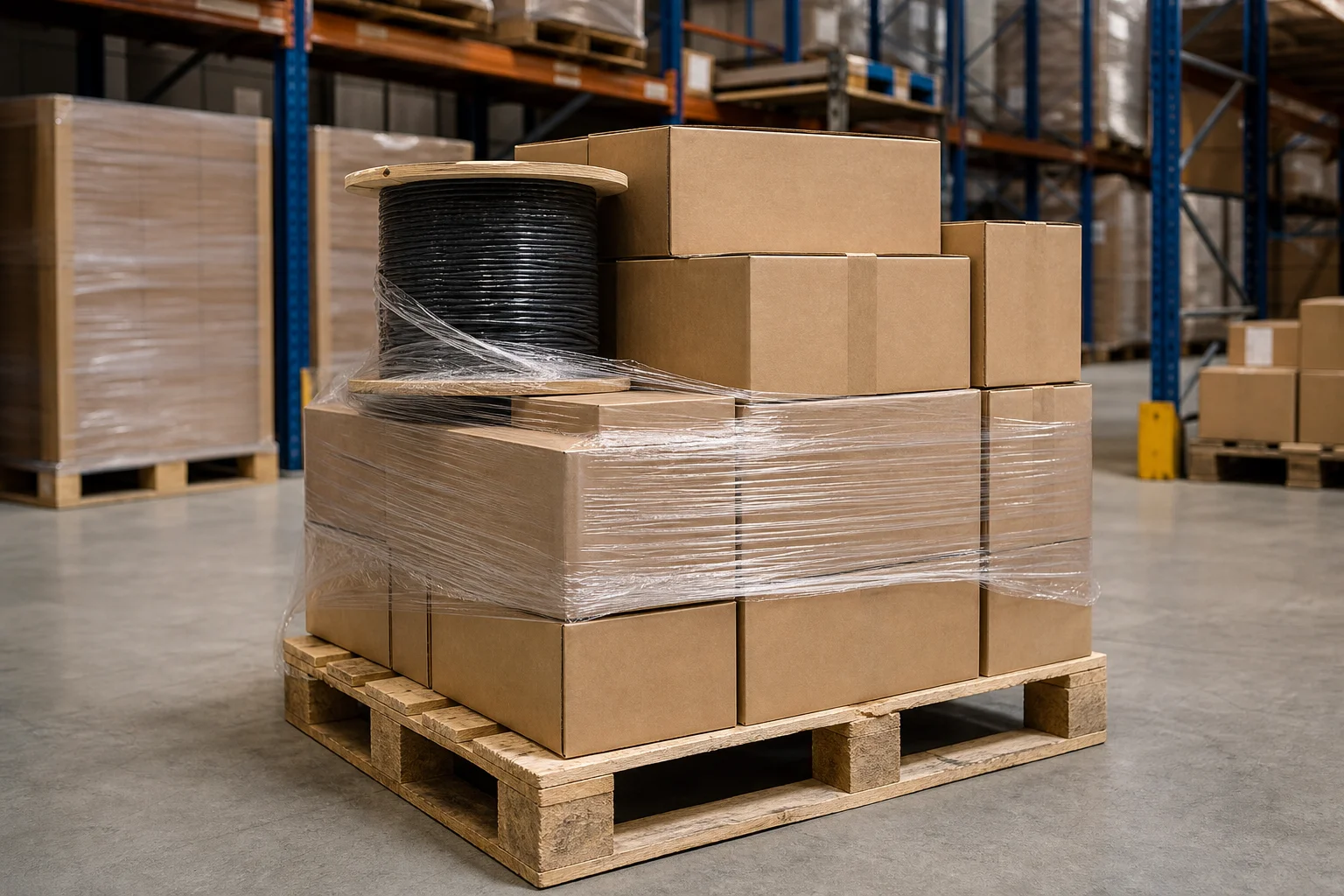
MOQ bands by order type
Cat7 is a Class F construction under ISO/IEC 11801, built as S/FTP with pair shielding and an overall braid. The extrusion and shielding steps are why set-up cost is high relative to a short run, and set-up cost is what an MOQ exists to cover. The table sets out indicative bands by order type, with the price and lead-time effect of each.
| Order type | Typical MOQ band | Price position in the band | Lead time | What triggers the minimum |
|---|---|---|---|---|
| Stocked standard reel, PVC or LSZH | 100 – 500 m per SKU | Upper end of the range | 3 – 7 days | No minimum run; you are buying existing stock |
| Custom jacket colour or non-standard length | 3,000 – 10,000 m | Middle of the range | 15 – 30 days | Extrusion set-up and compound change |
| OEM print and branded packing | 5 – 10 km | Lower end of the range | 20 – 30 days | Print plates, artwork proof, carton tooling |
| Private label patch cords | 500 – 2,000 pieces | Per-piece pricing | 15 – 25 days | Assembly, channel testing and retail packing |
| Container or annual frame | 20 – 60 km | Lowest band, copper clause applies | Release schedule | Capacity reservation and copper purchasing |
The pattern is consistent: the minimum rises with the amount of change you ask for, not with the meters you want. A standard construction in a standard colour has almost no minimum beyond a reel. A new colour, a new print or a new carton makes the factory stop the line, and the MOQ is the price of that stop.
What changes the number
Extrusion set-up. Every change of jacket compound, colour or diameter requires purging the extruder and re-setting the line. The material lost in that purge is fixed, so it weighs heavily on 800 m and barely shows on 8 km.
Jacket compound availability. PVC runs are routine. LSZH compounds are often bought in batches, so a factory may impose a higher minimum for an unusual colour or a specific CPR class than for the same construction in black PVC.
Print and packing. Jacket print needs a plate or a laser set-up, and branded cartons need a print run. Both are one-off costs with their own minimums, which is why OEM programmes start at 5 – 10 km rather than at a pallet.
Testing obligations. A lot test to Class F limits, plus a CPR or UL documentation package, adds fixed work per lot. Factories recover that over the lot size, so small lots carry a disproportionate testing cost.
Commercial risk. Minimums also protect the factory against buyers who order once and disappear. A repeat order history, a deposit or a scheduled programme will move a minimum faster than an argument about the price.
Season and capacity. Minimums soften when the line is idle and harden in a busy quarter. Buyers who can be flexible on delivery date often get a smaller run accepted. The practical timing picture is in our Asia lead time guide.
How to verify a supplier at a small MOQ
- Buy one stocked reel first and confirm the construction against a cut sample: conductor diameter, shield type and jacket print.
- Ask for the production lot number on that reel and request the matching test report, not a generic certificate.
- Verify the ISO 9001 and ISO 14001 certificates with the issuing body before discussing a custom run.
- Request the datasheet with a full frequency sweep to 600 MHz and check that the reel you received matches it.
- For a custom order, approve a pre-production sample and keep it sealed as the reference for the shipment.
- Book a pre-shipment inspection on the first custom lot and tie the balance payment to the inspection report.
Three buyer scenarios
- A new brand wanting 1 km with its own logo. The factory minimum of 5 – 10 km is out of reach, and paying for a custom run at 1 km is poor value. Take a stocked construction in a standard colour, print nothing on the jacket, and invest in branded cartons and labels applied locally. Move to OEM print when annual volume crosses 5 km.
- A distributor testing a new Cat7 line. Order 3 – 6 km of a standard LSZH construction across two drum sizes. This clears the custom-run threshold for length without paying for print, gives enough stock to serve three or four installers, and produces a real lot test history with the factory.
- A contractor needing 800 m of a specific colour for a phased fit-out. Ask the factory whether the colour is already scheduled for another customer, which occasionally allows a short run inside an existing set-up. If not, buy standard reels and accept the colour difference, or hold the specification and accept a 3,000 m minimum with the surplus carried to the next phase.
Can I order below the MOQ at a reasonable price?
Yes, through stock rather than production. Distributors and wholesalers hold standard constructions in 100 – 500 m units and sell single reels without a factory minimum, at a price that reflects handling and margin rather than tooling. Below 100 m, expect cut-length pricing that can be two to three times the reel rate. The trade-off is honest: you are paying for flexibility instead of volume, and the per-meter number will not match a container quote.
How to negotiate a lower MOQ
The levers that work are standardisation, scheduling and commitment. Standardise the construction to something the factory already runs, accept a delivery date in a quieter window, and offer a written annual forecast with a deposit. A factory that sees 20 km over twelve months will often accept a 2 km first release. What rarely works is asking for a lower minimum on a fully custom build with no history, because the cost the minimum covers does not disappear. Buyers planning a private label programme should read Cat7 OEM in China for how artwork, plates and packing are quoted, and reel sizes and drum lengths for choosing the unit that keeps a first order manageable on site.
What a first order should contain
Beyond the meters, a first order is where the working relationship is defined, and four items belong in it. First, a written specification that matches the datasheet line for line, including gauge, shield type and jacket compound, so that a later delivery can be checked against something. Second, a packing list that ties each drum to a lot number, because without it a failed test cannot be traced to a production run. Third, the documents: the frequency sweep, RoHS and REACH declarations, the CPR or UL evidence where applicable, and the ISO certificates. Fourth, an acceptance clause that allows you to reject a lot on a failed channel test and defines who pays return freight. Suppliers who resist the packing list and the acceptance clause are telling you something about how a second order would go, and it is worth finding that out at 800 m rather than at 8 km.
FAQ
1. What is the typical MOQ for Cat7 cable?
For stocked reels, 100 – 500 m per SKU is the normal band. A custom jacket colour or a non-standard length usually starts at 3,000 – 10,000 m, and OEM print with branded packing commonly requires 5 – 10 km. Patch cord programmes typically start at 500 – 2,000 pieces.
2. Why do factories ask for 5 km when I need 800 m?
Because a custom run requires an extrusion set-up, a purge, a print plate and a lot test, and those costs are fixed. At 800 m they dominate the price; at 5 km they spread thin. The minimum is covering set-up, not refusing small buyers.
3. Can I get Cat7 samples before committing to an MOQ?
Yes, and you should. Most suppliers provide short samples, often 1 – 5 m, sometimes free and sometimes charged with freight. For a meaningful check, buy one full reel of the stock construction so you can test a real link rather than a bench sample.
4. Does a higher MOQ get a better price per meter?
Generally yes, but the step is smaller than buyers expect: roughly 10 – 25 percent between a pallet and a container for the same construction. Most of the gain comes from packing density and a cleaner schedule, so confirm drum size and print before assuming volume alone wins.
5. How long does a first Cat7 order take from MOQ to delivery?
Stocked reels ship in 3 – 7 days. A custom production run takes 15 – 30 days, and sea freight adds 25 – 45 days to Europe or 25 – 40 days to the United States. Add inspection and inland transport, and a first custom order is realistically eight to ten weeks.