
Vietnam has become the default second option for buyers who want Asian cable capacity without depending on a single country. The plants are real, labour cost is competitive and the ports work. What is harder to establish is whether any given factory can screen pairs to Class F and prove it at 600 MHz, because most Vietnamese network cable output is Cat5e and Cat6A built for export programmes rather than Cat7 built to specification. This guide profiles five factory clusters worth shortlisting, the MOQ and lead-time ranges behind them, and the audit steps that separate a genuine Class F line from a relabelled Cat6A one.
Quick answer: Shortlist five clusters: Bac Ninh and Bac Giang in the north, Hai Phong around the port, the Hanoi industrial parks, the Ho Chi Minh City belt through Binh Duong and Dong Nai, and Da Nang in the centre. Bac Ninh and Hai Phong suit export programmes and OEM packaging; Binh Duong suits smaller flexible runs. Caveat: Class F capacity in Vietnam is thin, so confirm the screening line and a 600 MHz test report before treating any plant as a Cat7 factory.
Top 5 Cat7 Cable Factories in Vietnam
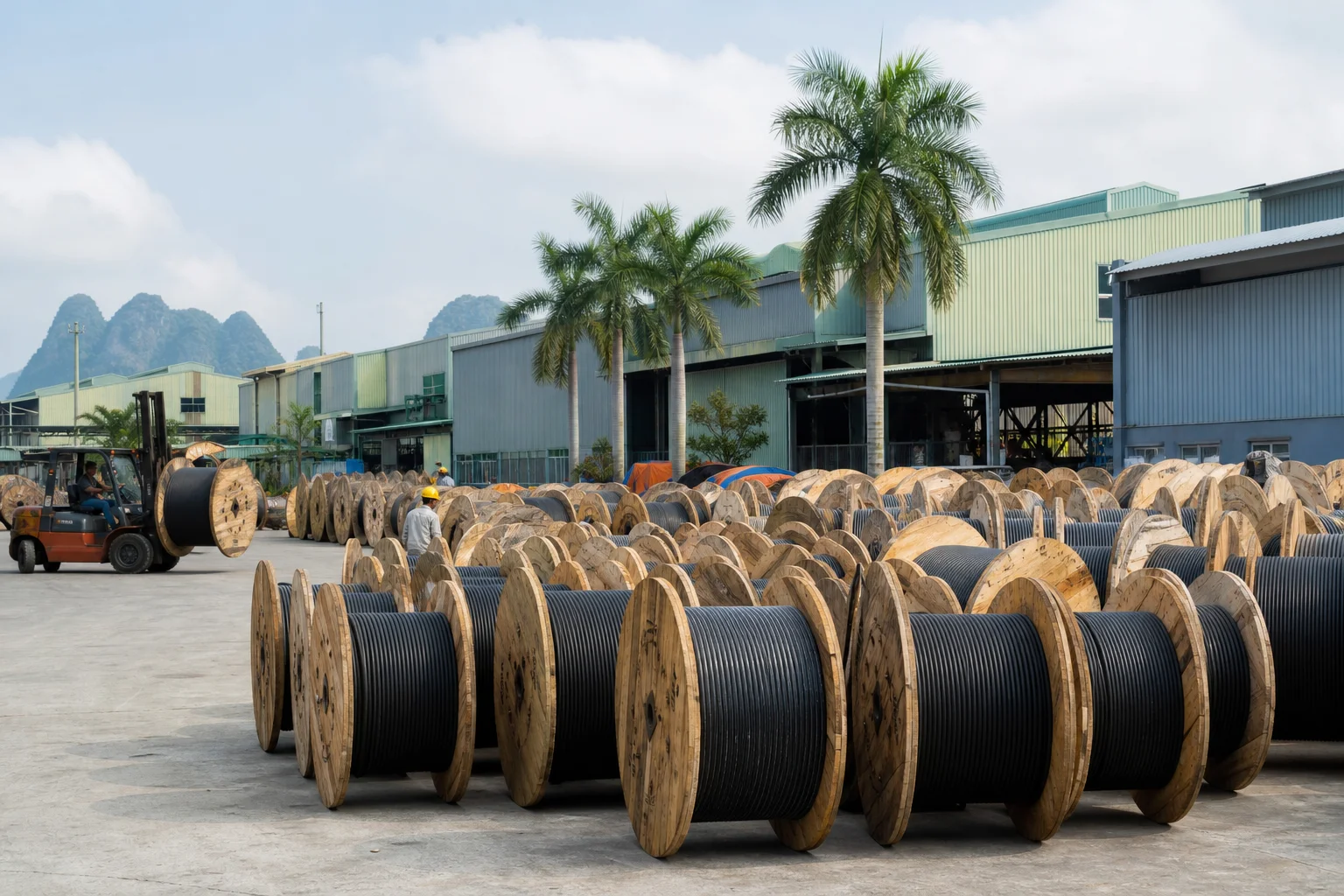
Vietnam’s cable industry grew on export orders for power cable, coaxial and Cat5e, and then moved up into Cat6 and Cat6A as foreign-owned plants relocated assembly from other parts of Asia. Cat7 is the next step, and only part of the industry has taken it. A plant that can extrude and jacket is not automatically a plant that can apply pair-level foil, hold the geometry through a braid and then verify 600 MHz performance on a shielded tester. That distinction is the whole game when you are shortlisting factories rather than buying reels from stock.
Where Cat7 Cable Factories in Vietnam Are Actually Located
The manufacturing base splits into a northern belt and a southern belt, with a smaller central cluster. The north runs from Bac Ninh and Bac Giang through the Hanoi industrial parks to Hai Phong, where deep-water container terminals make it the natural export gate. The south centres on Ho Chi Minh City and spills into Binh Duong and Dong Nai, where industrial parks host a dense mix of Taiwanese, Korean, Japanese and Chinese-owned cable and electronics plants. Da Nang and the central provinces host smaller operations, often serving local construction demand with limited export programmes.
Ownership matters more than geography. A foreign-owned plant inside a northern industrial park usually has a parent company’s process documentation, imported screening equipment and English-language test reports, which shortens qualification. A domestic Vietnamese plant may have lower overheads and more flexible scheduling but thinner Class F records. Neither is automatically better; the question is which one can produce the document set your buyer needs. Buyers comparing countries often look at Cat7 OEM in China at the same time, because the two sourcing routes compete on exactly these terms.
The Five Factory Clusters Compared
Ranges below are indicative for screened network cable and move with copper, jacket compound, construction and volume. No single figure should be treated as a quote.
| Cluster | Typical factory profile | MOQ range | Lead time range | Certification and test focus |
|---|---|---|---|---|
| Bac Ninh and Bac Giang | Foreign-owned electronics and cable plants, export programmes, strong process documentation | 3,000-10,000 m; OEM print 5-10 km | 20-30 days production | ISO 9001 and 14001; English test reports; 600 MHz sweep on request |
| Hai Phong and port industrial zones | Volume extrusion and jacketing, container-ready logistics, OEM packaging | 5-10 km | 20-30 days plus 25-40 days sea freight | ISO 9001; Fluke DSX reports; UL or ETL print where ordered |
| Hanoi industrial parks | Mixed domestic and joint-venture plants, patch cord assembly, smaller runs | 1,000-5,000 m; 100-500 m stock on some SKUs | 15-25 days | ISO 9001; per-lot channel tests for assemblies |
| Ho Chi Minh City, Binh Duong, Dong Nai | Dense supplier base, flexible scheduling, strong in Cat6A and assemblies | 1,000-5,000 m; custom jacket 3,000-10,000 m | 15-30 days | ISO 9001; CPR and RoHS declarations on request |
| Da Nang and central provinces | Smaller domestic plants, local construction focus, limited export paperwork | 500-3,000 m | 10-25 days | Basic ISO 9001; Class F lab evidence often outsourced |
| China baseline – Shenzhen and Dongguan | Deep screened-pair capacity, Class F and Class FA in routine production | 5-10 km OEM; 100-500 m stock reels | 15-30 days plus 25-40 days sea freight | Fluke reports routine; CPR and CE data available |
MOQ, Lead Time and the Port Question
Vietnamese factories generally quote production runs in the 1,000-5,000 m range for standard networking cable and 3,000-10,000 m once the jacket compound or print changes. OEM packaging under your own label typically starts at 5-10 km. Stocked reels exist, but mostly in Cat6 and Cat6A; holding Cat7 in stock is unusual because the demand is too concentrated on specific projects. Plan on production, not on stock, and plan the production slot around the factory’s export calendar rather than your commissioning date.
Lead time splits cleanly. Production of 15-30 days is normal, then 25-40 days of sea freight to the US or 30-45 days to Europe, plus a week of booking and drayage at each end. Hai Phong and Cat Lai near Ho Chi Minh City both offer direct sailings to Europe and the US, which is one reason the northern port cluster attracts export-oriented plants. Buyers who model total landed cost rather than FOB price usually find the port choice worth more than a small difference in the unit rate; our note on Cat7 lead times from Asia sets out the full calendar.
Can Vietnamese Factories Produce True Class F Cable?
Some can, and the number is growing, but Class F is not a default capability. True Cat7 requires pair-level foil screening, an overall braid, tight pair geometry held through the jacketing line, and a connector interface that supports bonding. A factory building unshielded Cat6A needs new equipment and new process control to move up, not just a new print legend on the jacket. Ask directly how many S/FTP lines are installed, when they were commissioned, and which customers the Class F output was built for.
Then ask for the evidence in a form you can check. A Fluke DSX-8000 permanent-link report at 600 MHz on a 90 m link, with the lot number and test date, is the minimum. A datasheet claiming Class F with a 500 MHz sweep is a Cat6A document. If the factory cannot produce a Class F report at all, it can still be a good supplier of Cat6A and a poor one for Cat7; treat the two product lines as separate qualifications rather than one factory score.
How to Audit a Cat7 Factory in Vietnam
- Identify the exact legal entity and the industrial park address, and confirm which entity will appear on the invoice and the bill of lading.
- Ask who owns the plant: parent company, joint venture or domestic group. Ownership predicts the documentation quality more reliably than plant size.
- Verify ISO 9001 and ISO 14001 certificates with the issuing body and check that the scope covers screened network cable, not only power cable.
- Request the S/FTP line count and a video or live walkthrough of the foil applicator, braiding machine and jacketing line running your construction.
- Demand a 600 MHz permanent-link and channel report with a lot number, then have a sample reel retested by a laboratory you appoint.
- Check copper weight and DC resistance on a 100 m sample against the datasheet, and confirm the AWG actually shipped.
- Review the jacket print, CPR or UL marking where relevant, RoHS and REACH declarations, and reel label traceability to the lot.
- Book pre-shipment inspection with a third party before the container is sealed, and hold the balance payment until the report is in hand.
Our checklist on verifying a Cat7 manufacturer expands each of these points into the questions worth asking on a live factory call.
Three Buyer Scenarios
- US distributor adding a Cat7 SKU, 8 km initial order. Use a foreign-owned plant in Bac Ninh or Hai Phong with existing export documentation, order OEM packaging at the 5-10 km threshold, and accept 20-30 days production plus 25-40 days sea freight. Confirm the Class F report before the deposit, not after.
- EU contractor needing 2,500 m for one building, ten-week window. A Binh Duong plant with 1,000-5,000 m flexibility fits better than a volume exporter, but the schedule only works if the reel ships within three weeks. Verify the production slot in writing, because a flexible MOQ usually means a later start.
- Regional wholesaler comparing Vietnam with China, 20 km annual. Vietnam wins on tariff exposure and labour cost, China wins on screened-pair depth and Class FA availability. Split the programme: Cat6A in Vietnam, Class F and Class FA in China, and audit both plants against the same test protocol.
What the OEM Paperwork Should Contain
For a private-label order, the document set is as important as the reel. Ask for artwork proofs with your brand, packaging specifications, a declaration that the factory will not sell the same print to another buyer, and test reports issued against the delivered lot rather than a generic type test from two years ago. Where a European buyer needs CPR classification, confirm which notified body or laboratory produced the data and whether the classification covers your construction and jacket compound, because a Dca result on a different construction does not transfer to yours.
FAQ
1. Are there real Cat7 cable factories in Vietnam?
Yes, mainly foreign-owned plants in the northern industrial belt and around Ho Chi Minh City. Most Vietnamese network cable output is Cat5e, Cat6 and Cat6A, so Class F capacity exists but is limited. Confirm the number of S/FTP lines and request a 600 MHz test report before qualifying a plant.
2. What MOQ should I expect from a Vietnamese Cat7 factory?
Standard production runs usually start at 1,000-5,000 m, and 3,000-10,000 m once the jacket compound or print changes. OEM packaging under your own label typically begins at 5-10 km. Stocked Cat7 reels are uncommon, so plan for a production slot rather than ex-stock delivery.
3. How long is production and shipping from Vietnam?
Production typically takes 15-30 days. Sea freight then adds 25-40 days to the US or 30-45 days to Europe, plus booking and inland handling at both ends. Hai Phong and the Ho Chi Minh City terminals offer direct sailings, which usually shortens the total calendar versus transshipment.
4. Is Vietnam cheaper than China for Cat7 cable?
Labour cost is lower, but screened-pair capacity is thinner, so the unit price gap is smaller than buyers expect and quality risk is higher. China still leads on Class F and Class FA depth. Compare total landed cost including freight, duty and re-testing, not the FOB figure alone.
5. Which Vietnamese cluster is best for a first order?
Bac Ninh, Bac Giang and Hai Phong suit export programmes because the plants already handle foreign documentation and container logistics. Binh Duong and Dong Nai suit smaller or more flexible runs. For a first order, choose the cluster whose existing customers already buy screened cable.