
600V Ethernet Cable: The Rating Explained
Quick answer / TL;DR: Short answer: 600V is an insulation rating for industrial environments where data cable runs in trays or panels alongside power. It does not change the data performance or the category. Specify category, 600V insulation, shield type, jacket material and the connector or termination, and confirm the local code requirement for separation from power conductors.
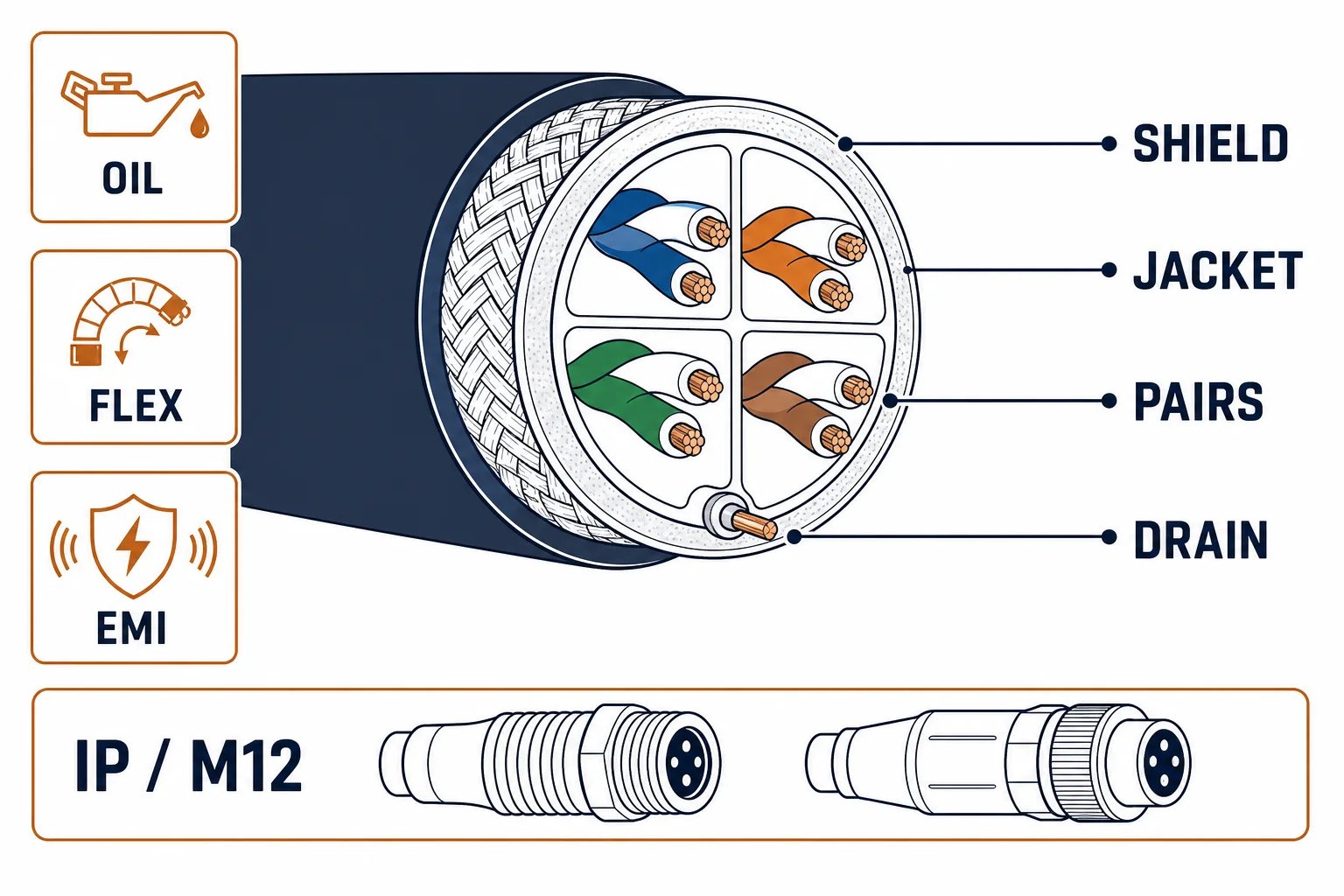
A 600V ethernet cable is a data cable whose insulation is rated for 600 volts, which matters in industrial panels and trays where data and power cables share a space and the code asks for a voltage rating on every conductor. The rating is about insulation and separation, not about the data signal.
This is the industrial rating guide: what 600V means in practice, where the requirement comes from, and the specification lines that keep a plant installation compliant.
What the Rating Actually Covers
| The element | The meaning | The note |
|---|---|---|
| Insulation | Rated for 600 V between conductors and to ground | A safety and code attribute |
| Data performance | Unchanged by the rating | Category still governs data |
| Jacket | Often oil and abrasion resistant | Plant conditions, not voltage |
| Application | Trays and panels shared with power | The reason the rating is asked for |
The rating is a safety attribute. A 600V Cat6 cable and an ordinary Cat6 cable carry the same data.
Why Plants Ask for It
- Shared trays: data and power in the same containment
- Panel wiring: conductors near mains terminals
- Code requirements: separation or rating, depending on the jurisdiction
- Maintenance standardisation: one cable type for the whole plant
The requirement usually originates with an inspector or a plant standard rather than with the network designer.
The Specification Lines
| The line | The example |
|---|---|
| Category | Cat6 |
| Insulation rating | 600 V |
| Shield | F/UTP for drive areas |
| Jacket | Oil-resistant, suitable for tray |
| Termination | Industrial RJ45 or M12 |
Standards and Verification
| The reference | The relevance |
|---|---|
| Local electrical code | Separation and rating requirements |
| UL 444 / cable standards | Construction and rating |
| IEC 61156 | Cable test methods |
| Field test | Channel test after installation |
Per-market code requirements are not provided in the knowledge base. Confirm the local rule for data and power separation; the rating itself is a property of the cable.
Real-World Applications
The shared tray
A packaging line with data and motor cables in one tray: 600V-rated shielded Cat6 throughout, separated by a divider where the tray allows – the inspector's requirement met by cable and layout together.
The panel run
An Ethernet link inside a control panel: 600V-rated cable from the panel entry to the switch, routed away from terminals – the rating covering the shared enclosure.
The over-specified office
A 600V cable specified for an office ceiling: no code reason and a higher price. Standard plenum-rated cable used instead – the rating matched to the environment.
Related reading: The industrial cable decisions in full? Read the industrial ethernet guide — blogs/news/industrial-ethernet-cable
Related reading: Why the shield matters near drives? Read the shielded cable guide — blogs/news/what-is-shielded-cable
Frequently Asked Questions
What does 600V mean on an ethernet cable?
The insulation is rated for 600 volts – a safety attribute for industrial trays and panels sharing space with power.
Does 600V cable carry data faster?
No – data performance is set by the category, not the voltage rating.
When do I need a 600V rating?
When local code or a plant standard requires it, typically where data and power share containment or a panel.
Can I use ordinary Cat6 in a plant?
Only where separation or code permits it. In shared trays, the rated cable is usually the simpler route.
Sourcing cables for a project, a store, or a private-label line? Contact our B2B sales team for specifications, certification evidence, and volume terms – FOB and CIF options available. Request a quote or sample.