
50 Ft Cat7 Cable: Practical Length
Quick answer / TL;DR: Short answer: a 50 ft Cat7 cable is S/FTP with pair foils plus a braid, usually RJ45-terminated. At 15 m it performs at least as well as Cat6a for any rate a 15 m run will carry, but the RJ45 termination means the channel cannot claim full Class F. For 10G, Cat6a is the certified choice; buy Cat7 only where the whole channel uses the matching interface.
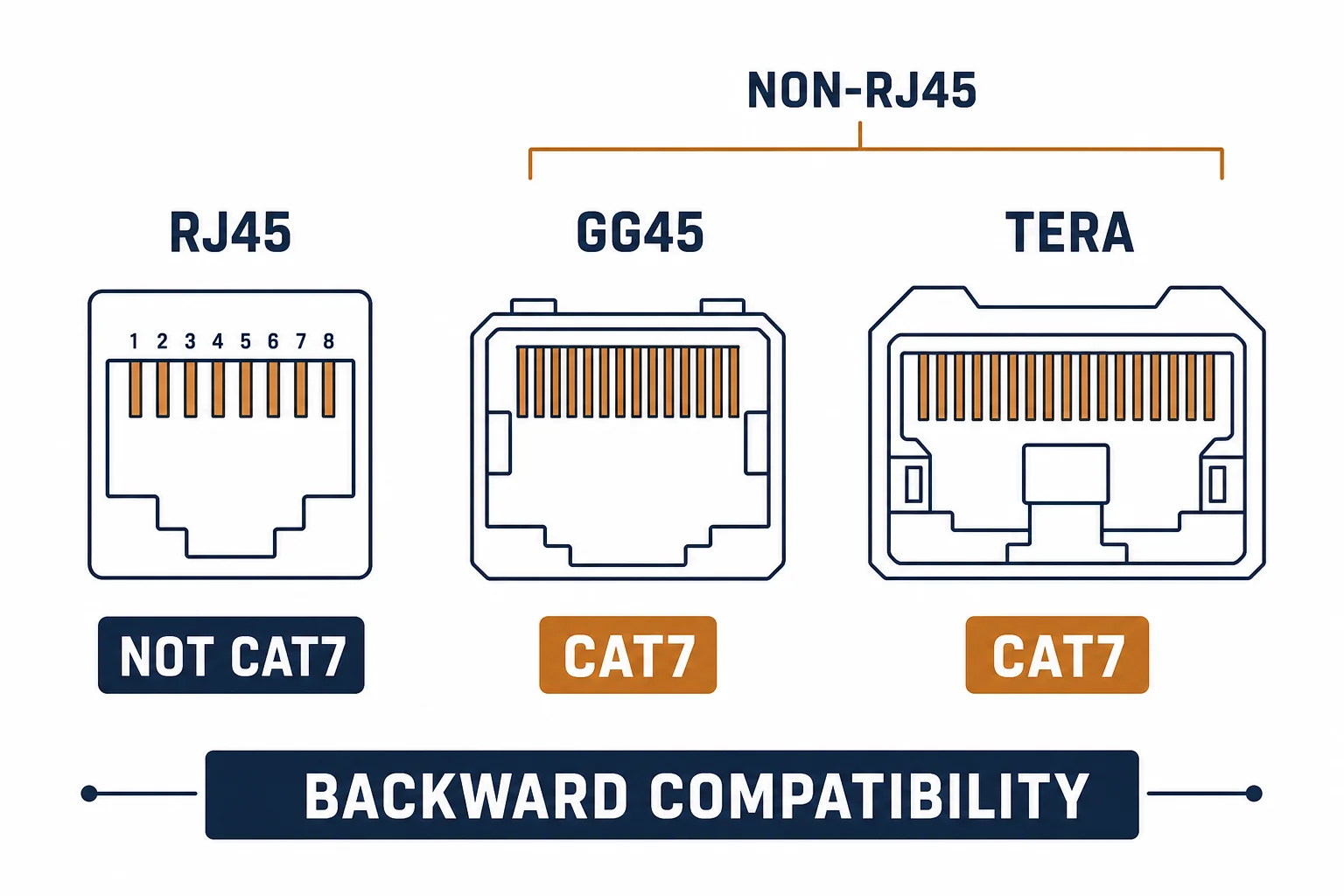
A 50 ft Cat7 cable is about 15 metres of S/FTP cable terminated – almost always – in RJ45 plugs. That combination is where the category's reputation gets complicated: the cable is rated to 600 MHz, and the familiar plug is not the interface the standard specifies.
This is the 50 ft Cat7 guide: what the construction delivers at this length, the connector caveat, and the honest comparison with Cat6a for the same run.
What the Construction Delivers
| The element | Cat7 | The effect |
|---|---|---|
| Band | 600 MHz (Class F) | Headroom above 10G |
| Shield | S/FTP | Best immunity in the family |
| Connector | GG45 or TERA | Rarely what is supplied |
| Diameter | Large | Stiff, harder to route |
The cable is genuinely the best screened twisted pair available; the limitation arrives at the plug.
The Connector Caveat
- RJ45-terminated Cat7 cannot claim full Class F
- The cable still performs well – it is the channel claim that weakens
- At 15 m, Cat6a delivers the same practical result
- Buy Cat7 only for a whole-channel Class F design
The caveat is about certification, not about whether the cable works: a 15 m run will carry 10G on either category.
Cat7 Against Cat6a at This Length
| The dimension | Cat7 50 ft | Cat6a 50 ft |
|---|---|---|
| Rate at 15 m | 10G comfortably | 10G comfortably |
| Channel claim | Limited by RJ45 | Class EA certified |
| Handling | Stiffer, larger | Easier |
| Price | Higher | Lower |
At this length the comparison is decided by handling and certification rather than by bandwidth.
Standards and Verification
| The reference | The relevance |
|---|---|
| ISO/IEC 11801-1 | Class F and connector requirements |
| IEC 60603-7-7 | GG45 interface |
| TIA-568.2-D | Cat6a as the RJ45 ceiling |
| Field test | Channel test at the connector's class |
Per-SKU connector interfaces are not provided in the knowledge base. The class definitions are standard; check what the plugs actually are before accepting a Class F claim.
Practical Notes
S/FTP cable is stiff enough that a 15 m run around furniture needs more clips than Cat6a and will not tolerate a tight bend at a skirting corner. Plan the route before buying the length.
Real-World Applications
The studio run
A 12 m run in a room with lighting dimmers: Cat7 S/FTP with RJ45 plugs, the channel tested as Cat6a – the screening delivering the practical benefit even without the class claim.
The certified design
A broadcast installation specifying Class F: GG45 jacks and panels throughout, Cat7 cords with matching plugs – the only configuration where the class was real.
The stiff-cable problem
A 15 m Cat7 cord routed around a desk leg: a forced bend at the skirting and a link that dropped under movement. Re-routed with clips – the bend radius was the issue, not the cable.
Related reading: The Cat7 connector problem — blogs/news/cat7-connector-problem
Related reading: The category that is certified with RJ45 — blogs/news/cat6a-ethernet-cable-guide
Frequently Asked Questions
Is a 50 ft Cat7 cable worth it?
For 10G at 15 m, Cat6a is certified and easier to handle. Cat7 helps in high-interference rooms.
Does Cat7 need special connectors?
The standard specifies GG45 or TERA; RJ45-terminated products cannot claim full Class F.
Will Cat7 make my network faster?
No – it raises the ceiling. The rate is set by the devices and the plan.
Is Cat7 harder to install?
Yes: larger diameter, stiffer, and a bigger bend radius than Cat6a.
Sourcing cables for a project, a store, or a private-label line? Contact our B2B sales team for specifications, certification evidence, and volume terms – FOB and CIF options available. Request a quote or sample.