
50 Foot Ethernet Cable: The Working Length
Quick answer / TL;DR: Short answer: at 50 feet (about 15 m) any working category delivers the same real-world performance – buy Cat6 for future headroom or Cat5e to save. Confirm the cable is stranded patch cord (not solid riser cable), check the jacket rating if the run passes through a wall or ceiling void, and keep the coil out of walkways.
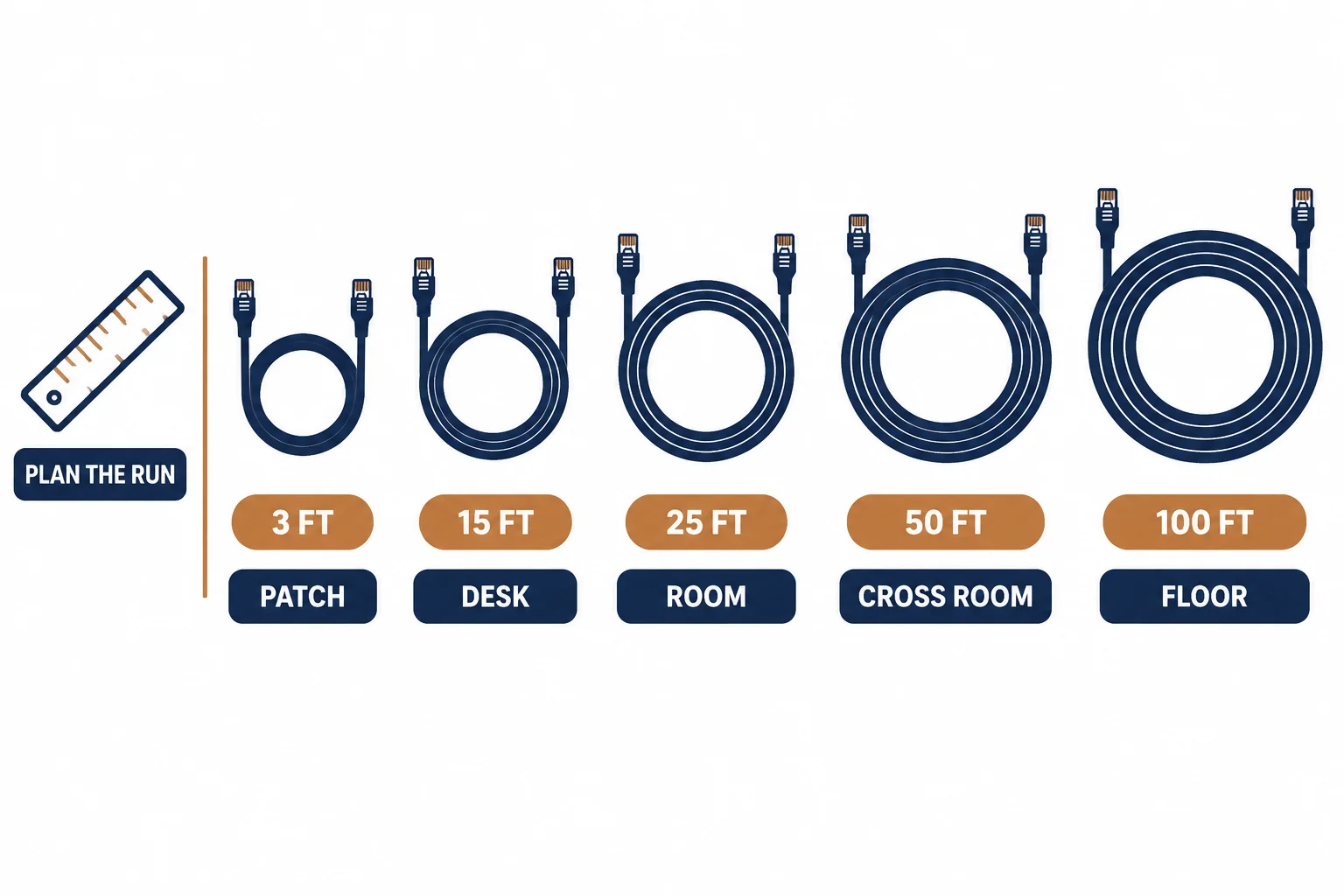
Fifty feet is the length that covers most cross-room runs: long enough to reach from a router in one corner to a desk, TV or access point in another, short enough to stay far inside the 100-metre channel limit. It is also the length where buyers most often over-specify the category and under-specify the jacket.
This is the length guide: which category to buy at 50 ft, when the run wants a different form, and the three checks before checkout.
What 50 Feet Buys
| The category | The practical result at 50 ft | The note |
|---|---|---|
| Cat5e | Gigabit | The cheapest that works |
| Cat6 | Gigabit, 2.5G/5G ready | The usual choice |
| Cat6a | Gigabit to 10G | Stiffer, harder to route |
At this length the categories converge in real performance; the differences show in handling, future headroom and price.
The Form Question
- Patch cord: stranded conductor with moulded plugs – the right form for a 50 ft run between devices
- Solid cable: intended for permanent runs and punch-down termination – a 50 ft solid lead is a compromise
- Flat: only where the route demands a low profile
- Shielded: only where interference or the specification requires it
The form matters more than the category at this length: a solid 50 ft lead flexed at both ends will fail at the plug long before the band does.
The Three Checks
| The check | The question |
|---|---|
| Jacket rating | Does the run pass a wall, ceiling void or riser? |
| Plugs | Moulded strain relief, not field-crimped? |
| Route | Will the coil or excess length sit in a walkway? |
Standards and Verification
| The reference | The relevance |
|---|---|
| TIA-568.2-D | Cord and channel requirements |
| IEEE 802.3ab | Gigabit over twisted pair |
| Field test | Channel test if the run is permanent |
Per-SKU cord construction is not provided in the knowledge base. The 100 m channel limit is standard; a 50 ft cord plus patch leads stays well inside it.
Real-World Applications
The living room to the study
A router in the living room, a desk one room away: a 50 ft Cat6 patch cord clipped along the skirting – gigabit at both ends.
The temporary office
A short-term lease with no cabling: 50 ft cords to each desk, labelled and tidied – removed intact at the end of the term.
The 50 ft solid mistake
A solid-conductor 50 ft lead used at a laptop that moves daily: continuity failing within months. Replaced with a stranded cord – the form corrected.
Related reading: How the shorter lengths work? Read the short ethernet cable guide — blogs/news/short-ethernet-cable
Related reading: The conductor form behind the failure? Read solid versus stranded — blogs/news/solid-vs-stranded-cat6
Frequently Asked Questions
What category should a 50 foot ethernet cable be?
Cat6 is the usual choice for headroom; Cat5e is fine for plain gigabit. At 50 ft all categories perform similarly in practice.
Is 50 feet too long for ethernet?
No – the channel limit is 100 metres (about 328 ft). Fifty feet is well inside it.
Should a 50 ft cable be solid or stranded?
Stranded, as a patch cord, if it connects devices and may be moved. Solid cable belongs in permanent runs.
Can I run a 50 ft cable through a wall?
Only with the right jacket rating for the space – CMR in a riser, CMP in a plenum. A patch cord is not rated for in-wall use.
Sourcing cables for a project, a store, or a private-label line? Contact our B2B sales team for specifications, certification evidence, and volume terms – FOB and CIF options available. Request a quote or sample.