
40 Ft Ethernet Cable: Across the Floor
Quick answer / TL;DR: Short answer: a 40 ft (12 m) cable works in any category with about 88 m of channel margin. Use a stranded cord if the route is exposed and temporary; install permanent cable to outlets if it passes through walls, ceilings or under fixed flooring. Route along skirting, protect door crossings, and keep the cable out of walkways.
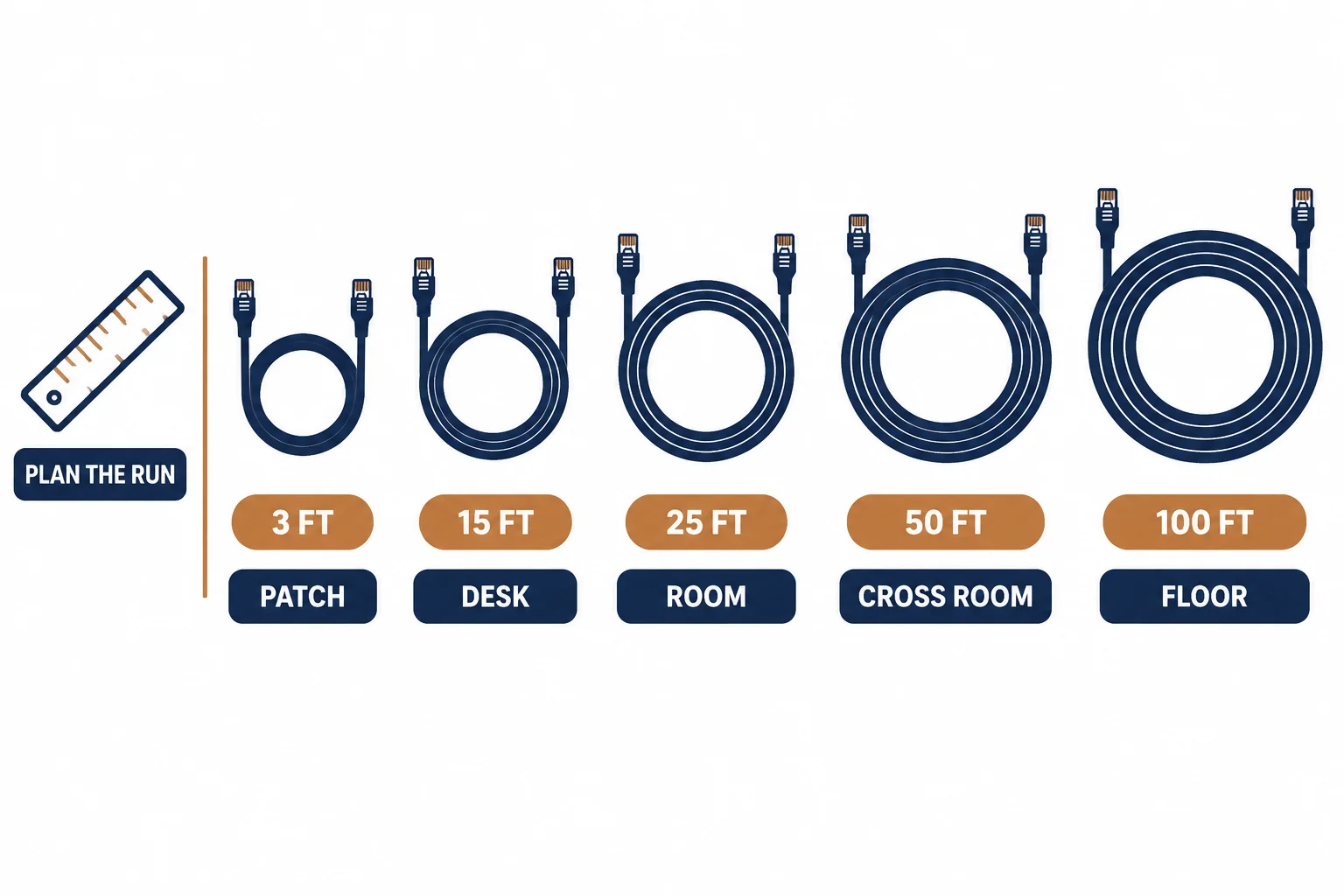
Forty feet covers most single-floor crossings: a router at one end of a flat, a desk or a media unit at the other. At 12 metres the cable is electrically trivial and mechanically significant – it will cross a doorway, pass behind furniture, and be walked near.
This is the 40 ft guide: the margin, the cord-versus-permanent decision, and the routing details that keep a long indoor run from becoming a hazard.
The Margin
| The element | The figure | The note |
|---|---|---|
| Cable | 12 m | About a tenth of the channel |
| Remaining | 88 m | Whatever category is chosen |
| Category effect | None at this length | Rate decides |
| Joints | None | No need |
The margin means the decisions are practical: where the cable goes and what it is allowed to cross.
Cord or Permanent
- Cord: surface routes, rentals, temporary layouts
- Permanent: walls, ceilings, under fixed flooring
- Hybrid: outlet near the destination plus a short cord
- Never: a cord stapled along a skirting or run through a door frame gap permanently
The distinction is about the building, not the length: a cord is removable, building cable is not.
Routing Details
| The detail | The practice |
|---|---|
| Skirting | Clip or trunking, not loose |
| Doorway | Flat cable with a protector, or route around |
| Furniture | Avoid pinch points and chair castors |
| Surplus | Coil and fix, do not leave loops |
Standards and Verification
| The reference | The relevance |
|---|---|
| TIA-568.2-D | Cord and channel requirements |
| IEEE 802.3ab | Gigabit over twisted pair |
| Local code | In-wall and fire-rating rules |
Per-SKU construction is not provided in the knowledge base. The 100 m channel limit is standard; 12 m is well inside it.
Real-World Applications
The flat crossing
A router in the hall, a desk in the far bedroom: a 40 ft Cat6 cord along the skirting and around one door frame – no drilling, no trip hazard.
The castor failure
A cord left loose under an office chair: the jacket cut by a castor and a pair shorted. Replaced and clipped to the desk leg – the mechanical cause removed.
The permanent conversion
The same run made permanent when the lease was extended: two outlets and two short cords replaced one long one – the infrastructure catching up with the requirement.
Related reading: The next length down? Read the 30 foot guide — blogs/news/30-foot-ethernet-cable
Related reading: The longer room-to-room step? Read the 50 foot guide — blogs/news/50-foot-ethernet-cable
Frequently Asked Questions
Is 40 ft too long for ethernet?
No – about 12 m against a 100 m limit. The margin is large.
Cat5e or Cat6 at 40 ft?
Either; Cat6 for 2.5G headroom. Performance at this length is otherwise identical.
Can a 40 ft cord pass through a doorway?
Only with a flat cable and a protector. A round cable will be pinched.
Should I install an outlet instead?
Yes if the route is permanent – outlets make the run testable and replaceable.
Sourcing cables for a project, a store, or a private-label line? Contact our B2B sales team for specifications, certification evidence, and volume terms – FOB and CIF options available. Request a quote or sample.