
25 Ft HDMI Cable: The Passive Edge
Quick answer / TL;DR: Short answer: a certified 25 ft Premium High Speed cable can carry 4K 60 Hz, but reliability depends on conductor gauge, shielding and route. If the run is near power, in a hot void, or needs 4K at high refresh, buy active or fiber instead. Test at the target mode before installation – this is the length where assumptions cost the most.
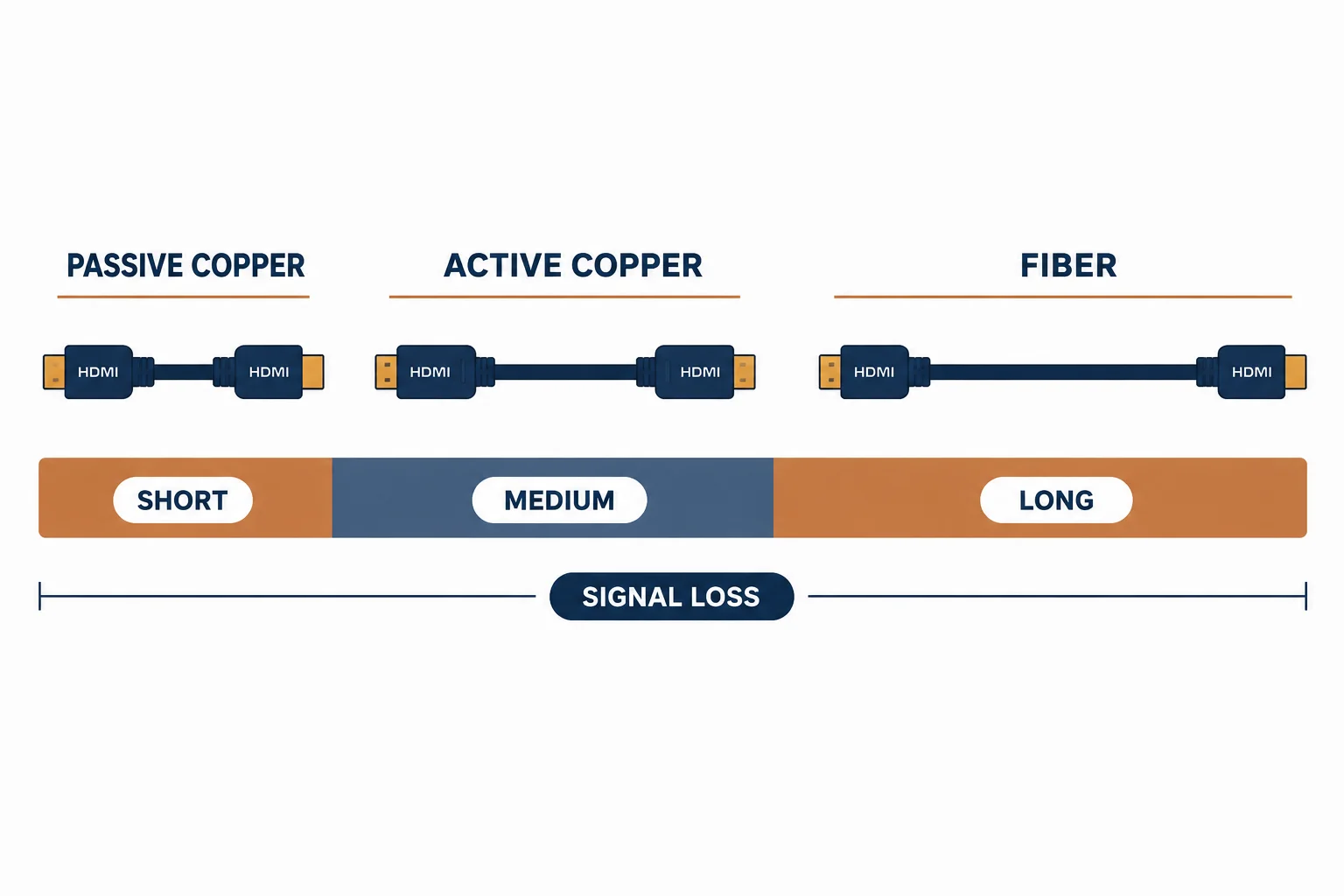
A 25 ft HDMI cable is about 7.6 metres – the length where passive copper still works at 4K in good conditions and fails in mediocre ones. It is the boundary product of the category: buying it is a bet on the cable's quality and the route.
This is the 25 ft guide: what the length can realistically carry, the signs that passive is the wrong choice, and the active alternatives that remove the uncertainty.
What It Can Carry
| The mode | The likelihood | The note |
|---|---|---|
| 1080p | Good | Most cables manage |
| 4K 60 Hz | Conditional | Certified cable, clean route |
| 4K 120 Hz | Poor | Active or fiber |
| 8K | No | Fiber |
The conditional row is the honest answer at this length: it works, sometimes, depending on everything else.
When to Stop Buying Passive
- The route runs beside mains for more than a metre
- The cable passes through a hot ceiling void
- The mode is 4K at high refresh or 8K
- The installation is permanent and hard to change
Any one of these tips the decision toward active or fiber, which cost more and remove the doubt.
The Alternatives
| The option | The reach | The cost |
|---|---|---|
| Active copper | Medium | Moderate |
| Fiber HDMI | Long | Higher |
| Extender pair | Long, over Cat6 | Moderate plus power |
The alternatives are all powered or optical: at 7.6 m, the physics starts to require help.
Standards and Verification
| The reference | The relevance |
|---|---|
| HDMI specification | Cable categories |
| HDMI certification | Premium and Ultra programmes |
| Field test | Mode and stability over time |
Per-SKU certification is not provided in the knowledge base. The categories are standard; test at the target mode and re-test after installation.
Practical Notes
A 25 ft cable that works on the bench can fail in a wall: the difference is temperature, bend radius and interference. Test after installation, in place, at the real mode – the bench result proves only that the cable is not dead.
Real-World Applications
The conservative choice
A 7 m run to a wall-mounted screen: an active cable bought instead of passive – one purchase, no diagnosis, stable at 4K.
The bench success
A passive 25 ft cable that worked perfectly before installation: sparkle once it was inside a warm ceiling void. Replaced with fiber – the environment, not the cable, had changed the result.
The 1080p system
An older 1080p projector at 7 m: a passive cable adequate – the length was not the issue at that bandwidth, and the money went elsewhere.
Related reading: Active cable behaviour — blogs/news/active-hdmi-cable
Related reading: Fiber for the long run — blogs/news/fiber-optic-hdmi-cable
Frequently Asked Questions
Will a 25 ft cable do 4K?
Often, with a certified cable and a clean route – but it is at the edge of passive reliability.
When should I buy active?
For high refresh, noisy routes, hot voids or permanent installs.
What is the difference in cost?
Active and fiber cables cost more, and remove the uncertainty.
Why did it work on the bench but not in the wall?
Temperature, bend radius and interference differ once installed.
Sourcing cables for a project, a store, or a private-label line? Contact our B2B sales team for specifications, certification evidence, and volume terms – FOB and CIF options available. Request a quote or sample.