
22 AWG Ethernet Cable: Heavier Copper
Quick answer / TL;DR: Short answer: 22 AWG suits long PoE runs and installations where voltage drop is the constraint – cameras, access points and industrial devices at distance. It is not necessary for ordinary office links, where 23 AWG is cheaper and easier to install. Check that connectors, jacks and conduit accept the larger diameter before ordering.
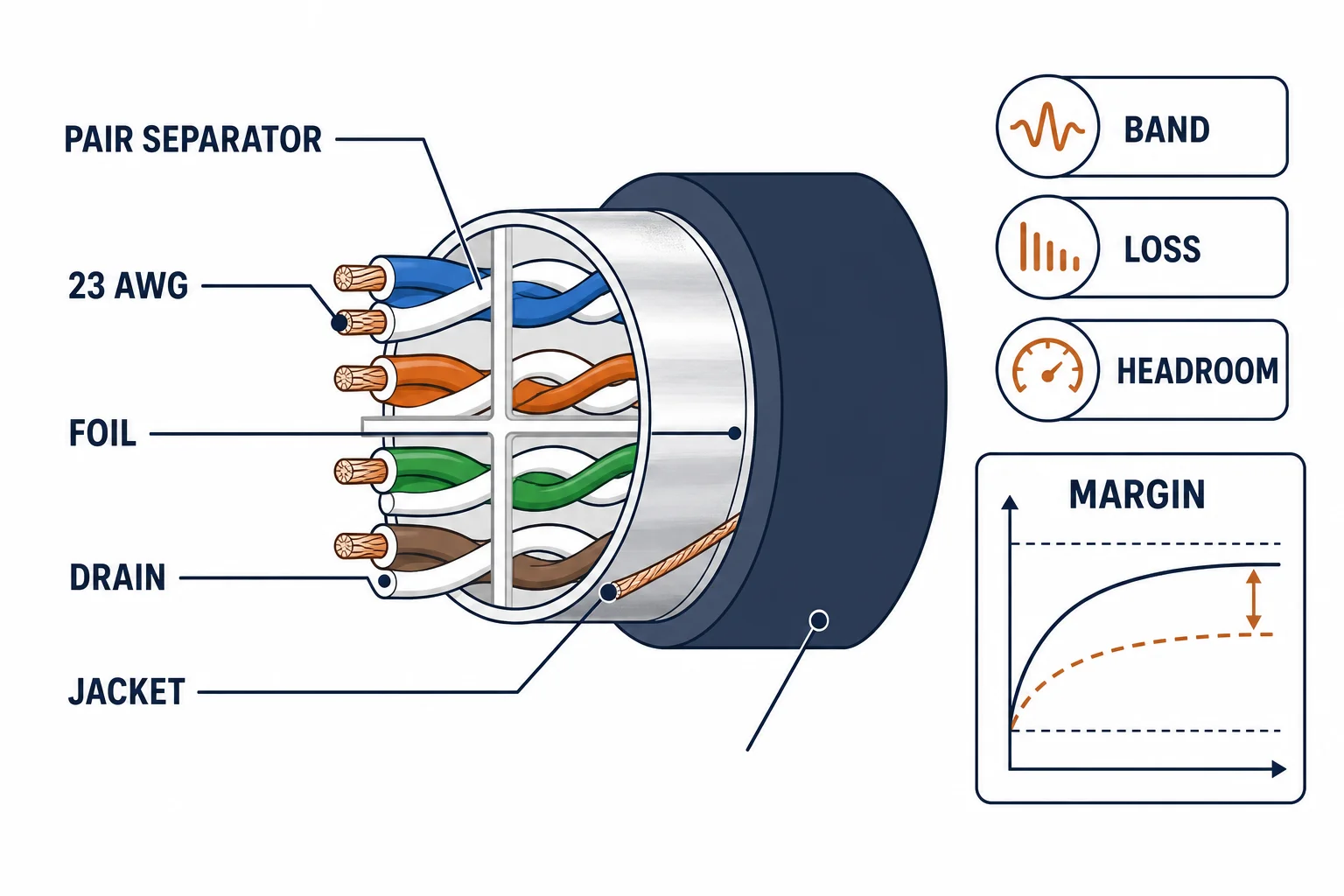
22 AWG ethernet cable uses heavier conductors than the usual 23 or 24 AWG: lower resistance, less attenuation, and less voltage drop over a powered run. It is also thicker and stiffer, which is why it is a specialist choice rather than a default.
This is the heavy-gauge guide: what the extra copper buys, where it is worth the handling penalty, and the installations that justify it.
What the Extra Copper Buys
| The property | 22 AWG | 23 AWG |
|---|---|---|
| Resistance per metre | Lower | Higher |
| Attenuation | Lower | Higher |
| PoE voltage drop | Less | More |
| Diameter | Larger | Smaller |
The gain is in the resistance, which is exactly the number that limits a long powered run.
Where It Pays
- PoE devices at 80-100 m on the edge of their class
- Industrial runs where the load is constant
- Applications that cannot tolerate a reboot at night
- Long runs that must stay inside one channel with cords included
The justification is a device that fails on a marginal supply, not a preference for heavier cable.
The Penalties
| The penalty | The effect |
|---|---|
| Diameter | Fewer cables per conduit |
| Stiffness | Larger bend radius, harder pulls |
| Termination | Some jacks are rated for 23-24 AWG only |
| Cost | More copper per metre |
The termination limit is the one that catches people: a jack rated for 24 AWG may not accept a 22 AWG conductor reliably.
Standards and Verification
| The reference | The relevance |
|---|---|
| TIA-568.2-D | Category requirements |
| IEC 61156 | Conductor definitions |
| IEEE 802.3at/bt | PoE classes and power |
| Field test | Channel test plus a voltage measurement |
Per-SKU connector compatibility is not provided in the knowledge base. The gauge advantage is standard; confirm the jack and plug range before ordering a reel.
Practical Notes
Where the device is genuinely at the edge of its PoE class, the correct answer is often a shorter run or a local power supply rather than heavier cable. Heavier copper buys margin; it does not buy unlimited distance.
Real-World Applications
The perimeter camera
A camera 95 m from the switch drawing close to its class limit: 22 AWG used for the run, the delivered voltage measured under load – no more night reboots.
The conduit that would not fill
22 AWG specified for twelve runs in a 25 mm conduit: the fill exceeded the limit after four. The remaining runs planned on 23 AWG – the gauge benefit limited by geometry.
The jack mismatch
22 AWG landed on jacks rated for 24 AWG: two terminations failing after a month. Jacks rated for the range fitted – the incompatibility found at the termination, not the cable.
Related reading: The PoE load that drives the choice — blogs/news/cat6-poe-cable
Related reading: Why 24 AWG is often enough — blogs/news/24-awg-cat6-cable
Frequently Asked Questions
What is 22 AWG ethernet cable used for?
Long PoE runs and installations where voltage drop is the limiting factor.
Is 22 AWG better than 23 AWG?
Electrically yes, mechanically no – it is thicker, stiffer and needs compatible connectors.
Do ordinary jacks accept 22 AWG?
Many are rated 23-24 AWG only. Check before terminating.
Does it extend the 100 m limit?
No – the channel limit is unchanged. It reduces loss within the limit.
Sourcing cables for a project, a store, or a private-label line? Contact our B2B sales team for specifications, certification evidence, and volume terms – FOB and CIF options available. Request a quote or sample.