
20 Foot Ethernet Cable: The Flexible Middle
Quick answer / TL;DR: Short answer: a 20 ft (6 m) Cat6 patch cord covers most media-cabinet and desk-move runs. Category is not the constraint at this length; buy Cat6 for headroom, confirm the cord is stranded with moulded plugs, and check the route for pinch points behind furniture.
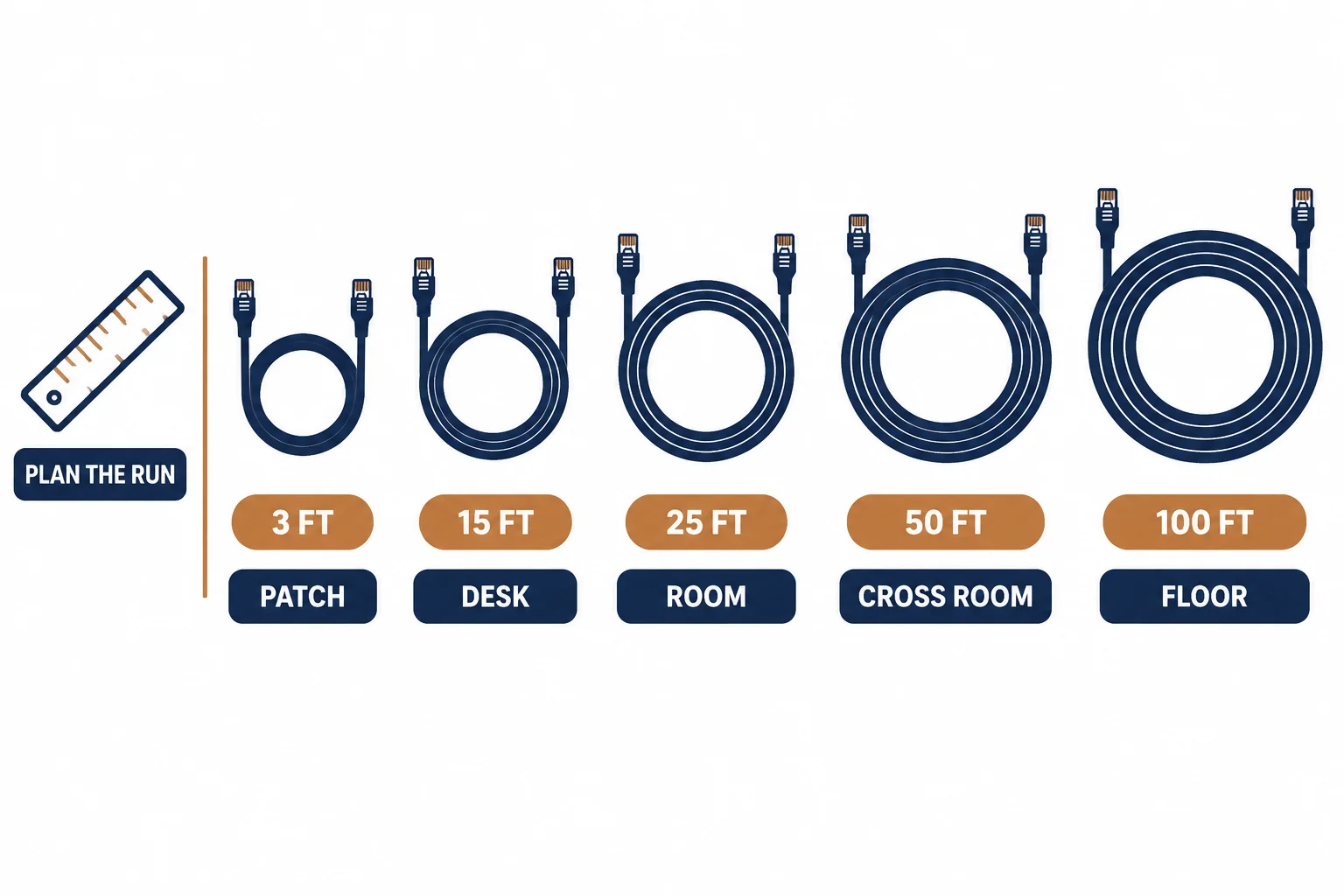
Twenty feet sits between the desk cord and the room-to-room run: long enough to reach around furniture, short enough to keep the excess manageable. It is the length that gets bought for media cabinets, wall-mounted TVs and desk moves where the planned position changed.
This is the 20 ft guide: when this length is right, the category to buy, and the routing checks that prevent a tidy-looking install from hiding a pinched cable.
Where 20 Feet Fits
| The situation | The fit | The note |
|---|---|---|
| Media cabinet to wall outlet | Good | Room for service loops |
| Wall-mounted TV to router | Good | Route behind the unit |
| Desk moved across a room | Good | Avoids a new outlet |
| Cabinet patch field | Too long | Use 0.5-1 m |
The length is a compromise between reach and tidiness, which is why it sells well for retrofits where the original plan changed.
The Category Question
- At 6 m, every category delivers gigabit with margin
- Cat6 adds headroom for 2.5G and costs little more
- Cat5e is the value choice where the requirement is fixed
- Cat6a is unnecessary unless the link is 10G
The category decision is about the future, not the length: at 6 m the copper is not the limit.
Routing Checks
| The check | The question |
|---|---|
| Pinch points | Does the route pass behind a unit that can trap the cable? |
| Heat | Is the run beside a hot amplifier or PSU? |
| Service loop | Is there slack to move the device without unplugging? |
Standards and Verification
| The reference | The relevance |
|---|---|
| TIA-568.2-D | Cord requirements |
| IEEE 802.3ab | Gigabit over twisted pair |
| Local code | In-wall rules where the route enters a wall |
Per-SKU construction is not provided in the knowledge base. The channel limit is 100 m; 20 ft is well inside it at any category.
Real-World Applications
The media wall
A TV and console in a cabinet, the outlet behind: a 20 ft Cat6 cord with a service loop – the devices movable without unplugging.
The moved desk
A desk relocated across a room with no new outlet: a 20 ft cord routed along the wall base – the move completed in an afternoon.
The hot amplifier
A cord draped over a warm amplifier: the jacket softening over months. Re-routed behind the cabinet – the heat path removed.
Related reading: The step up in length? Read the 25 foot guide — blogs/news/25-foot-ethernet-cable
Related reading: The longest practical runs? Read the 100 foot guide — blogs/news/100-foot-ethernet-cable
Frequently Asked Questions
What is a 20 ft ethernet cable used for?
Media cabinets, wall-mounted TVs and desk moves – runs long enough to route around furniture but short enough to keep tidy.
Cat6 or Cat5e at 20 ft?
Cat6 for headroom; Cat5e where gigabit is the fixed requirement. Performance at 6 m is otherwise the same.
Can a 20 ft cord be used in a wall?
No – cords are not rated for in-wall use. Use rated cable to an outlet.
How much slack should I leave?
Enough to move the device without unplugging – a service loop of a foot or so, coiled and fixed.
Sourcing cables for a project, a store, or a private-label line? Contact our B2B sales team for specifications, certification evidence, and volume terms – FOB and CIF options available. Request a quote or sample.