
16 Gauge Speaker Wire: Short Runs
Quick answer / TL;DR: Short answer: 16 AWG is fine for runs up to about 8 m at 8 ohms and moderate power. Beyond that, or with 4-ohm speakers, step to 14 or 12 AWG. It terminates easily in spring terminals and most banana plugs, which is part of why it is the default – convenience as well as cost.
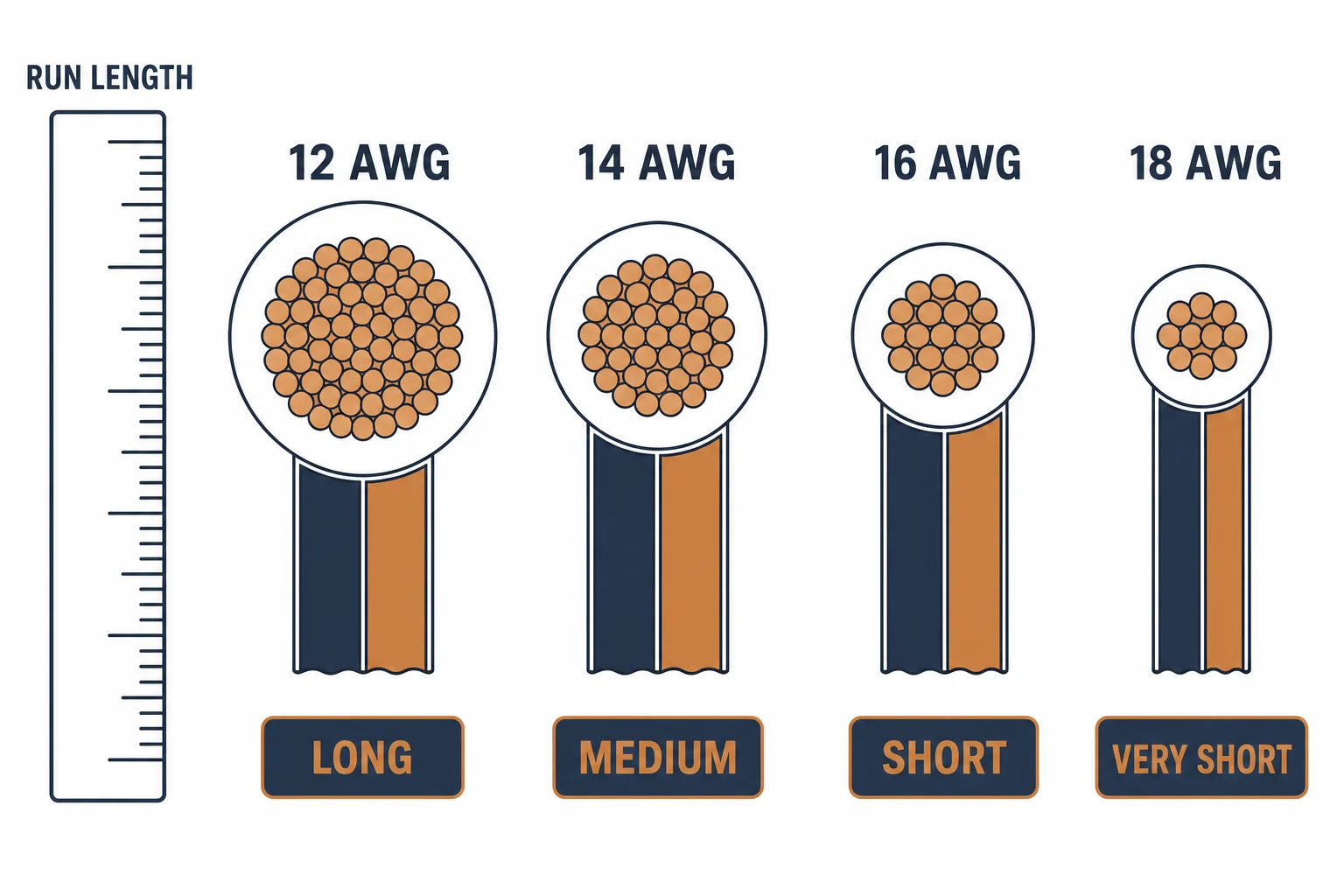
Sixteen gauge speaker wire is the default in domestic audio: thin enough to route behind skirting, thick enough for runs of a few metres at eight ohms. It becomes inadequate in exactly two situations – length and low impedance – and those are the two that produce the complaints.
This is the 16 AWG guide: where it is sufficient, the arithmetic that decides, and the termination that suits a thinner conductor.
Where 16 AWG Is Sufficient
| The run | The load | The verdict |
|---|---|---|
| Up to 8 m | 8 ohm | Good |
| 8-15 m | 8 ohm | Marginal |
| Any length | 4 ohm | Step up |
| High power | Any | Step up |
The table is short because the rule is: short runs at eight ohms, otherwise buy heavier wire.
The Arithmetic
- Resistance rises with length and falls with gauge
- Loss appears as reduced damping, not as obvious distortion
- Low-impedance speakers draw more current for the same power
- The audible symptom is loose bass at high level
The symptom is subtle, which is why thin wire survives in installations where it should not.
Termination
| The terminal | The fit |
|---|---|
| Spring terminal | Good, up to 16 AWG |
| Binding post | Good |
| Banana plug | Most accept 16 AWG |
| Screw terminal | Good with a ferrule |
The thin conductor's advantage is that nearly every connector accepts it without modification.
Standards and Verification
| The reference | The relevance |
|---|---|
| IEC 60268 | Audio interconnection |
| Local code | In-wall cable requirements |
| Continuity test | Per conductor |
Per-SKU conductor stranding is not provided in the knowledge base. The gauge arithmetic is standard; for in-wall routes confirm the jacket rating separately.
Practical Notes
In-wall runs should not use flexible speaker cord at all: the jacket is not rated for the space. A CL-rated in-wall speaker cable of the same gauge is the correct product, and the gauge arithmetic is unchanged.
Real-World Applications
The bookshelf system
Speakers either side of a desk, 2 m runs: 16 AWG cord, terminated in spring terminals – adequate, tidy, and cheap.
The long rear pair
Rear speakers 12 m from the amplifier: 16 AWG left the bass thin at high level. 14 AWG used for those two runs only – the arithmetic applied where it mattered.
The in-wall substitution
Flexible 16 AWG cord run inside a wall: the inspector rejected the jacket. Replaced with CL-rated in-wall cable of the same gauge – the electrical result unchanged, the compliance corrected.
Related reading: The 12 gauge long-run case — blogs/news/12-gauge-speaker-wire
Related reading: Speaker cable extension — blogs/news/speaker-wire-extension
Frequently Asked Questions
Is 16 gauge speaker wire good enough?
For runs up to about 8 m at 8 ohms, yes.
When should I use 14 or 12 gauge?
Longer runs, 4-ohm speakers or high power.
Can I use it in a wall?
Only a rated in-wall cable – flexible cord is not permitted.
Does gauge affect sound?
It affects loss and damping; subtle at short lengths, audible at long ones.
Sourcing cables for a project, a store, or a private-label line? Contact our B2B sales team for specifications, certification evidence, and volume terms – FOB and CIF options available. Request a quote or sample.