
150 Ft Ethernet Cable: The Long Domestic Run
Quick answer / TL;DR: Short answer: 150 ft (46 m) works in any category, leaving about 54 m of channel margin. For an exposed, movable run a stranded cord is acceptable; for anything entering a wall, ceiling or garden, use permanent cable with a rated jacket and terminate at outlets. Keep joints to zero and support the cable along its route.
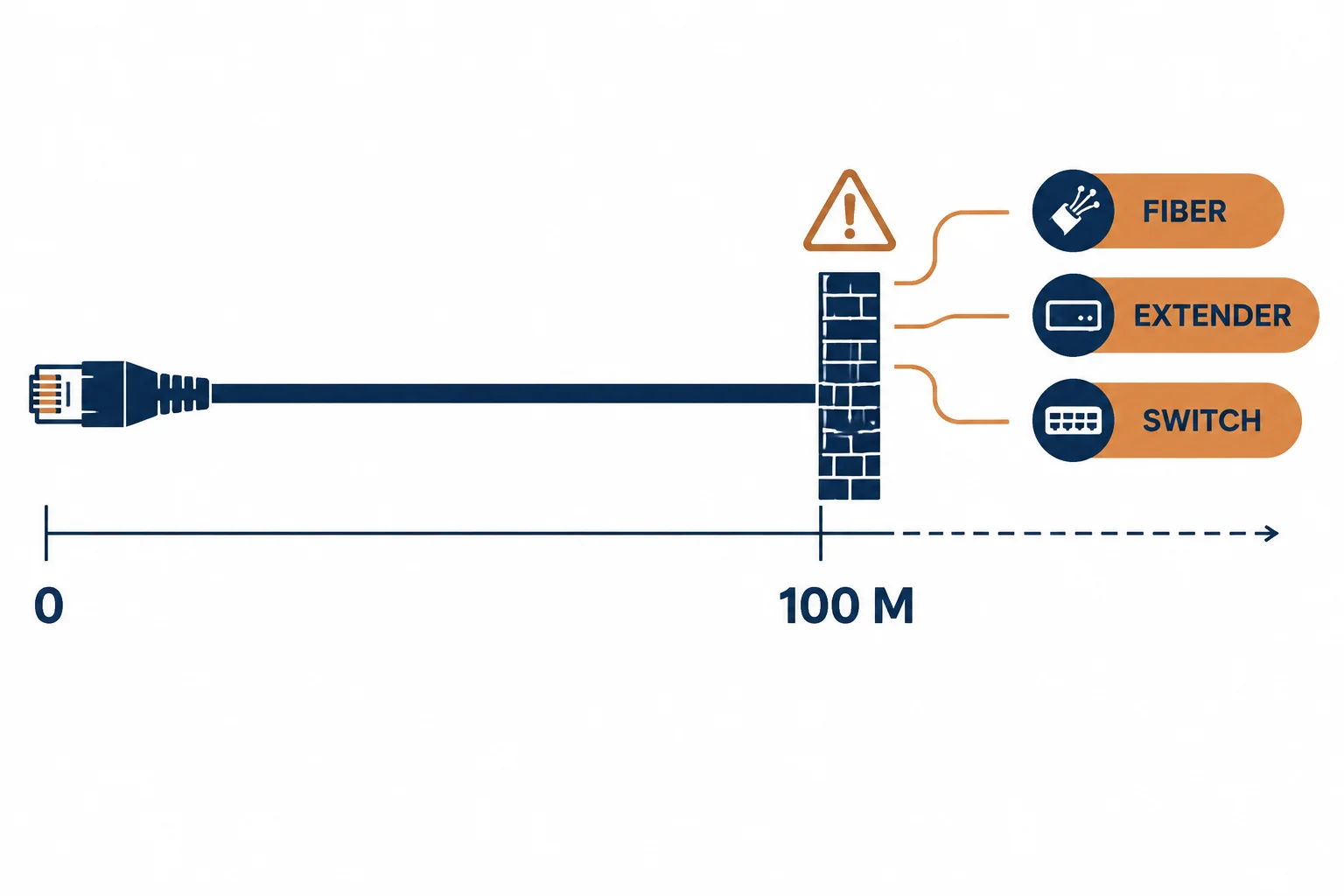
At 150 feet – about 46 metres – a cable has left the patch-cord world: it crosses a house, a garden or a workshop, and the decisions shift from category to construction. Half the channel limit is gone, and the route matters more than the band.
This is the 150 ft guide: the distance arithmetic, cord against permanent cable, and the routing rules for a run that is no longer casual.
The Distance Arithmetic
| The element | The figure | The note |
|---|---|---|
| Cable | 46 m | The 150 ft run |
| Channel limit | 100 m | All segments included |
| Remaining | About 54 m | Still comfortable |
| Joints | None ideally | Each one costs margin |
The arithmetic still permits a 10G design at Cat6a, which is why the category question is secondary at this length.
Cord or Permanent
- Cord: exposed surface routes, temporary layouts, rentals
- Permanent: any wall, ceiling, void or garden crossing
- Garden: outdoor-rated or burial-rated cable, never an indoor cord
- Hybrid: permanent to an outlet, cord for the last few metres
The rule is the same at every length: cable that enters the fabric must be building cable.
Routing a Long Run
| The detail | The practice |
|---|---|
| Support | Clips at regular spacing, no long free spans |
| Separation | Cross power at right angles, avoid parallel runs |
| Protection | Trunking where exposed to impact |
| Testing | Channel test at completion |
Standards and Verification
| The reference | The relevance |
|---|---|
| TIA-568.2-D | Channel and installation practice |
| IEEE 802.3 | Rates over twisted pair |
| Local code | In-wall and exterior rules |
Per-SKU construction is not provided in the knowledge base. The 100 m limit is standard; 46 m leaves margin in any category.
Real-World Applications
The annexe
A garden annexe 40 m from the house: outdoor-rated Cat6 in conduit, outlets at both ends – the run permanent and testable.
The long cord
A 150 ft cord used for a temporary office in a warehouse: acceptable while the layout is temporary, replaced with outlets when the lease extended.
The parallel power run
A 150 ft run sharing a conduit with a mains cable for 20 m: the link dropping under load. The route re-drilled with separation – the parallel section eliminated.
Related reading: The distance wall beyond 100 m? Read the long cable guide — blogs/news/long-ethernet-cable
Related reading: Running outside to reach the annexe? Read is Cat6 outdoor rated — blogs/news/cat6-outdoor-rated
Frequently Asked Questions
Is 150 ft too long for ethernet?
No – about 46 m against a 100 m limit. The margin is comfortable.
Cat5e or Cat6 at 150 ft?
Cat6 for headroom; Cat5e for a fixed gigabit requirement. Both work at this distance.
Can a 150 ft cable go outside?
Only an outdoor-rated or burial-rated cable, preferably in conduit. An indoor cord will fail.
How should a long run be supported?
Clipped or in trunking at regular spacing, with separation from power and protection where exposed.
Sourcing cables for a project, a store, or a private-label line? Contact our B2B sales team for specifications, certification evidence, and volume terms – FOB and CIF options available. Request a quote or sample.