
150 Ft Cat6: The Long Run
Quick answer / TL;DR: Short answer: 150 ft (46 m) of Cat6 leaves about 54 m of channel margin, enough for gigabit and 2.5G. It is not a general 10G solution – the channel total matters. Use a cord for exposed temporary routes and install rated cable to outlets for anything entering a wall or a ceiling.
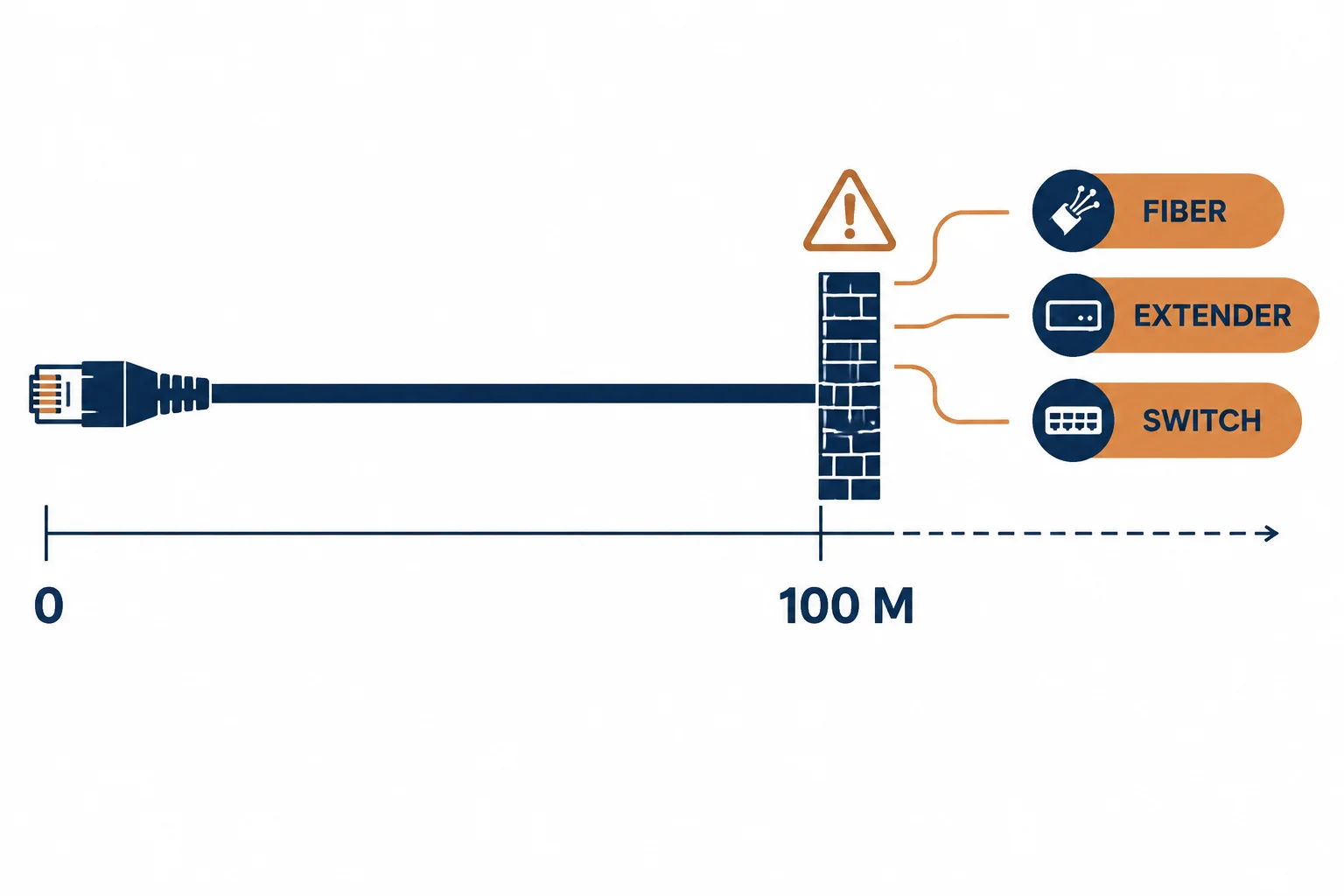
A 150 ft Cat6 cable covers about 46 metres – nearly half the channel – and is the length where a cord starts to behave like infrastructure: it crosses rooms, passes doorways, and is hard to keep tidy. Cat6 at this length carries gigabit and 2.5G with margin, and 10G only in specific configurations.
This is the 150 ft Cat6 guide: the margin arithmetic, the handling problem, and the decision between a long cord and a permanent outlet.
The Margin
| The element | The figure | The note |
|---|---|---|
| Cable | 46 m | Nearly half the channel |
| Remaining | 54 m | Enough for cords and error |
| 10G | Configuration-dependent | Check the total channel |
| Joints | None | Each one costs margin |
The margin is still comfortable for gigabit and 2.5G, which is what most 150 ft runs actually carry.
The Handling Problem
- Length means coils, and coils mean trip hazards
- Doorways and walkways need protection
- The cord is heavy enough to strain its own plugs
- Tidiness becomes a daily task rather than a one-off
The handling issues are why long cords are often replaced by outlets within a year of installation.
Cord or Outlet
| The route | The choice |
|---|---|
| Exposed, temporary | Cord |
| Through a wall or ceiling | Rated cable and outlets |
| Across a doorway | Flat cable with a protector |
| Permanent room change | Outlets, then short cords |
The rule is unchanged at every length: what enters the fabric must be building cable.
Standards and Verification
| The reference | The relevance |
|---|---|
| TIA-568.2-D | Channel definition |
| IEEE 802.3ab/an | Gigabit and 10GBASE-T |
| Local code | In-wall and fire requirements |
| Field test | Channel test for permanent runs |
Per-SKU construction is not provided in the knowledge base. The 100 m limit is standard; include every cord in the channel calculation.
Practical Notes
A 150 ft cord that is coiled and hung on a hook is not a permanent solution: the coil is where the damage happens. If the route will exist for more than a few months, price the outlet – it is usually cheaper than the cord plus the management.
Real-World Applications
The temporary office
A project office in a warehouse for six months: 150 ft Cat6 cords to four desks, clipped along a wall – removed intact when the lease ended.
The permanent conversion
The same route after the lease was extended: two outlets and four short cords replaced the long runs – tidier, testable, and cheaper than replacing damaged cords annually.
The doorway coil
A 150 ft cord left coiled across a doorway: a trip hazard and a crushed jacket within a month. Re-routed along the skirting with a door protector – the hazard removed.
Related reading: The distance wall beyond 100 m — blogs/news/long-ethernet-cable
Related reading: The 150 ft Cat5e comparison — blogs/news/150-foot-ethernet-cable
Frequently Asked Questions
Is 150 ft too long for Cat6?
No – about 46 m of the 100 m channel. Gigabit and 2.5G are comfortable.
Can it do 10G?
Only if the total channel is short enough. Check the whole path, not just the cord.
Should I use a cord or install outlets?
Outlets for anything permanent; a cord for temporary exposed routes.
How do I manage the excess?
Clip it along a wall or use a cable tray – never leave a coil on the floor.
Sourcing cables for a project, a store, or a private-label line? Contact our B2B sales team for specifications, certification evidence, and volume terms – FOB and CIF options available. Request a quote or sample.