
100 Foot Ethernet Cable: The Long Run
Quick answer / TL;DR: Short answer: a 100 ft (30 m) ethernet cable works in any category, leaving about 70 m of channel margin. Buy Cat6 for headroom, prefer a permanent run with outlets if the cable must cross walls or ceilings, and support the cable along its route rather than hanging it from fixtures.
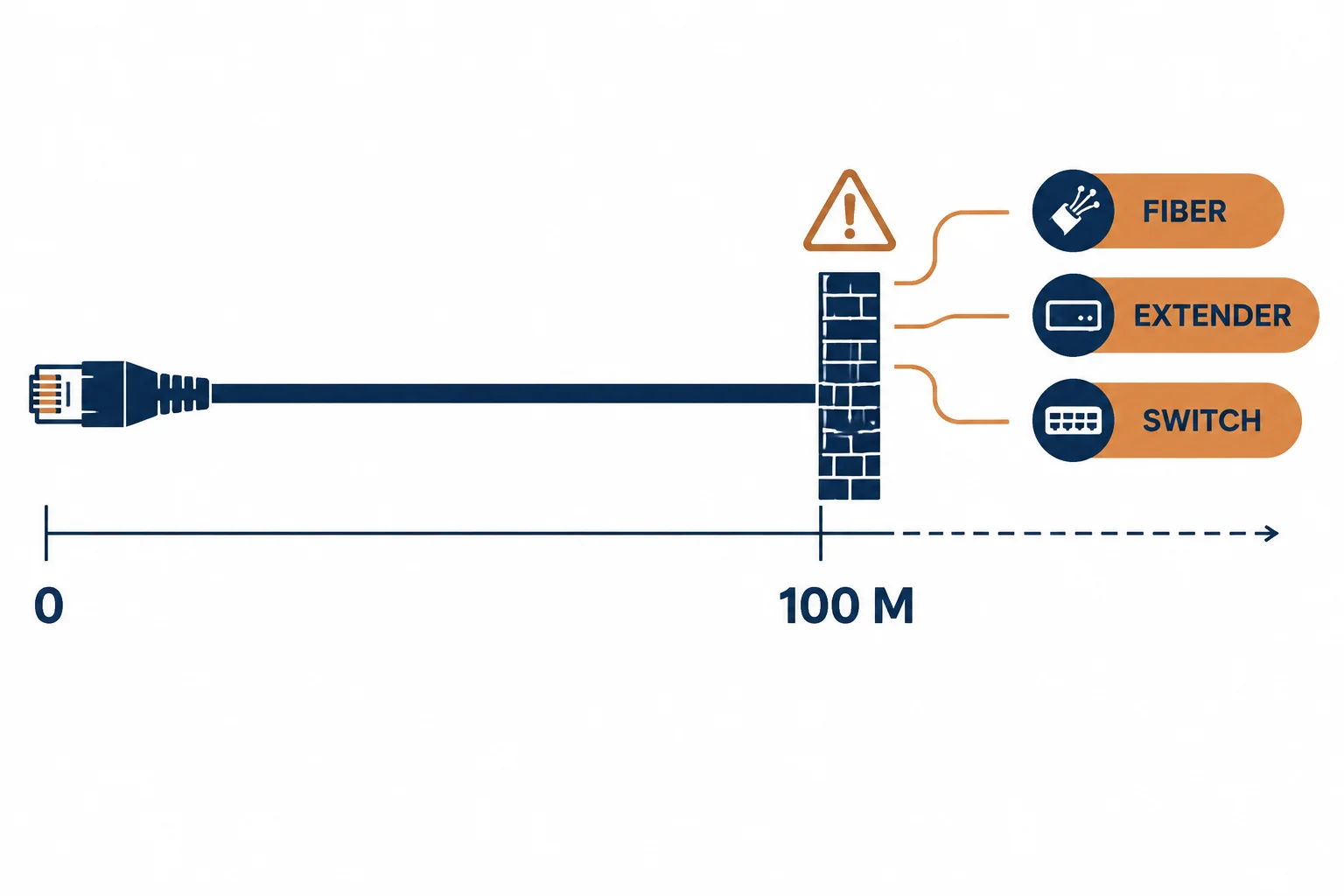
One hundred feet is roughly 30 metres – still well inside the 100-metre channel limit, but long enough that the run starts to be a project rather than a cord: routing, support, and the question of whether a permanent outlet would serve better.
This is the 100 ft guide: the distance arithmetic, the category to buy, and the installation details that separate a working long run from a temporary one.
The Distance Arithmetic
| The element | The figure | The note |
|---|---|---|
| Cable length | 30 m | The 100 ft cord |
| Channel limit | 100 m | Includes all cords and joints |
| Remaining margin | About 70 m | Ample at any category |
| Joints | Zero ideally | Each coupler costs margin |
The arithmetic is comfortable, which is why the constraints at this length are mechanical: support, route and protection.
Category at 30 Metres
- Gigabit: any category, with margin
- 2.5G/5G: Cat6 or better
- 10G: Cat6a for the full channel, Cat6 only at short total length
- PoE: gauge matters more than length here
The category choice is about the rate and the future, not about the 30 metres.
Route and Support
| The detail | The practice |
|---|---|
| Support | Clips or tray every metre or so, no hanging spans |
| Crossings | Right angles over power, short parallel sections |
| Protection | Conduit or trunking where the route is exposed |
| Service loops | At both ends, coiled and fixed |
Standards and Verification
| The reference | The relevance |
|---|---|
| TIA-568.2-D | Channel definition and installation |
| IEEE 802.3 | The rates the cable must carry |
| Field test | Channel test for permanent runs |
Per-SKU construction is not provided in the knowledge base. The 100 m channel limit is standard; 30 m leaves ample margin in any category.
Real-World Applications
The garden office
A shed studio 28 m from the house: a 100 ft Cat6 run in conduit along the fence line – supported, protected, tested at both ends.
The warehouse desk
An office desk at the far end of a workshop: 100 ft Cat6 on tray, separated from power – the run stable despite the machinery.
The hanging span
A cable strung between two fixtures with no support: the jacket stretched, a pair damaged. Clipped and re-routed – the support rule applied.
Related reading: The wall where distance becomes a problem? Read the long cable guide — blogs/news/long-ethernet-cable
Related reading: The couplers that would eat the margin? Read the coupler guide — blogs/news/ethernet-coupler-junction-box
Frequently Asked Questions
Is 100 ft too long for ethernet?
No – it is about 30 m against a 100 m channel limit. The margin is ample in any category.
What category for a 100 ft run?
Cat6 for headroom; Cat6a if 10G is planned across the full channel.
Can I join two 100 ft cables?
A coupler works electrically but adds loss and a failure point. For permanent runs, pull a single cable.
Does a long cable need support?
Yes – clip or tray it. Hanging spans stretch the jacket and strain the conductors.
Sourcing cables for a project, a store, or a private-label line? Contact our B2B sales team for specifications, certification evidence, and volume terms – FOB and CIF options available. Request a quote or sample.