
1 m Fiber Patch Cable: Short and Standard
Quick answer / TL;DR: Short answer: use 1 m fiber cords for rack patching and panel-to-switch connections, in the fiber type and connector the plant uses – OS2 single mode or OM3/OM4 multimode, LC or SC. Match the polish (UPC blue, APC green) and confirm polarity A-B. Never coil a fiber cord tightly; a 1 m length is short enough to route without a loop.
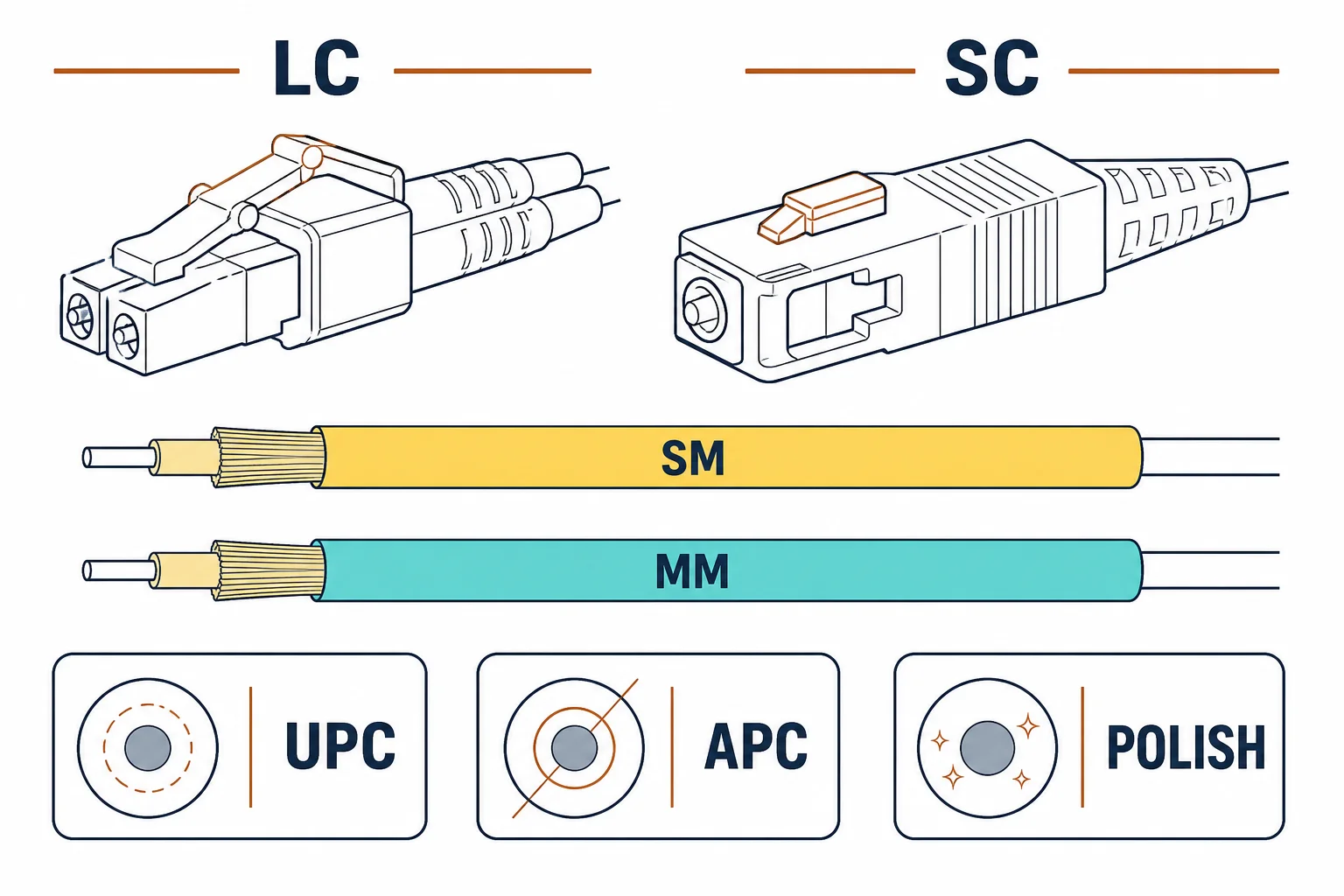
A one metre fiber patch cable is the standard length for patching inside a rack: long enough to reach between adjacent panels, short enough that the excess does not violate the bend radius. Fiber does not tolerate tight coiling, which is why the short length exists rather than a longer cord looped up.
This is the 1 m fiber guide: where the length belongs, the polish and polarity checks, and the handling that keeps a delicate cord serviceable.
Where 1 m Belongs
| The position | The fit | The note |
|---|---|---|
| Panel to switch, same rack | Ideal | No loop needed |
| Adjacent racks | Ideal | Short and direct |
| Across an aisle | Too short | Use 3-5 m |
| Wall to rack | Varies | Measure first |
The length is defined by adjacency, exactly as with copper cords – but the consequence of excess is worse.
The Checks
- Fiber type: OS2 or OM3/OM4, matching the plant
- Connector: LC or SC, matching the port
- Polish: UPC or APC, never mixed
- Polarity: A-B for duplex links, documented
The polish check is the one that produces a working-looking link with no light: the connectors mate, the end faces do not.
Standards and Verification
| The reference | The relevance |
|---|---|
| ITU-T G.652 | Single-mode fiber |
| ISO/IEC 11801-1 | OM3/OM4 definitions |
| IEC 61300 | Connector test methods |
| Field test | Loss measurement per link |
Per-SKU loss figures are not provided in the knowledge base. The polish and polarity rules are standard; measure the link rather than assuming the cords are matched.
Practical Notes
Fiber cords are fragile in a way copper is not: a bend tighter than the minimum radius can crack the core invisibly. In a dense rack, route them in a dedicated trough rather than alongside copper, and never let a door close on one.
Real-World Applications
The rack patch
An LC patch field with 1 m OS2 cords: UPC throughout, polarity documented on the panel – every link measured inside its loss budget.
The coiled excess
A 3 m cord looped tightly in a shallow rack: loss rising over months. Replaced with 1 m cords – the bend radius was the fault, not the fiber.
The polish mismatch
An APC cord mated to a UPC adapter: the link alive but marginal. The green-to-blue mismatch found and the cord replaced – the loss budget restored.
Related reading: The single-mode cord specification — blogs/news/single-mode-fiber-patch-cable
Related reading: The multimode OM3 variant — blogs/news/om3-lc-fiber-patch
Frequently Asked Questions
What is a 1 m fiber patch cable used for?
Rack patching between panels and switches where a longer cord would need coiling.
UPC or APC?
Match the plant. APC (green) is common in PON; UPC (blue) in data centres.
Can I coil a fiber cord?
Only at a generous radius – tight coils crack the core.
How do I verify the link?
Measure loss with a power meter or OTDR; a link light is not a measurement.
Sourcing cables for a project, a store, or a private-label line? Contact our B2B sales team for specifications, certification evidence, and volume terms – FOB and CIF options available. Request a quote or sample.