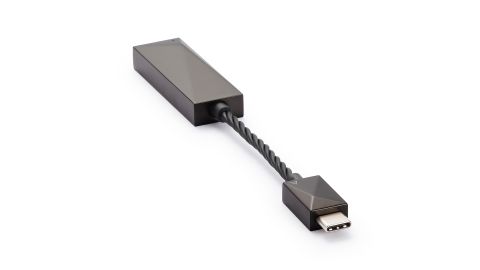
Quick answer: A powered cabinet contains its own amplifier, so the cable feeding it carries signal rather than speaker current. A TS plug is unbalanced with two contacts; a TRS plug is balanced with three. Short links from a mixer or monitor output often work with either, but the plug must match the socket wiring at both ends, and phantom power should stay away from a TS link.
Powered cabinets moved the amplifier out of the rack and into the box behind the woofer, and the cable between mixer and cabinet changed job with it. It carries a line level signal now, which makes a quarter inch plug acceptable on a short run. The wiring inside that plug still decides whether the link is balanced, and short form cables are where the difference shows.

The cable has changed job
Nothing about the connector announces the change. The same plug that once carried amplifier output now carries a volt or two of signal into a high impedance input.
What the powered cabinet expects
Most powered cabinets accept a line level signal on a quarter inch or XLR input, with a gain control to match the source. The input impedance is high, so the cable carries almost no current and its series resistance barely matters.
Where the amplifier now sits
Because the amplifier is inside the cabinet, the cable from the mixer is not a speaker line and must not be treated as one. A cable built for speaker current works in this role, but its heavy conductors and lack of shielding make it a poor choice for a signal link.
TS against TRS in the plug
Tip and sleeve gives one signal conductor plus a return, which is unbalanced. Tip, ring and sleeve gives two signal conductors plus a return, which allows a balanced connection.
In a balanced link the receiving circuit compares the two signal conductors and rejects whatever is common to both, so interference picked up along the cable cancels at the input. An unbalanced link sends the interference straight into the signal.
When balanced wiring earns its place
On a one metre patch behind a mixer, the difference is small. Across a stage, beside lighting dimmers and mains runs, the balanced version is the reason the link stays quiet. Length and cable routing decide, not the price of the plug.
Level, phantom power and hum
Three practical issues appear on almost every powered cabinet install, and each has a simple test.
| Connector pair | Wiring | Signal path | Result on a short link |
|---|
| TS to TS | Two contacts, unbalanced | Tip signal, sleeve return | Works, most exposed to hum |
| TRS to TRS | Three contacts, balanced | Hot and cold plus return | Works, interference rejected |
| TRS out to TS in | Ring left unconnected | Half the balanced pair | Works, level drops slightly |
| XLR out to TS in | Adapter with pin 3 to ground | Balanced output, unbalanced link | Works, adapter is the weak point |
Phantom power is the one that causes damage. Condenser microphones need it, and it appears on XLR inputs as a common voltage on both signal pins. A TS plug sleeves that voltage to ground, which can stress an output stage. Keep phantom switched off on any channel feeding a quarter inch link.
Choosing the short cable
Buy the length you need rather than the shortest one listed. A cable that is too short pulls on the socket when the cabinet is angled, and a socket that has been pulled sideways develops a crack at the board joint.
Shielding matters more than gauge here. A braided or spiral shield around a twisted pair suits a signal link, while a two conductor speaker cable with no shield belongs on the output side of an amplifier.
Testing the link before the show
Plug the link in, set the cabinet gain low, and send a familiar track at a modest level. Then wiggle each plug gently while listening. A crackle points at the socket or the plug, and finding that at the desk costs less than finding it on stage with a full room waiting.
Practical scenarios
- Monitor wedge from an aux output: a short TRS to TRS link keeps the run balanced if the mixer output is balanced too.
- Two powered tops linked through: the through output is often unbalanced, so keep the second link short.
- Keyboard into a powered speaker: a TS link from an unbalanced keyboard output is the correct match, and nothing is gained by a balanced cable there.
- Cabinet across a stage: go balanced or move the cabinet closer, because length is what exposes an unbalanced link to interference.
FAQ
Is a 1/4 in speaker cable the same as an instrument cable?
The plugs match, the cable does not. For a powered cabinet you want a shielded signal cable, because the link carries line level rather than amplifier current.
Can I use a guitar lead to feed a powered speaker?
It will usually work over a short distance. The lead is unbalanced and lightly shielded, so it picks up noise near dimmers and power supplies.
Does phantom power damage a powered cabinet?
It can stress an unprotected output or input stage. Switch phantom off on channels connected through a TS plug, and use a transformer or a proper balanced connection if a condenser mic shares the path.
Next step
Match the plug to the socket, then match the cable to the job. Read the 1/4 inch speaker cable page for output side builds, the short 1/4 speaker cable options for tight racks, and the TS instrument cable page for unbalanced signal links.
See the matching cables and adapters